
first-known, published haiku comic!
Among the many genres of poetry, haiku (the short poem that originated in Japan) is well suited to comics. Generally (and perhaps stereotypically), haiku speak to one moment, use just a few words to communicate an idea, and often make a (meta) leap between lines (or after grammatical marker). These traits lend themselves to techniques often used in comics — short dialogue (often contained in speech bubbles), a shift between panels (a different perspective or point of view, for example), and the punchline (prevalent in daily comic strips).
Definitely one of the earliest haiku comics was by Seth, the Canadian cartoonist known for his series Palookaville. He used a well-known comic strip character to recite a haiku by the Japanese master Bashō, expressing it in the popular four-panel strip format:
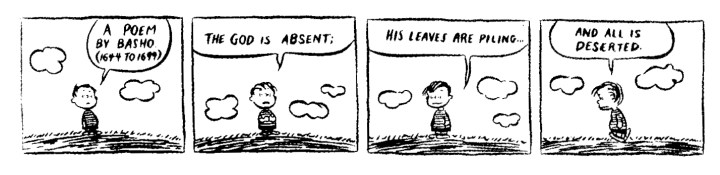
Comics artist and poet David Lasky, who creates and teaches haiku comics as part of his repertoire, suggests this is probably the first haiku comic, writing:
My first experience of a haiku comic was probably Seth’s short comic of Linus, from ‘Peanuts,’ illegally but respectfully reciting a poem by Bashō in four panels. The poem appeared as a ‘topper’ above Seth’s one-page comic, ‘Good Grief,’ in the Drawn and Quarterly anthology, Volume 2, Issue 4, in 1995. When I first saw that tiny, fake ‘Peanuts’ strip, a small electrical charge went off in my brain and I knew I needed to learn who this Bashō person was.
Source: David Lasky in his Introduction to Less Desolate by Shin Yu Pai and Justin Rueff
In a 2006 interview with Marc Ngui in Carousel 19, Seth says :
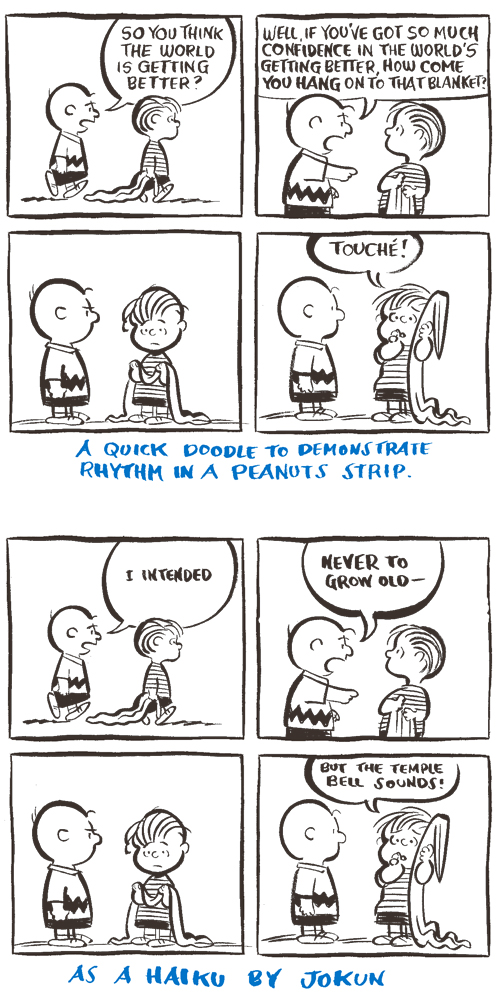
“I have felt, for some time, a connection between comics and poetry. It’s an obvious connection to anyone who has ever sat down and tried to write a comic strip. I think the idea first occurred to me way back in the late 80’s when I was studying Charles Schulz’s Peanuts strips. It seemed so clear that his four-panel setup was just like reading a haiku; it had a specific rhythm to how he set up the panels and the dialogue. Three beats: doot doot doot— followed by an infinitesimal pause, and then the final beat: doot. Anyone can recognize this when reading a Peanuts strip. These strips have that sameness of rhythm that haikus have— the haikus mostly ending with a nature reference separated off in the final line.
Source: “Poetry, Design and Comics: An Interview with Seth” by Marc Ngui in Carousel 19 (Spring-Summer 2006) [archived PDF]
Accompanying that interview was this example by Seth:
*Full disclosure: My teacher and friend David Lasky continues to be instrumental in shaping this “A History of Poetry Comics” blog with tips, insights, and suggestions. In this case, his research has led to Seth as the creator of the first haiku comic. This poet hasn’t found any earler examples of haiku comics. So be it.
Timeline: 1995 (the first haiku comic)
Warning: This incomplete history maps my journey as a poet learning about comics and doesn’t follow a strict chronological order.
 JB
JB 