here’s the first use of term ‘poetry comics’
The first use of the term “poetry comics” was quite literal. In 1979 poet Dave Morice created “Poetry Comics,” a 22-page comic book of comic-ized poems from the (then) English canon. He drew comics that illustrated poems by Emily Dickinson, Sylvia Plath, Walt Whitman, Allen Ginsberg and others we elders know from high school English class. Each poem got a different treatment, covering many comics styles, that uniquely illuminated that particular poem.

Morice created 17 comic books of poetry comics between 1979 and 1982, which he photocopied and mailed to other poets. His poetry comics werre collected in “Poetry Comics: A Cartooniverse of Poems” (Simon and Schuster, 1985). The same year, he published “How to Make Poetry Comics (Teachers & Writers, 1985), a guide for teachers.
At the time, a review by Bruce Brooks professed: “By the time Ebenezer Cooke was snapping off wry hudibrastics in the early 1700s, the Greek had been chuckling over Aristophanes for twenty-one centuries. But now America has initiated another tradition equally amusing, if not equally honorabler: poetry comics.”
In an essay “Poetry Comics: Taking Poems Out of Church” for Teachers and Writers magazine in 2008, Morice tells about the birth of his poetry comics:
One autumn night in 1977, I went over to the apartment of a friend who was in the Iowa Writers Workshop. She had hundreds of poems stuffed into twelve black binders on her writing desk and I had about as many of those same binders filled with poetry at home, so what else could we begin the evening with but a discussion of poetry? At one point she said in a serious tone, “Great poems should paint pictures in the mind.” And I said, partly to tease her, “Great poems would make great cartoons.” After a short pause, she smiled and said, “Hey, you know you’re right. You should draw some.”
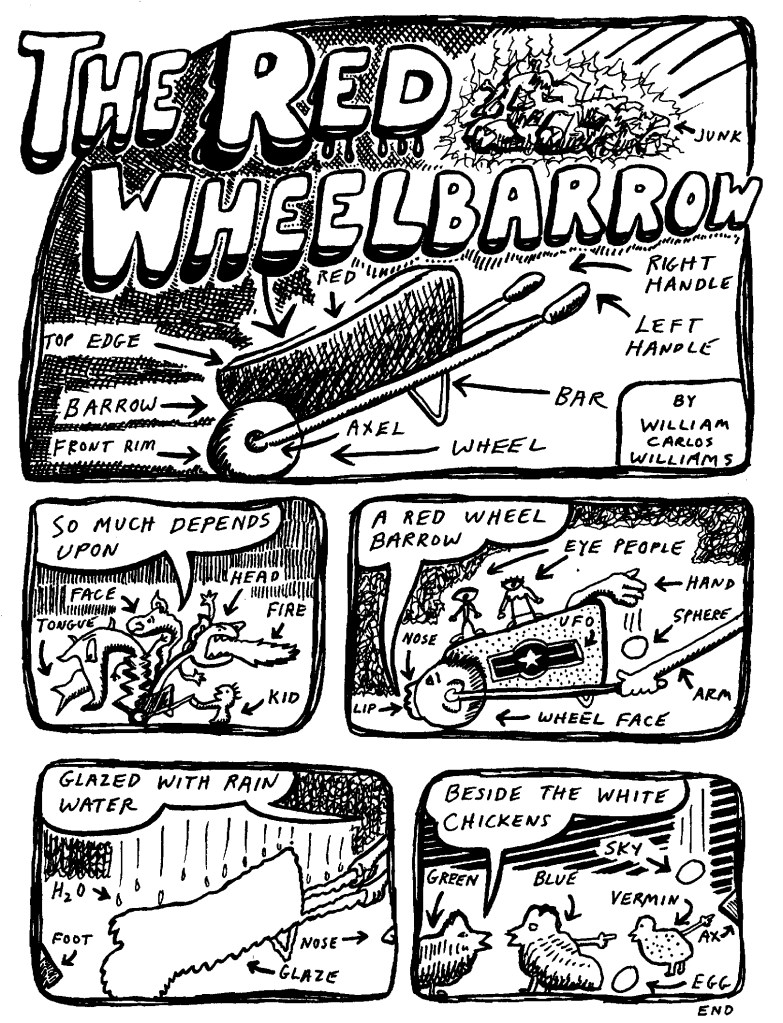
Here’s one example of Morice’s poetry comics:
Timeline: 1979 – so far, first documented use of the term “poetry comics”
Warning: This incomplete history maps my journey as a poet learning about comics and doesn’t follow a strict chronological order.
 JB
JB 