A History of Poetry Comics

book reviewS – recent collaborations

Collaboration has a long history in American comics. Until the underground comix movement in the 1960s and 1970s, a team of writers and illustrators was the norm (the team also often included support from an editor, penciler, inker, colorist, and letterer). Perhaps the most (in)famous duo is Stan Lee (writer/editor) and Jack Kirby (comics artist) and their work at Marvel Comics. The tradition continues today but with a more equitable and transparent sharing of credit.

Collaborations between poets and artists have shown up in poetry comics since at least the early 1960s. Just three examples: Poet/artist Joe Brainard creating comics collaborations (often featuring Nancy) with poets Ted Berrigan and Ron Padgett (see History of Poetry Comics #08). KAPOW! zine pairing spokenword poets with cartoonist in the late 1990s (see History of Poetry Comics #16.) And poetry comics creator Bianca Stone illustrating Anne Carson’s translation of Antigonick by Sophokles in 2012 (see History of Poetry Comics #04.)

Here are two recent noteworthy collaborations between poet and comics artist.

THE STONEWARE JUG
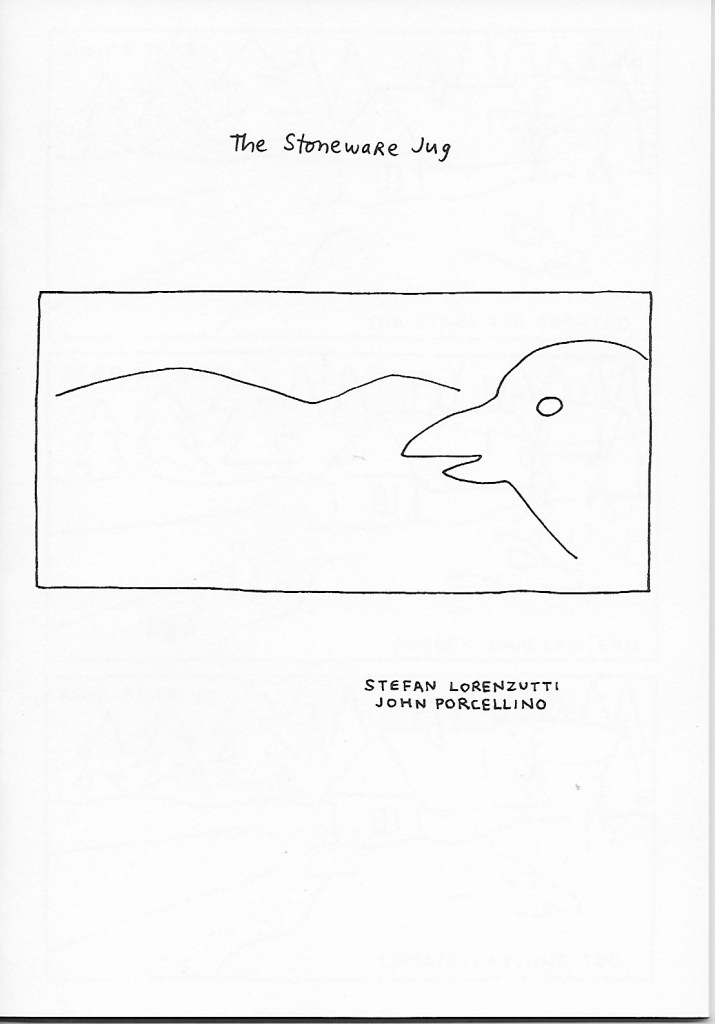
The Stoneware Jug by Stefan Lorenzutti (words) and John Porcellino (pictures) (Nieves, Bored Wolves, and Spit and a Half, 2022). In this collection of poems illustrated with 1- to 6-panel, 1-page comics, Stefan Lorenzutti provides simple, direct poems about being cold, the end of winter, and memories of (seemingly) empty places. Titles include “The Iceberg,” “When I Lived in Krakow,” and “On a Night of Cruel Frost.” The 13 poems in the collection are perfectly illuminated by John Porcellino in the simple, direct line drawings that he’s known for. Here’s the title poem from the collection:
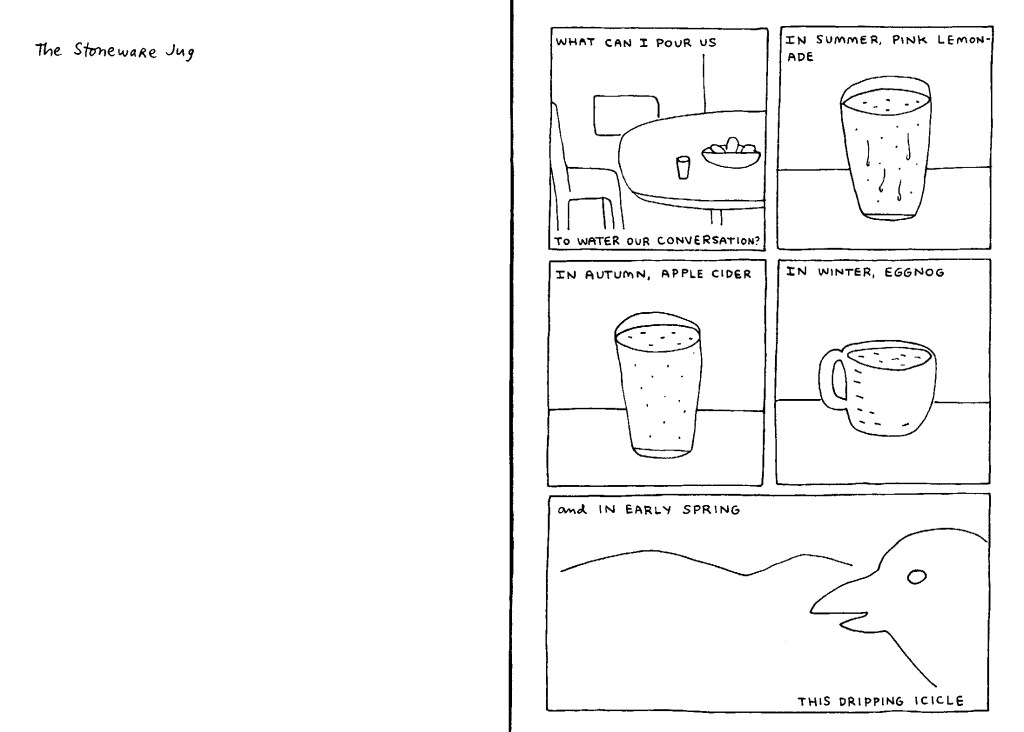
from The Stoneware Jug by Stefan Lorenzutti and John Porcellino.

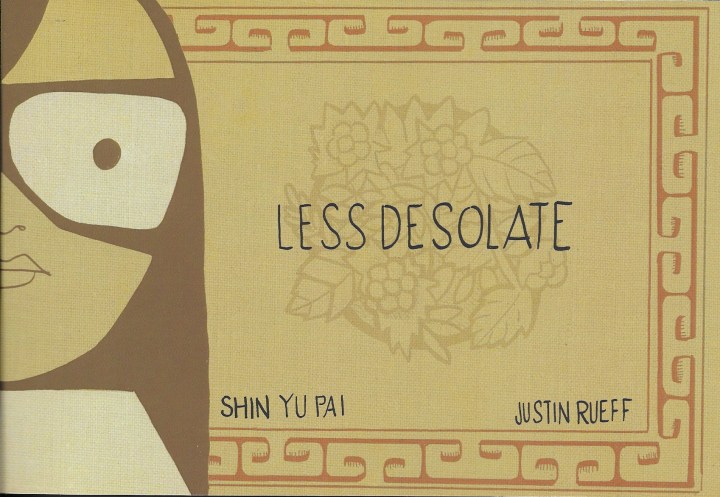
LESS DESOLATE

Less Desolate by Shin Yu Pai (haiku) and Justin Rueff (illustrator) (Blue Cactus Press, 2023). Poet/artist/podcaster Shin Yu Pai collects haiku she wrote during the pandemic, including the concurrent social unrest and her personal search for being present. Her haiku flow from rituals to yoga, from social distancing to social justice, and from being at home to being part of a wider community and world. The haiku are minimal yet pack a lot of meaning in a few words (12 words or fewer in most cases). Justin Rueff provides comics-inspired illustrations ranging fron 1 to 4 frames for the 1-page haiku comics, giving us just the right amount of context — and occasionally a touch of color. Here’s the title haiku comic from the collection:
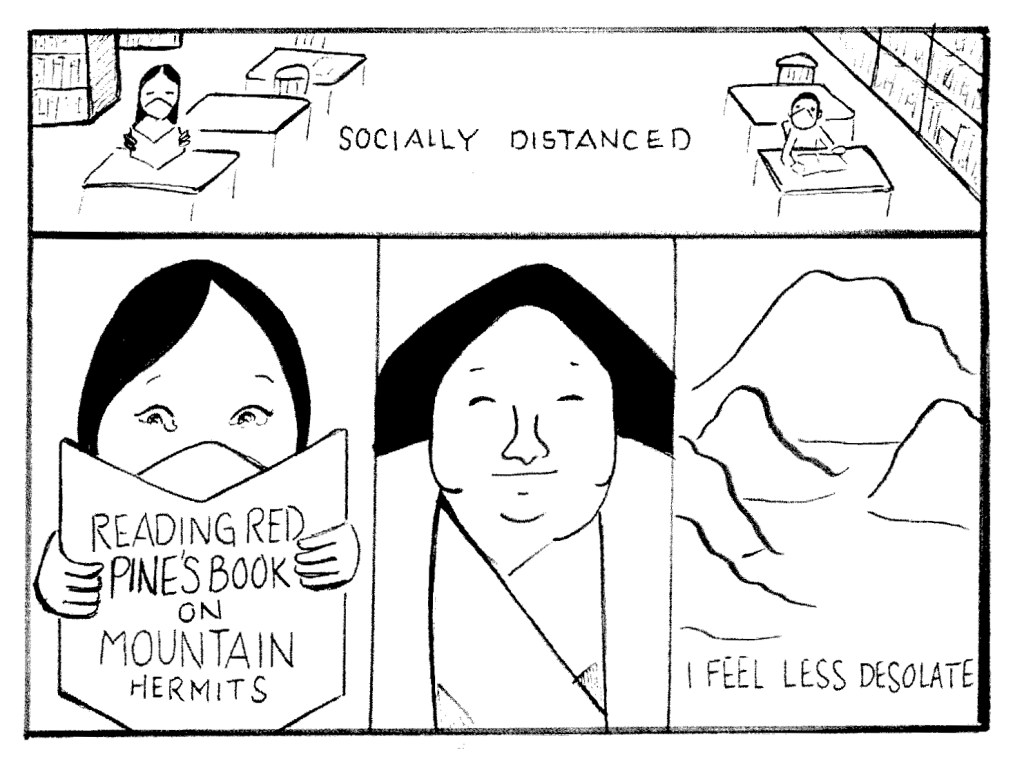
from Less Desolate by Shin Yu Pai and Justin Rueff

Timeline: Current (2022-2023)

Warning: This incomplete history maps my journey as a poet learning about comics and doesn’t follow a strict chronological order.
A History of Poetry Comics

kapow! paired poets with cartoon artists

I admire zinesters on many fronts. Their DIY attitude. Their willingness to work outside traditional publishing and distribution channels. Their strong sense of community. Their courageous sharing of what catches their attention or what they’re obsessing on. And always, their ideas.

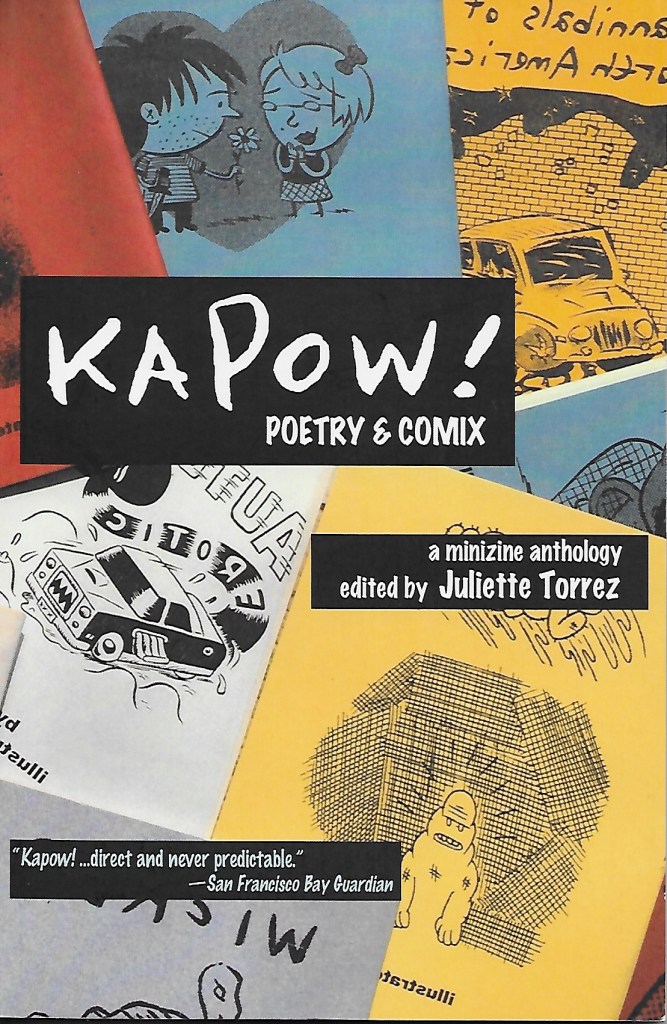
So it was soul-affirming to be led to Juliette Torrez and her idea to match slam poets’ work with comic artists’ drawings. She published these match-ups originally in her hand-stapled zine (are there any others?) Kapow! in the late 1990s. Eventually these collaborations (or actually illuminated poems) were collected in Kapow! Poetry & Comix (Manic D Press, 2017).

Kapow! Poetry & Comix, edited by Juliette Torrez (Manic D Press, 2017)

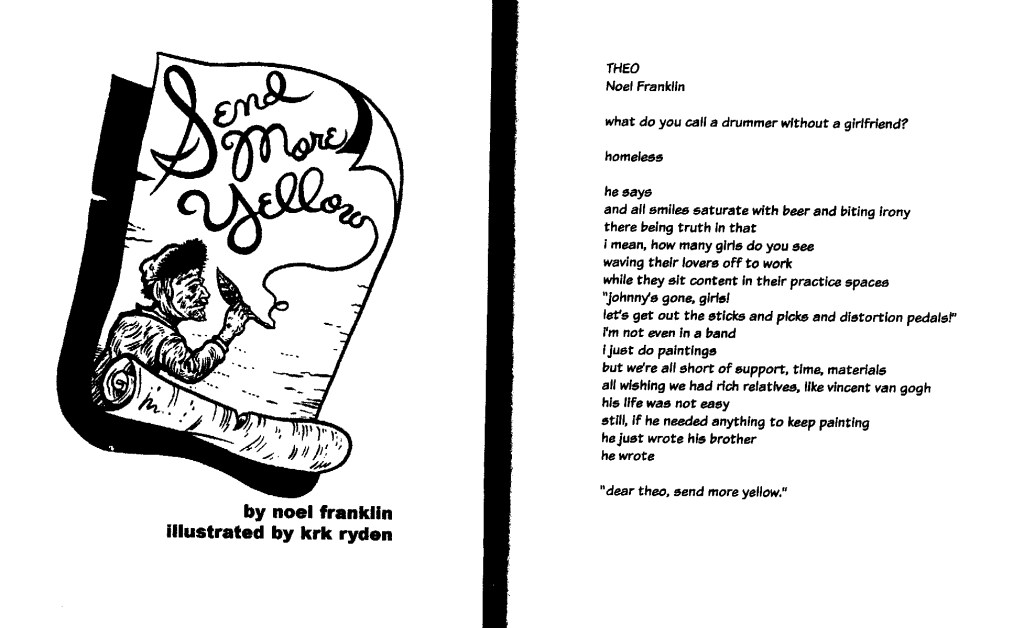
Here are a couple of examples from the anthology. (Both are facing pages.)

From Kapow! Poetry & Comix (Manic D Press, 2017)

The matches made here are right on thanks to Torrez’s knack for pairing the right comics artist with the right spoken word poet. These pairings showcase the edginess/ directness/ openness of the work in a way that goes beyond illustration. The comics provide context, a moment in time, new ways to consider the text, and a willingness to accept outside influence.

Collaboration between artists and writers has been a part of the comics canon almost since the beginning of comic books (e.g., perhaps most famously, Stan Lee and Jack Kirby). Zine culture – and Kapow! specifically – gave it an updated twist. More on collaboration in a future AHOPC.

Timeline: 1990s

Warning: This incomplete history maps my journey as a poet learning about comics and doesn’t follow a strict chronological order.
A History of Poetry Comics

Pop art or poetry comics? of Joe Brainard

Writer and artist Joe Brainard (1942-1994) was obsessed with (among other things) Nancy, finding ways to collaboratively collage, coerce and copy the comic strip stalwart into his art.

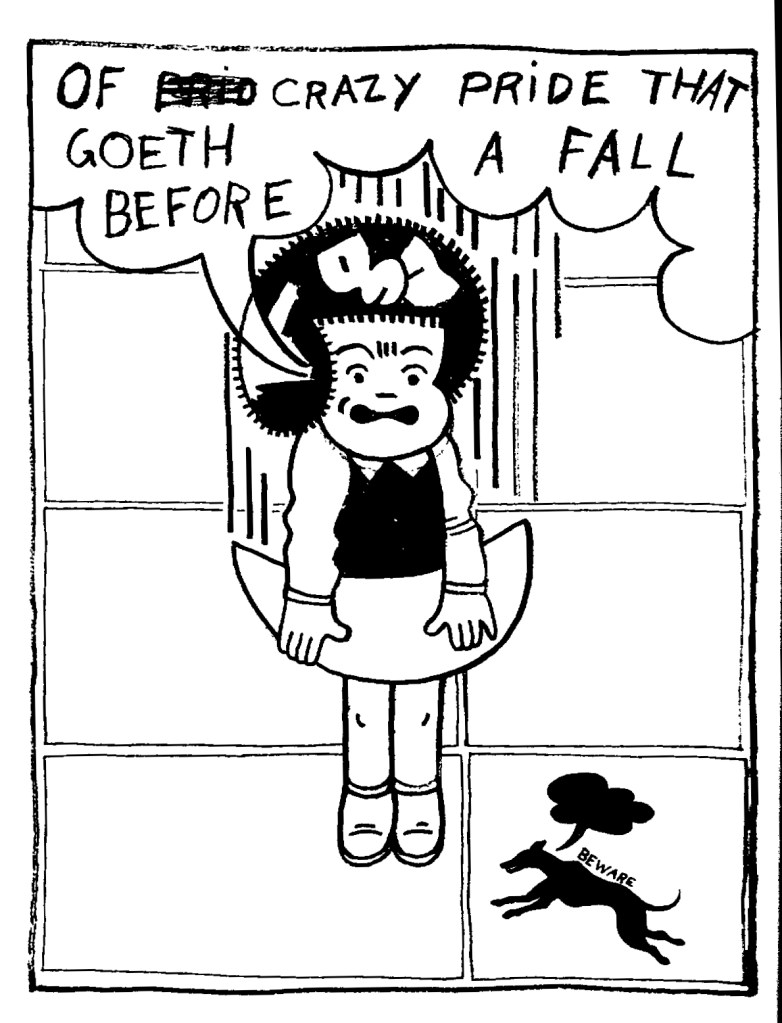
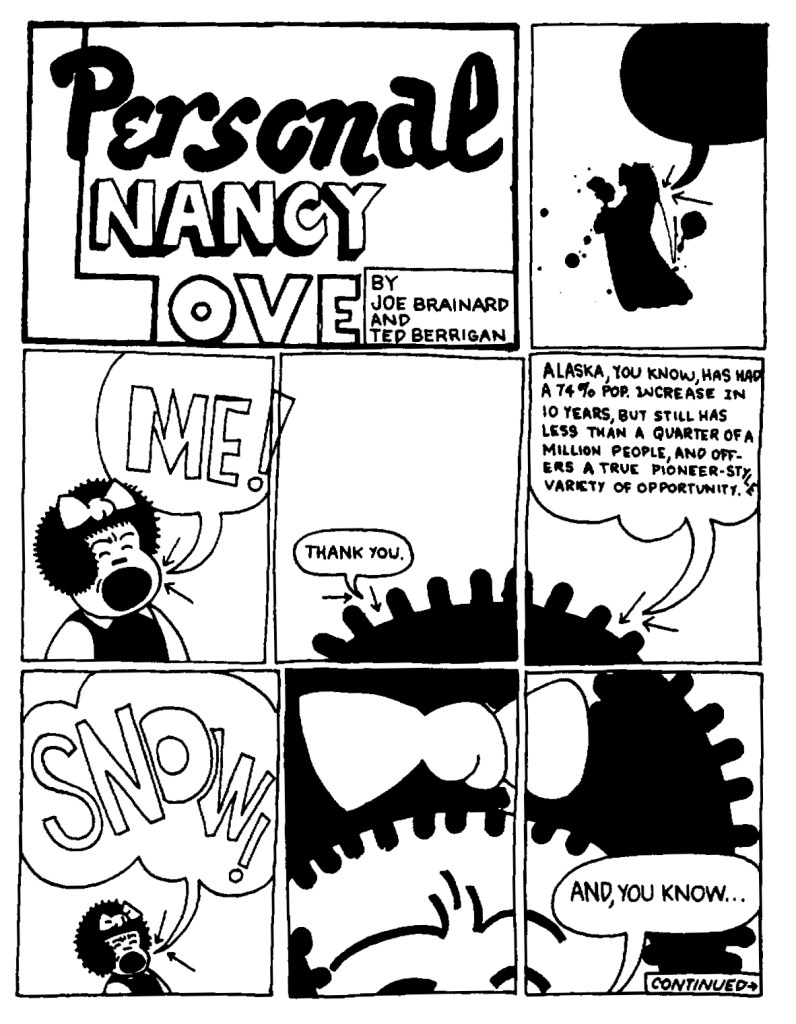
Brainard’s The Nancy Book (Siglio Press, 2008) collects a large selection of his work (both written and drawn) that features Nancy. He draws his subject in the style of other artists, collages her into cigarette ads, and other times poses her in pornographic situations. He often places her within the visual language of comics, using elements such as panels, speech bubbles, captions, and emanata. Two examples are below.

Collaboration between Joe Brainard and poet Ted Berrigan from The Nancy Book (Siglio Press, 2008)
Collaboration between Joe Brainard and poet Ron Padgett from The Nancy Book (Siglio Press, 2008)

In the first one, the panels can hardly hold Brainard’s Nancy until she finally breaks the gutter and covers the bottom lower right panels. In the second one, Nancy is free falling across the panels. In both cases, they perfectly represent what Ann Lauterbach calls in the introduction to The Nancy Book: “Candor: a kind of fearlessness about boundaries.” (p. 8)

There’s also the concept of collaboration to consider in these poetry comics. Both examples credit poets Ted Berrigan and Ron Padgett. Thinking collage, in the same way he found Nancy in the comics page, he found poetry in the words of his friends. (More about collaborations in a later post.)

Of note, in addition to his Nancy drawings, Brainard created other comic books, including “People of the World: Relax!,” “Some Drawings of Some Notes to Myself,” and “The Cigarette Book” all found in The Collected Writings of Joe Brainard (The Library of America, 2012). These underscore his ongoing conversation with comics.

As Brainard makes us consider popular comics as rightful subjects and architecture for fine art, he equally makes us consider a wider acceptance of what a poem is. This is what I think the best poetry comics do.

Timeline: 1963-1978

Warning: This incomplete history maps my journey as a poet learning about comics and doesn’t follow a strict chronological order.
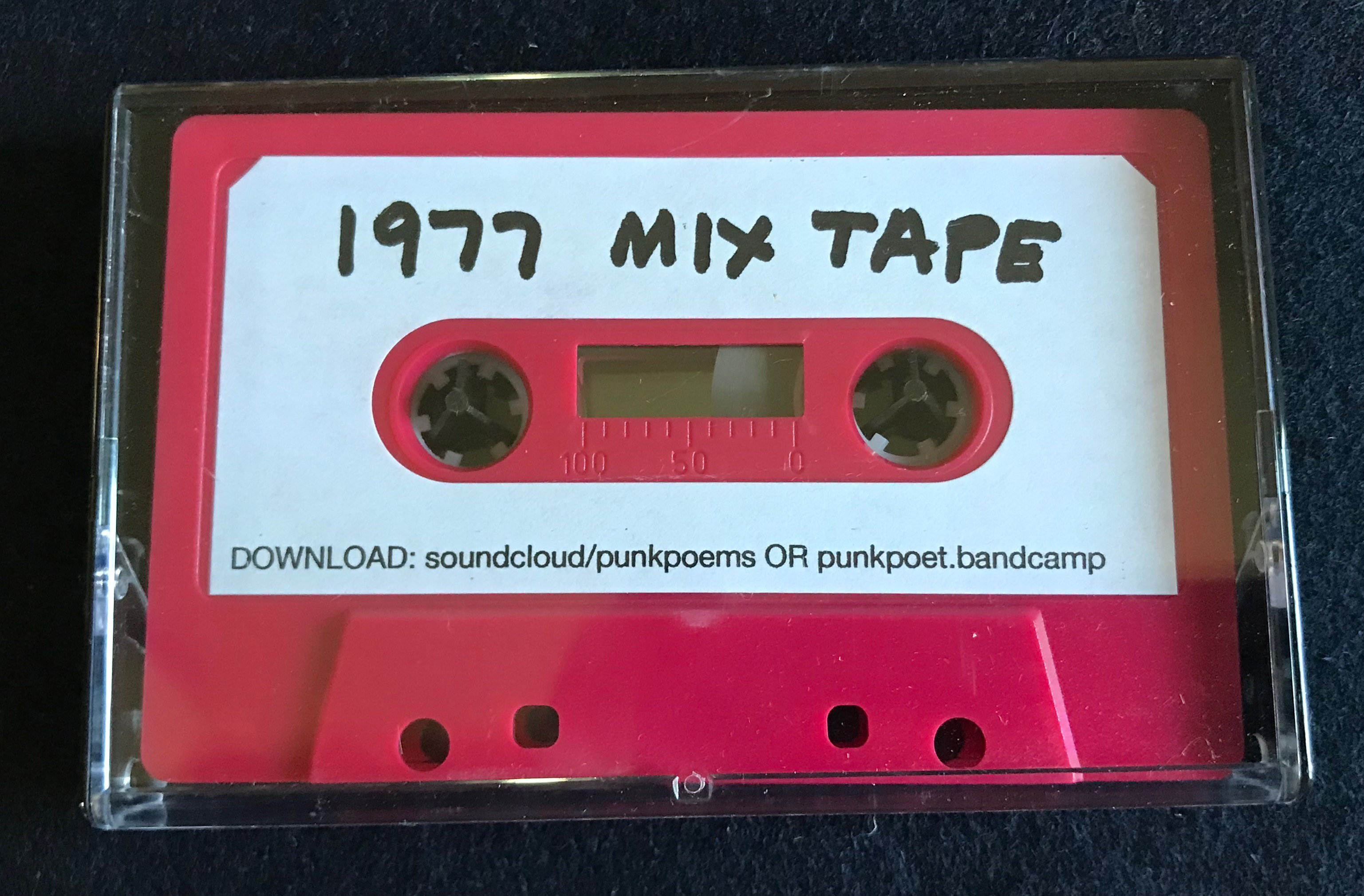
Mix Tape
I have a tape I’d like to play for you …

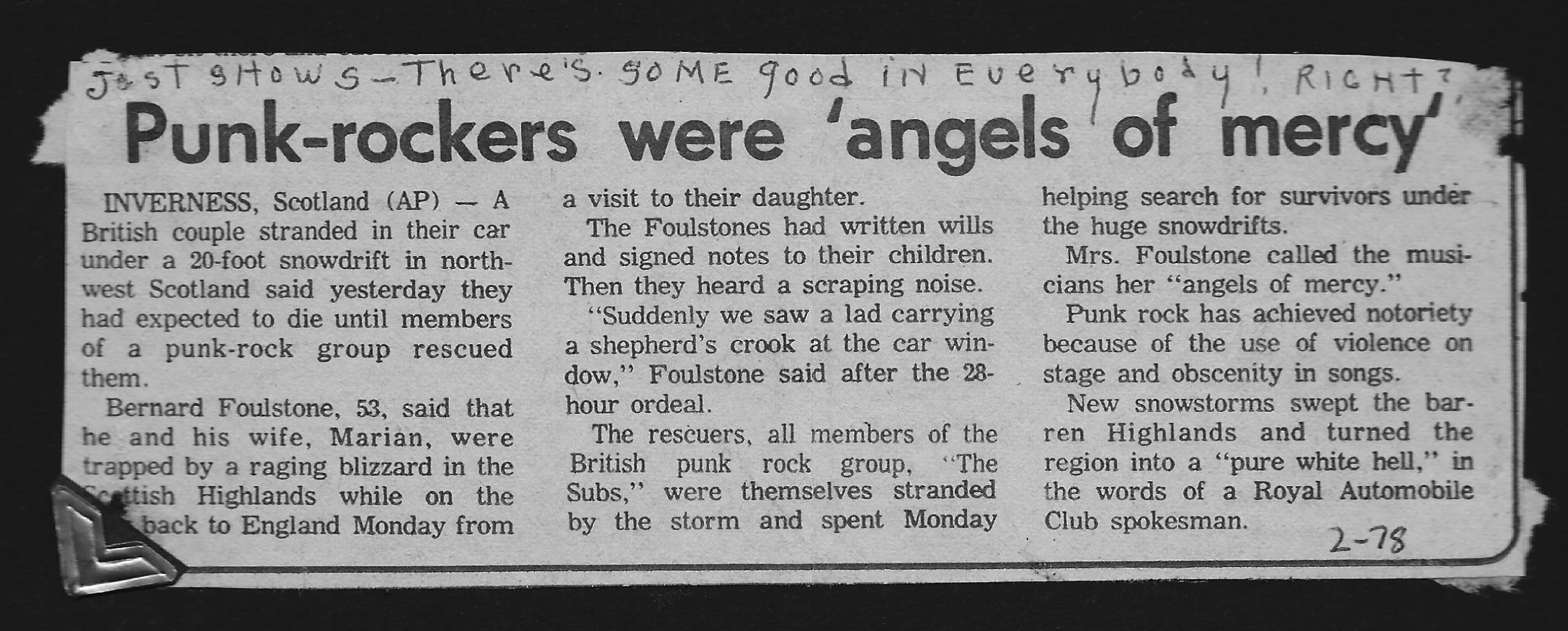
“What does it mean?” Context is a landscape for understanding. Music often triggers memories of place and time. Collage forces contradictions to confront each other. Dice and loop put things together to make something new.

e.g., my poems on 1977 Mix Tape are provided context and additional meaning  by collaborator James Nugent. Listen or download for free at SoundCloud or Bandcamp.