A History of Poetry Comics

Rise in comics paralleled experimental poetry

It’s notable that concurrent with the rise in popularity and proliferation of comics in the years between about 1870 and 1920 poetry was becoming more experiemental. Possibilities for poetry were opening up, starting with how the page and text could be used to add context and illuminate meaning.

Two early (perhaps the first modern?) examples of poets experimenting with page and type are both French: Stephane Mallarme (1842-1892) and Guillaume Apollinaire (1880-1918).

Mallarme created poems that broke the constraints of the line and the page. His late poems would run down the page, across the gutter, and even page to page. Considered a Symbolist master in France in the 1890s, Mallarme created poems toward the end of his life that were concerned with meaning and how text placement, type face, and font size could convey meaning — or at least provide graphical clues to meaning.

Here’s a two-page spread from Mallarme’s “Throw of the Dice” (1897) that illustrates the poet’s breaking with expected norms of poetry and creating what he said had “the look of a constellation.”
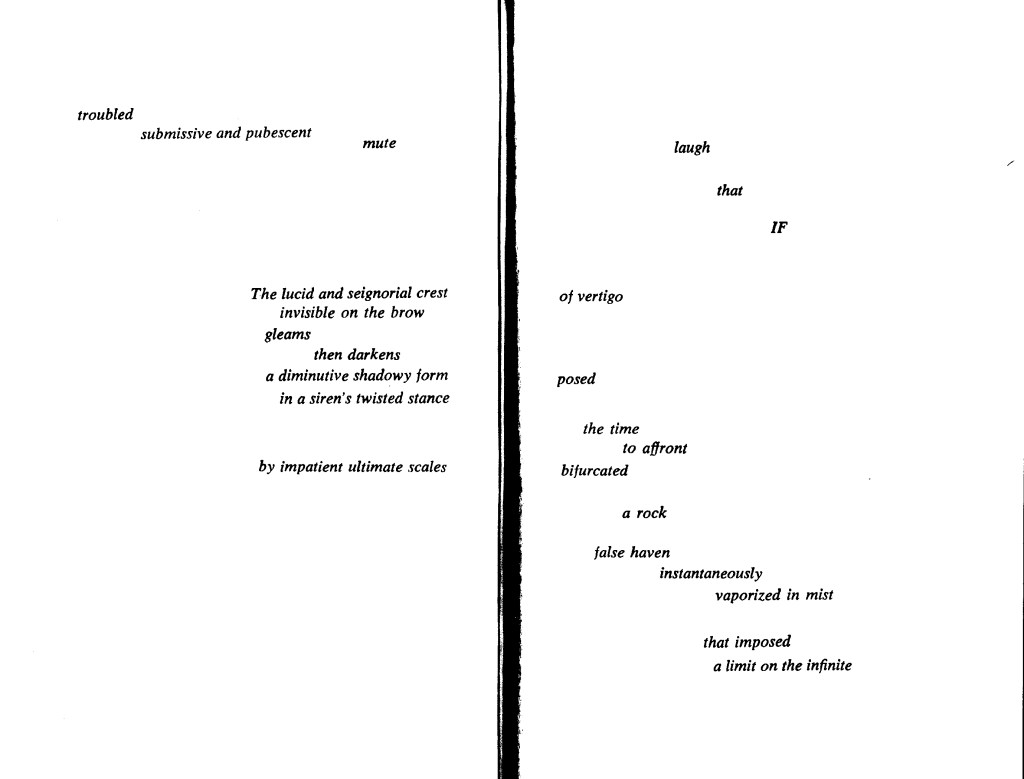
From “A Throw of the Dice” by Mallarme as reproduced in Speaking Pictures (Harmony Books, 1975)

Apollinaire, who was influenced by the Symbolist and the more ancient pattern poetry, created poems that built on the use of the page as a canvas (as a painter would use). His calligrams left behind the linear (as in lines) of poetry, opting instead for creating meaning through graphic display of the text. He also created poems in own handwriting, which are closest to poetry comics.

Here’s an example from Apollinaire’s Calligrammes:

“It’s Raining” by Apollinaire; translated by Anne Hyde Greet in Calligrammes (University of California Press, 1980)

As a footnote, experimental poetry based on text and space became fertile ground first for concrete poetry which in turn was a forerunner of visual poetry (vispo) which continues today. See A History of Poetry Comics #10 https://punkpoet.net/2023/02/17/a-history-of-poetry-comics-10/

And BTW, in 1958 artist-poet Brion Gysin who added cut-up and collage to the poet’s toolkit, said “Writing is 50 years behind painting.” Perhaps.

Timeline: Pre-history (1897 & 1912-1913)

Warning: This incomplete history maps my journey as a poet learning about comics and doesn’t follow a strict chronological order.
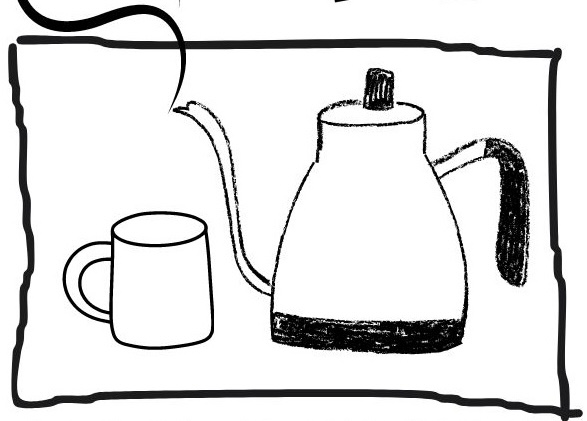
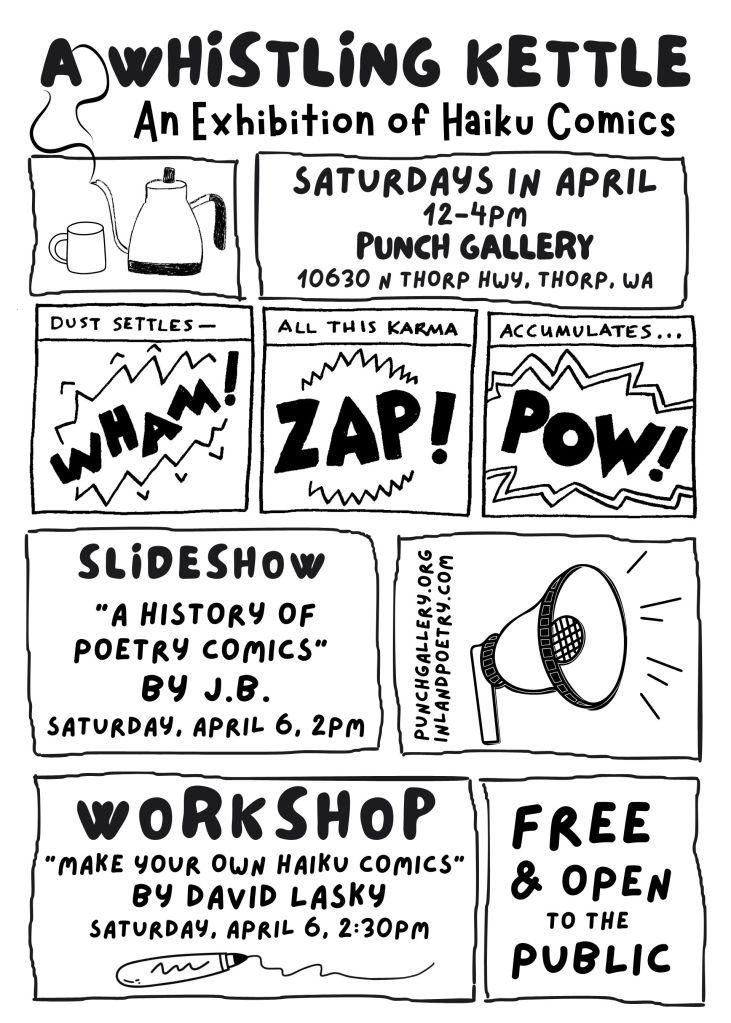
Curated by David Lasky and J.B., this exhibition features 22 poet-artists with 69 haiku comics.

Artist statement

“A Whistling Kettle: An Exhibition of Haiku Comics,” that I co-curated with David Lasky, provokes a mixed bag of feelings. It’s like when I heard the punk band Ramones broadcast on radio for the first time. And when I saw 1970s street art and graffiti were taken inside to be exhibited and sold in art galleries (RIP Keith Haring). And when I discovered I wasn’t the only angst-riddled teenager that read MAD magazine (thanks to my dentist’s office).

It’s feelings of disbelief that the things I identified with were now being mass marketed. Disappointment at losing another counter-culture fixture to the mainstream. But also pride that things I admire and worship were deemed worthy and valuable. In the end, this validation increased my hip credentials — I knew about an art movement, a music scene, a zine before a lot of others caught on.

We are all students and explorers. The haiku comics here are the direct result of classes taught by Lasky, a comics artist learning about haiku. I’m seeing first-hand, as a poet learning about comics (and trying some myself), the transformative power that pictures and words have together. (See the note on “Illumination” in A History of Poetry Comics #05, part of my attempt to define poetry comics.) I believe the best poetry comics create a third meaning that words or pictures can’t do on their own.

This show collects works that transcend what’s hung on the gallery wall. There are underscores and counterpoints. There are kireji (the “cut” in Japanese haiku) and kigo (the season word in Japanese haiku). There’s context, witnessing, confessions. There’s complexity and simplicity sometimes in the same work. And there’s illumination — that “third meaning” that happens when your mind jumps beyond the words and pictures.

For me, this show is validation of the exploration we poet-artists have been doing on the fringes of both comics and poetry. It expands the audience for our work. And it makes us feel (perhaps) a little less like outsiders.

Enjoy the hip credentials!