A History of Poetry Comics

THE BOOK of Death Haiku Comics

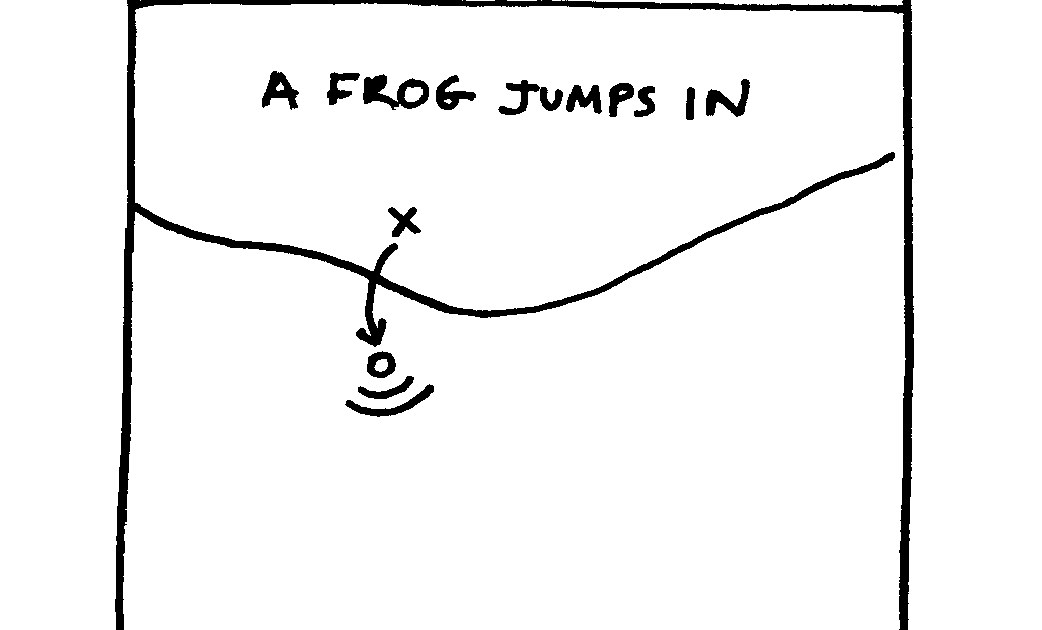
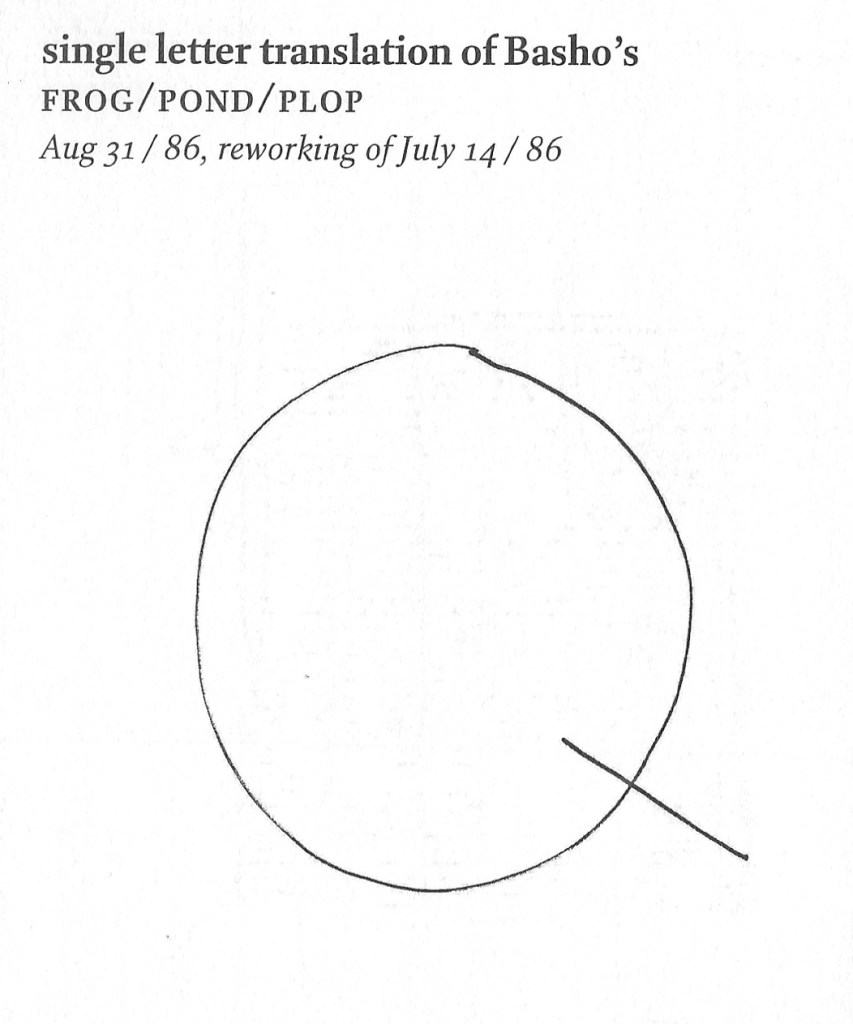
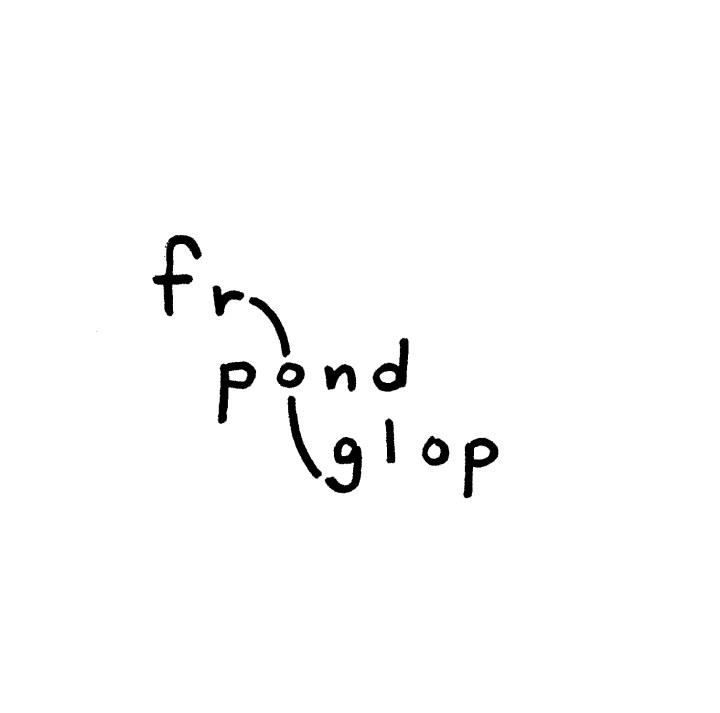
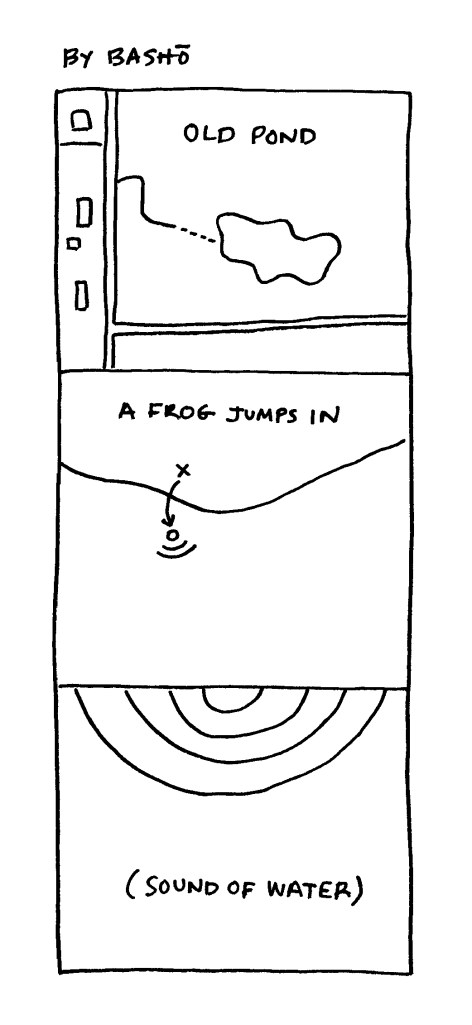
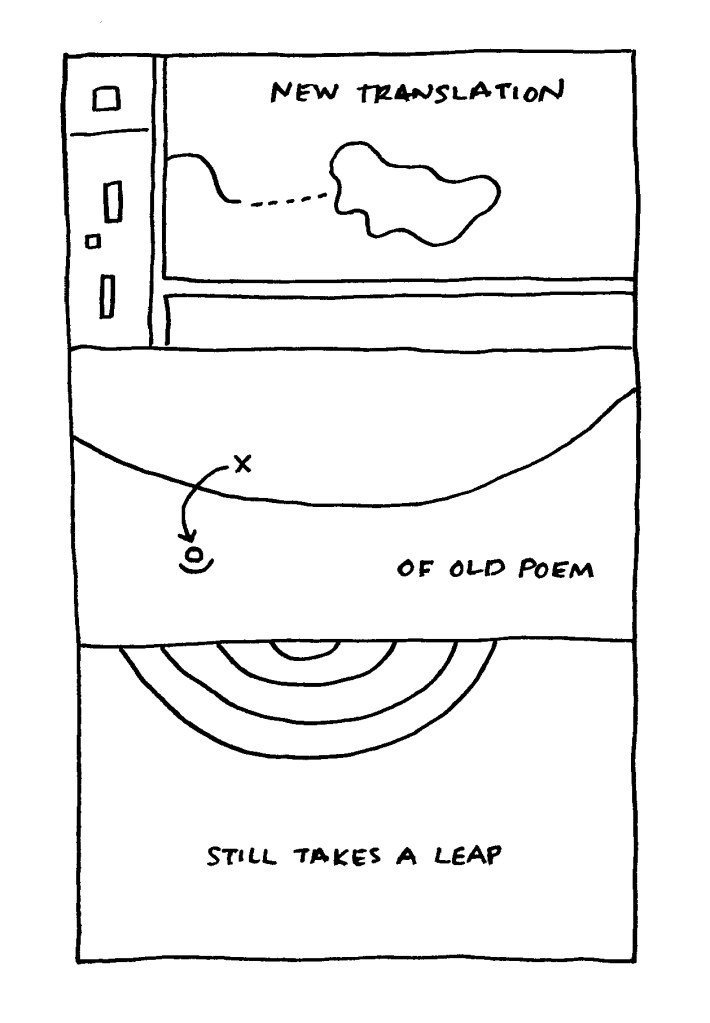
Haiku comics are a relatively new development in the history of poetry comics. While a scattering of forerunners can be found in the 1970s and 1980s, we consider the first haiku comic to be a four-panel rendering of a Basho haiku by the Canadian comics artist Seth published in Drawn & Quarterly in 1995. (See AHOPC #21 for a closer look at this.) Since then there has been markedly more comics artists/poets creating haiku comics.

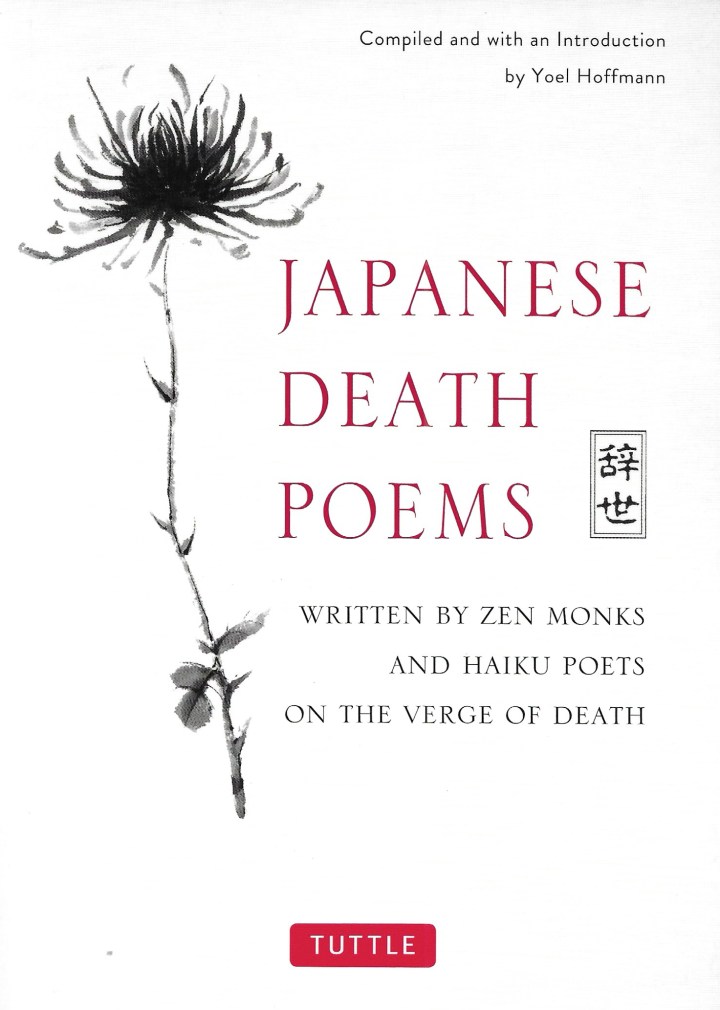
Cover of Japanese Death Poems compiled by Yoel Hoffman

Joining the movement is Seattle artist/writer William Chen, whose new work is The Book of Death Haiku Comics. Using as a resource Japanese Death Poems (Tuttle, 1986) compiled by Yoel Hoffman, Chen has made his own translations to which he adds skillfully executed drawings that feel like a whole graphic novel in one page.

Chen talks about his project: “Jisei, which come from Japan, are poems written on the occasion of one’s own death. I don’t remember how I stumbled on them, but when I did, death haiku immediately struck me as a fascinating subject for interpreting and illustrating as poetry comics.”

Chen lived in Otsu, Japan (just a 10-minute, local train ride from Kyoto) for about a year. He made a living teaching at an English conversation school to people of all ages. While there he saw sites, studied Japanese, and learned to Pop (Popping, the dance style).

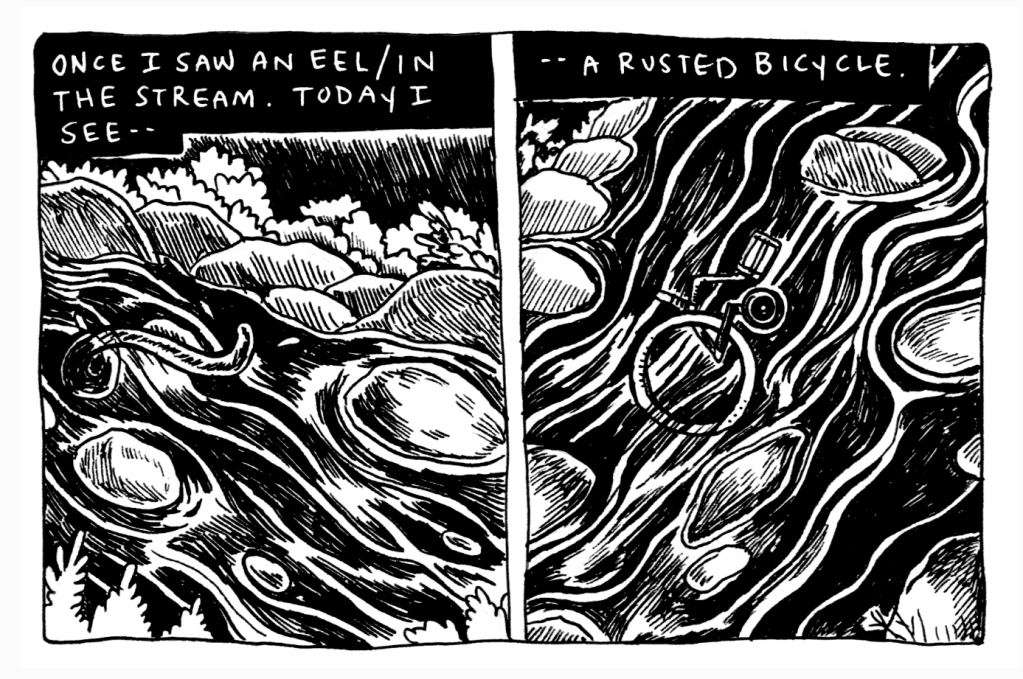
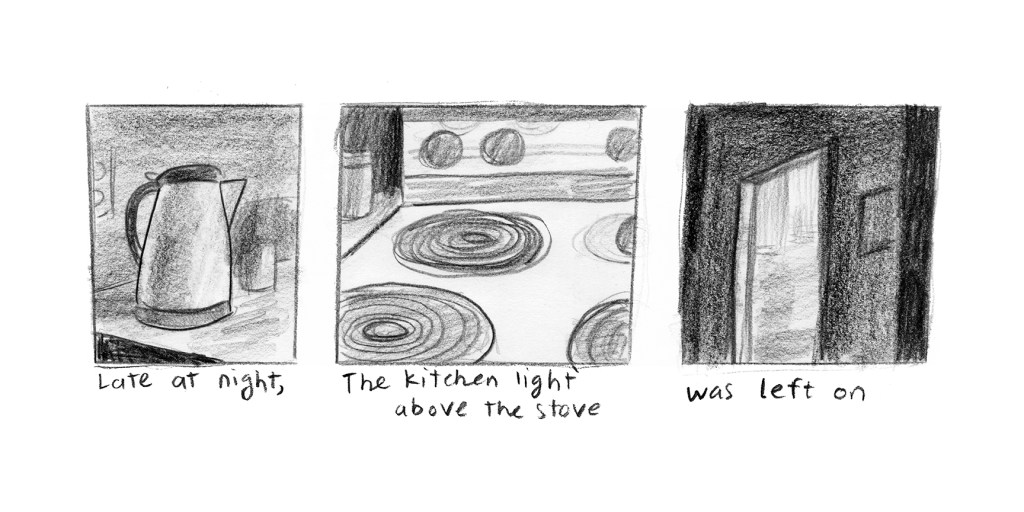
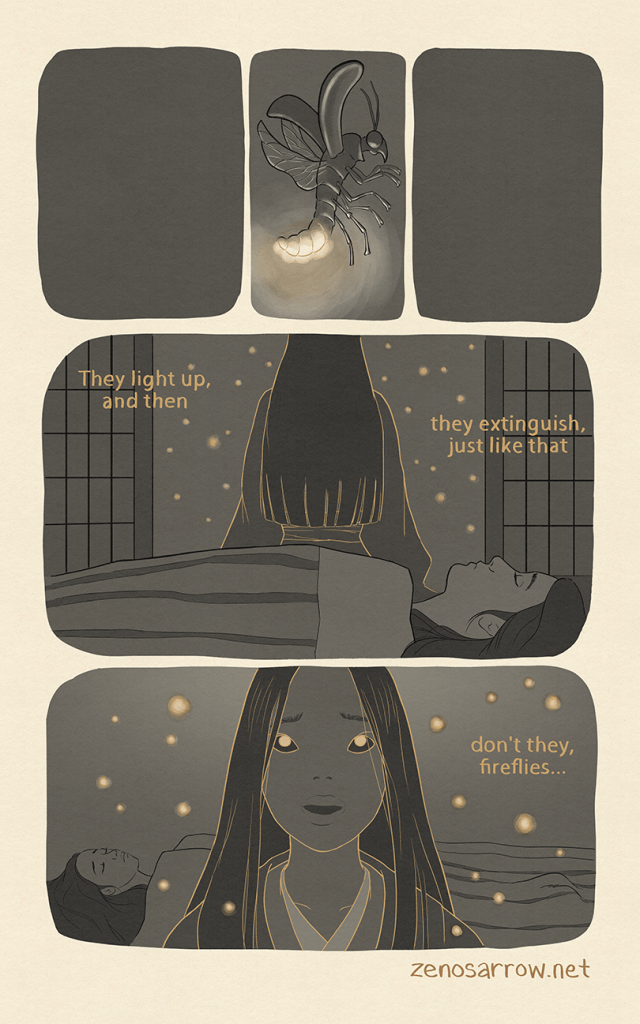
Here’s one example from his forthcoming chapbook:

ChinE’s Fleeting Fireflies

For a copy of “The Book of Death Haiku Comics” visit his table at Short Run (Nov. 1, 2025, in Seattle). After that, you can go to Chen’s Ko-Fi store here. He will also have copies in a few local comic shops around Seattle (Fantagraphics, Phoenix, Outsider).

Follow Chen on Bluesky @zenosarrow.net.

READ MORE: I came across “Japanese Death Poems” in 2006. I was staying with a poet-friend in San Francisco while doing readings for “Punk Poems,” and he had a copy in his library. I couldn’t put it down and had to get my own copy so I could finish consuming it. Hoffman’s background introduction is essential. The poems are in two large sections: Death Poems by Zen Monks and Death Poems by Haiku Poets. And the Index of Poetic Terms at the end of the book provides additional context and cultural insights. Recommended.

Timeline: 2025

Warning: This incomplete history maps my journey as a poet learning about comics and doesn’t follow a strict chronological order.
A History of Poetry Comics

Notable / Recent Finds

At AHOPC we’re open to exploring the roots, influences, and parallel movements that inform poetry comics. These three notable / recent finds present poetry as art that’s sometimes outside the definition of poetry comics but still in the sphere of influence.

GLYPH by Naoko Fujimoto

Collage has been used by both visual artists and poets alike since it’s recognition as as art form in the early 20th century. Naoko Fujimoto uses collage to create what she calls “graphic poetry,” bringing in materials that thematically underscores their meaning. Her collection “GLYPH: graphic poetry = trans. sensory” (Tupelo Press, 2021) brings both the beauty and the power of collage to the intimacy of personal poetry. In the introduction Fujimoto writes, “I wanted my graphic poems to transport the viewer’s senses from paper, bridging the gap between words and images and their physical counterparts.” She uses found materials to create a base for her poetry, which is often handwritten, sometimes cut up, and always cascaded across her canvas. Her found materials include washi, origami paper, supermarket advertisements, gift wrap, postcards, and magazines among other materials. Among my favorite poems here are “Natane Rain Is,” “Greenhouse,” and “I Burn the Upright Piano.” This is a great addition to the graphic literature canon.

More often closer to Abstract Comics than Poetry Comics, David Lasky‘s “Manifesto Items #14: Postcard Comics” (2025) expands what can be done with the constraints of a structured format. Like fitting a sonnet into 14 lines or a haiku into 17 syllables, Lasky masters the postcard form to tell stories, illuminate poems, and expand our definnition of landscapes. He then mails them out, as he writes in the introduction, “to see if something small and precious could survive the machinery of the USPS and reach its destination.” His humor, wit (he goes meta in all the right ways), and color expertise are all on display here. For example, check out the raven’s attempt to correct Poe’s nevermore! Don’t wait to get your copy! Available here. ICYMI: I first mentioned Lasky’s “Lucky 13” a year ago in AHOPC #23. Lucky for us, he has reissued this 2023 sprawling collection of poems, comics, and poetry comics, adding some new ones and giving others more space. Full disclosure: David is my comics teacher and friend. We’ve co-curated exhibitions of haiku comics in 2024 and 2025 for art spaces in Washington and Oregon. And he’s the inspiration for this blog!

Letter of Intent by Nico Vassilakis

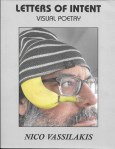
Visual poetry, as noted in AHOPC #28, is the direct descendent of concrete poetry. There’s a painterly feel to vispo that’s not always present in concrete. Poet Nico Vassilakis continues to explore and explode the power of letters to create (or should I say paint?) his poetry work “Letters of Intent” (Cyberwit.net, 2022). He notes this is “a collection of visual essays designed to explore the interior space of language material.” There’s humor (“Letters Are Escaping”); there’s instruction (“Ways To Begin”); there’s a nod to couplets (“Doubles”). The section “Opinions” sees messages emerging from the alphabet-primordial soup such as “letters are leaving these words,” “staring,” and “words are a crowd.” Like an abstract painting, I like taking my time when looking at each piece as different meanings emerge and submerge. Often layered like graffiti on graffiti, other times blended until just a color field remains, the work grabs your attention and creates wonder (a future language, perhaps?) for the reader/viewer.

Timeline: Current

Warning: This incomplete history maps my journey as a poet learning about comics and doesn’t follow a strict chronological order.
A History of Poetry Comics

A Map of Roots & Influences


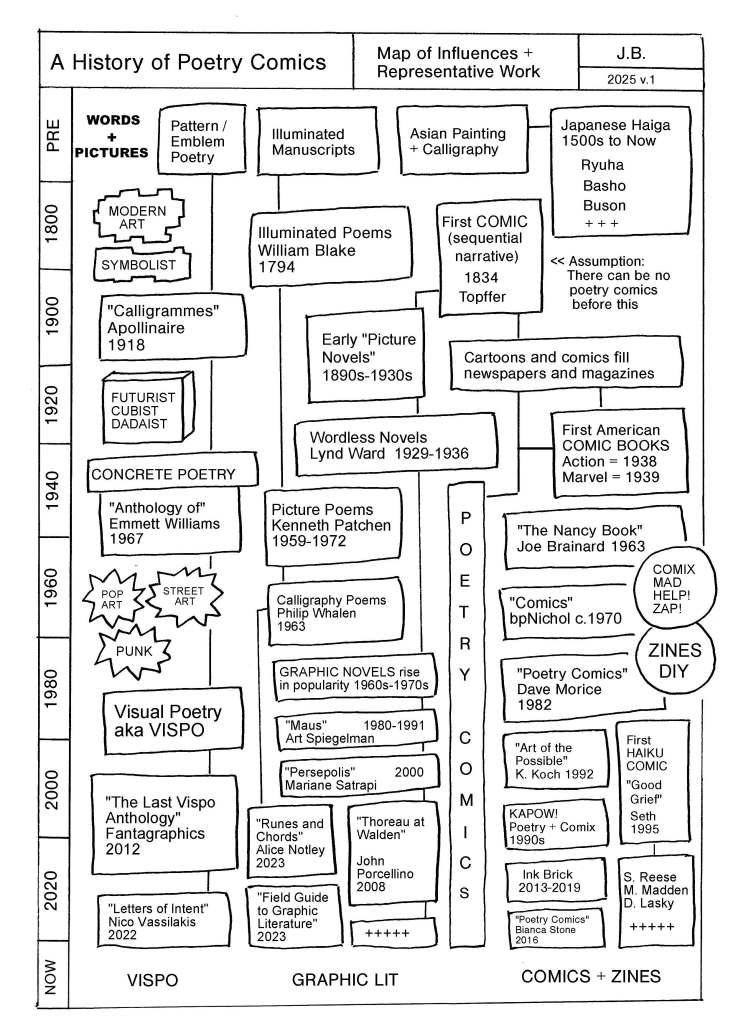
Poetry comics and haiku comics are a relatively new development in the historical context of artists and writers using words and pictures together to create meaning deeper than either could do on its own.

Historical roots can be traced back centuries to pattern poems and illuminated texts in Europe and calligraphic pictures and poems in Asia, Japanese haiga for example. By the 1800s painters and poets were looking at things differently and becoming more experimental and more accepting of non-traditional influences. This led to the concrete poetry movement in poetry and the pop art aesthetic in painting.

Comics, which can be defined as drawings that tell a sequential narrative, started in the (mostly agreed to) 1870s. The rise of comics and comic strips, which were going full bore by the 1940s in newspapers and magazines, provided source materials for poets and artists who used influences from comic book aesthetics, comic strip characters, and comics’ mechanics.

Poetry comics, a term finally coined in the 1970s, have continued through today, running parallel with the mainstream acceptance and interest in graphic literature, DIY, and zines. Haiku comics, starting around 1995 as a natural outgrowth of poetry comics, have been recently popularized by poets/comic artists.

I’m sharing the first draft of my map of “A History of Poetry Comics” that attempts to show related roots, influences and representative practitioners of poetry comics. While definitely not definitive, hopefully it will serve to illuminate and inspire further investigation. This is what I’ve learned so far.

Timeline: 2025

Warning: This incomplete history maps my journey as a poet learning about comics and doesn’t follow a strict chronological order.
A History of Poetry Comics

Naming Poetry Comics

“Rose is a rose is a rose is a rose.” -Gertrude Stein

Although labeled differently by poets, artists, and historians, work that investigates the relationship between pictures and words (i.e. drawing and poetry) strives for the same result: create meaning that’s not possible with words or pictures alone.

Here are terms “A History of Poetry Comics” has uncovered that each point in their own way to the practice of incorporating words and pictures into art.

TermRepresented byTimeline
haiga (Japanese haiku drawings)Bashō, Buson1500s on
illuminated poemsWilliam Blake1780s
sequential narrativesRodolphe Topffer1830s
comic books, comic strips, comics Various*1890s-1930s
pictorial prose poems (without words)Lynd Ward1930s
picture poemsKenneth Patchen1940s-70s
concrete poems –> vispo (visual poetry)Augusto deCampos,
Nico Vassilakis
1950s-70s on
graphic novelscoined by Richard Kyle1960s
hand-drawn poemsbpNichol1970s
poetry comics (drawings w/ other’s poems)Coined by Dave Morice1980s
comics mainly without picturesKenneth Koch1990s
haiku comicsSeth1995
poetry comics** (drawings w/ own poems)Bianca Stone2010s
poem/drawingsAlice Notley2020s
graphic poetryNaoko Fujimoto2021

*A good starting point to get perspective on when these terms were first use is Wikipedia’s History of Comics. For U.S.-centric perspective, American Comics: A History by Jeremy Dauber (W.W. Norton & Co., 2022) comes recommended.

**See A History of Poetry Comics #05 for suggested ways to identify poetry comics.

Timeline: Pre-history to Current

Warning: This incomplete history maps my journey as a poet learning about comics and doesn’t follow a strict chronological order.
Poetry Comics’ Intersection with Vispo

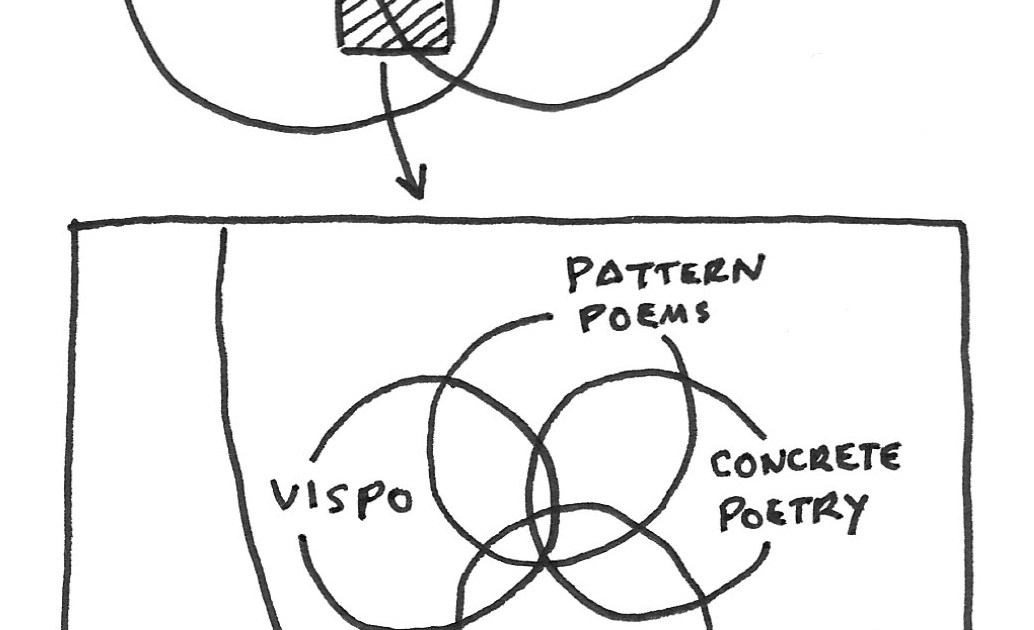
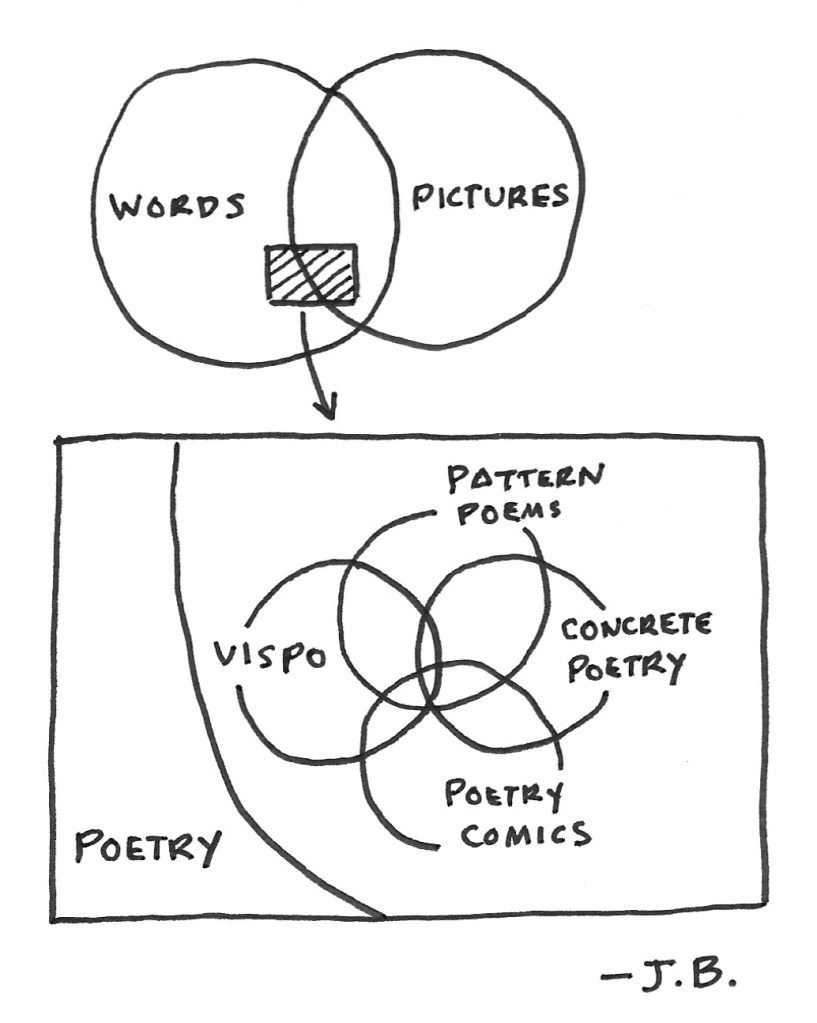
There’s a reason why borders, boundaries, and categorizations don’t work. Even with narrowly defined genres, movements, schools, etc. there are works that blur the edges and distinctions. Such is the case with visual poetry (vispo) and its intersection with poetry comics.

While definitely an oversimplication, here’s a Venn diagram that attempts to illustrate this point of overlap and influence:

Vispo grew directly out of the concrete poetry movement of the mid-1900s. (See AHOPC #10 for more on concrete poetry.) Definitions of vispo are as varied as its practicioners. Poet Nico Vassilakis in a 2014 inteview with BODY offers this way into understanding vispo:

Vispo is clearly a response to language. It tends to enhance the quantum aspects of language by focusing on the elemental design parts of language material. What’s that mean? People like fidgeting with alphabet.

The letter, itself, has been my point of interest.

Vispo is a response to reading and writing language. There is a connection between seeing writing and writing reading and reading seeing (hand-eye-brain).

–Nico Vassilakis

To locate the overlap between vispo and poetry comics, I turned to the volume “The Last Vispo Anthology: Visual Poetry 1998-2008” (Fantagraphics Books, 2012) edited by Crag Hill and Nico Vassilakis. I found examples that hint (either directly or indirectly) at some aspect of poetry comics, such as sequential panels, comic books, speech bubbles, and hand lettering. I make the case these works exist in the intersection of vispo and poetry comics — regardless of how they’re categorized.

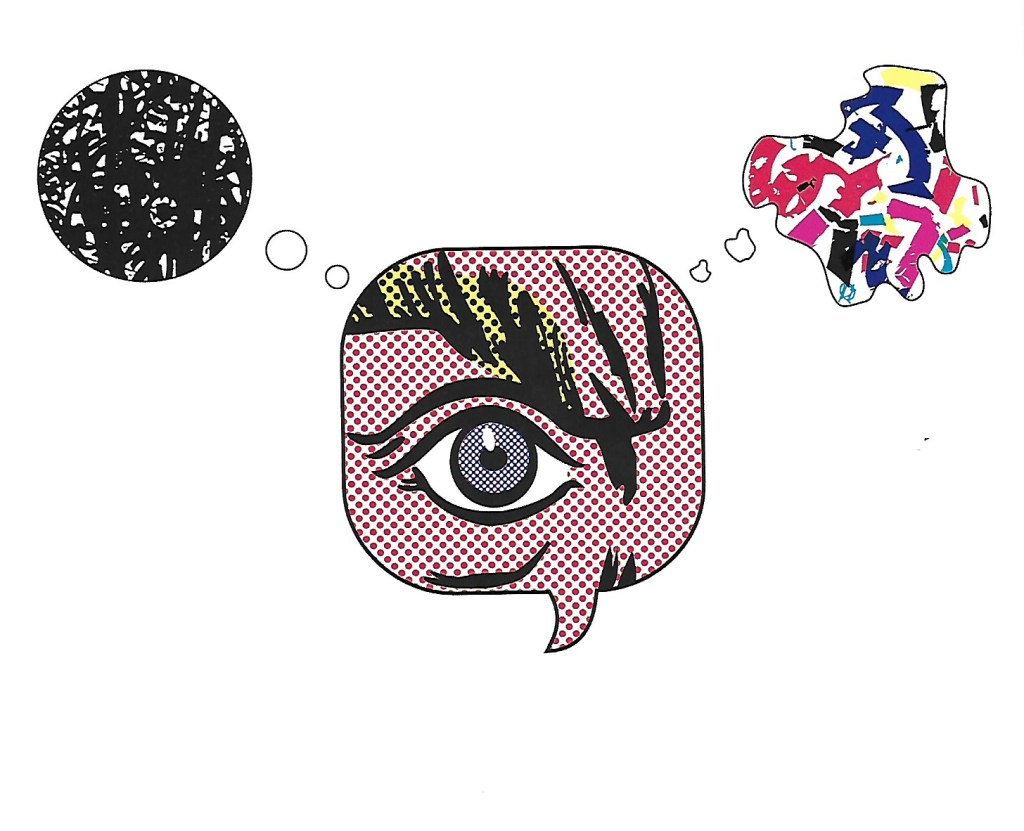
Closed Caption by damian lopes (The Last Vispo Anthology, No. 36). The poetry here is created in the interplay between speech/thought bubbles; the speech bubble, with a Lichtenstein looking eye, is having thoughts of its own, each more abstract. With the above we’re led to consider Pop Art as well as comics. Speech bubbles have a long history when pictures and words are used together and have become of one of the hallmarks of comics and graphic novels.
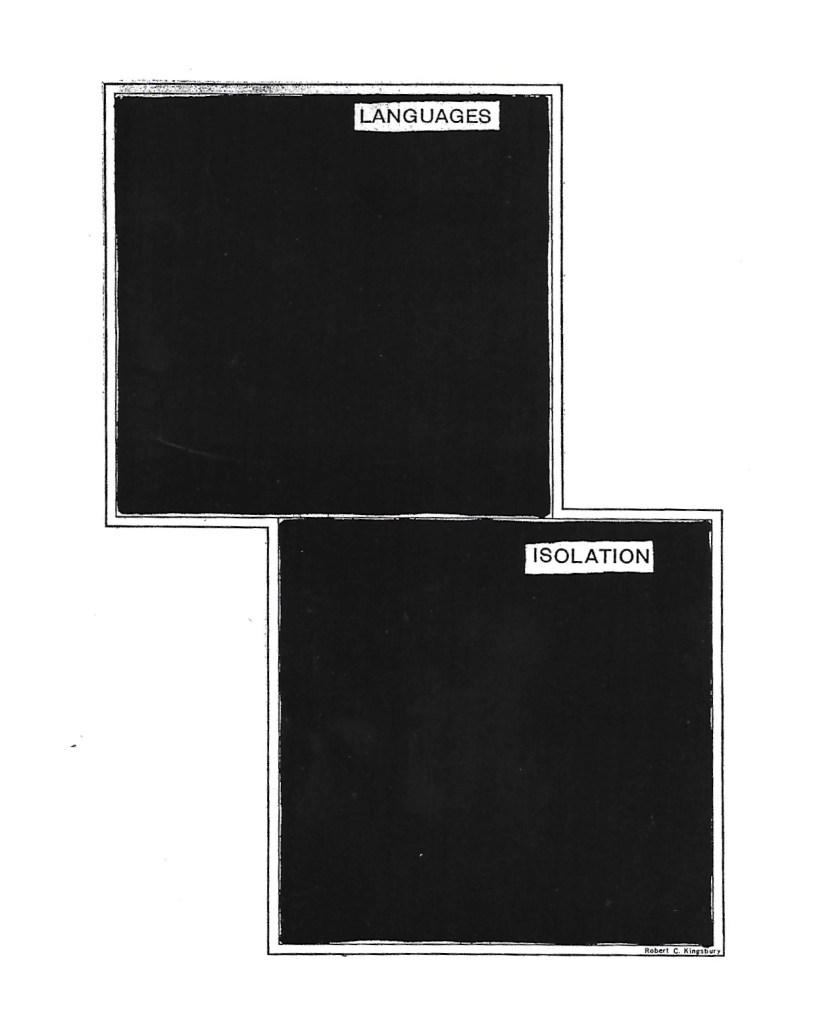
Languages & Isolation by Gustave Morin (The Last Vispo Anthology, No. 109). These two-panels allude to a sequential narrative, one definition of comics. To be sure we see this poem as sequential, the poet has the two panels overlap slightly. It makes me ponder how isolating languages can be for travelers, immigrants, and others. And I wonder what has been blacked out. Check out Morin’s “Toon Tune” on the Poetry Foundation website.
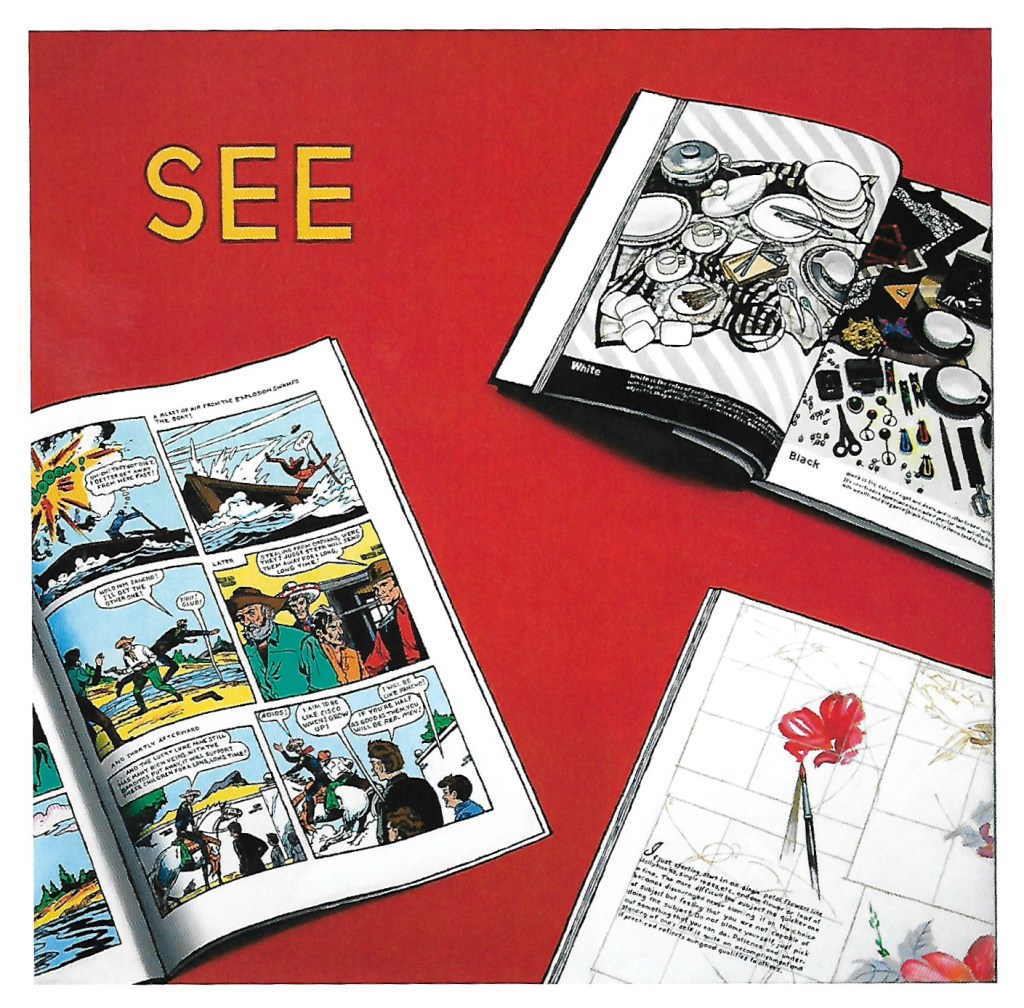
See by David Ostrem (The Last Vispo Antholoogy, No. 168). It’s easy to consider this work in terms of poetry comics; a little harder to explain why. The poet/artist includes faithfully drawn copies of three books, one being an opened Western comic book (easy). The word SEE is open to interpretation (harder). I take it as “notice this” — here are drawn pictures of books that are either about drawing or are drawn themselves.
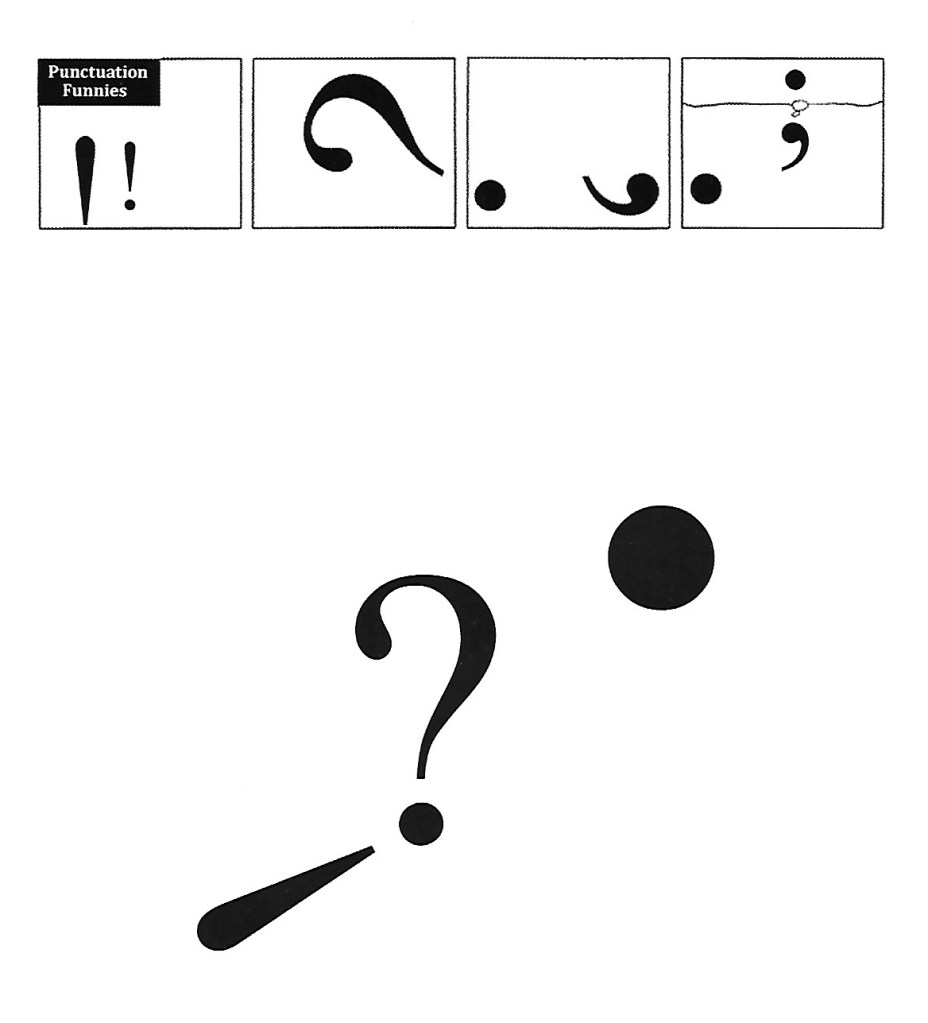
Punctuation Funnies / Questionable Shadow by Gary Barwin (The Last Vispo Anthology, No. 221). I feel this work by Canadian poet/artist Gary Barwin definitely falls inside the shared space of vispo and poetry comics. It’s one of my favorite examples. Starting with calling these drawings “funnies,” then using the standard newspaper comic strip of four frames, and ending with a thought bubble, there’s little doubt they intended to evoke comics. The visual joke of the Questionable Shadow mirrors the kind of humor found in daily newspaper comic strips.
Cartoon0002 by Paul Lambert (The Last Vispo Anthology, No. 249). There’s something comic-book-ish about the lettering that hints at a connection with poetry comics. The shape of the frame and how the lettering reverses to create a kind of horizon line cause a comics feeling to arise. Again, it’s hard to put an exact finger on the reason, but what’s happening in this single frame results in something happening outside the frame, which in turn makes the reader/viewer imagine a second sequential frame and then perhaps a third.

Timeline: 2000s

Warning: This incomplete history maps my journey as a poet learning about comics and doesn’t follow a strict chronological order.
A History of Poetry Comics

Pattern Poetry: Words and Pictures have Gone together since the beginning

Poetry comics are just one step on a continuum. They’re among the recent incarnations of words and pictures being used together to create context and/or deeper meaning. Tracing these roots back — well before comics existed as a form of literature — leads you to century-old forerunners that evolved to inform today’s illuminated texts, picture poems, concrete poetry, visual poetry (vispo), and poetry comics. For discussion sake, let’s collectively categorize these words-and-pictures progenitors as pattern poetry.

“The story of pattern poetry is, in fact, not the story of a single development or of one simple form, but the story of an ongoing human wish to combine the visual and literary impulses, to tie together the experience of these two areas into an aesthetic whole.” Poet Dick Higgins wrote that in “A Short History of Pattern Poetry” from his 1987 work “Pattern Poetry: Guide to an Unknown Literature” (State University of New York Press, 1987).

Let’s look at early examples of pattern poetry from c. 300 BC to c. 1700 AD, collected by Higgins, to get a sense of how long the history is of poets using words and pictures together. There are pattern poems in more than the countries and areas chosen here, too, speaking to the diversity and range of this impluse.

“The Egg” by Simmias of Rhodes c. 325 BC. According to Higgins, “The text is lyrical, celebrating nature.” This makes it one of the earliest extant examples of poetry and shape being used together. (Higgins p. 20)
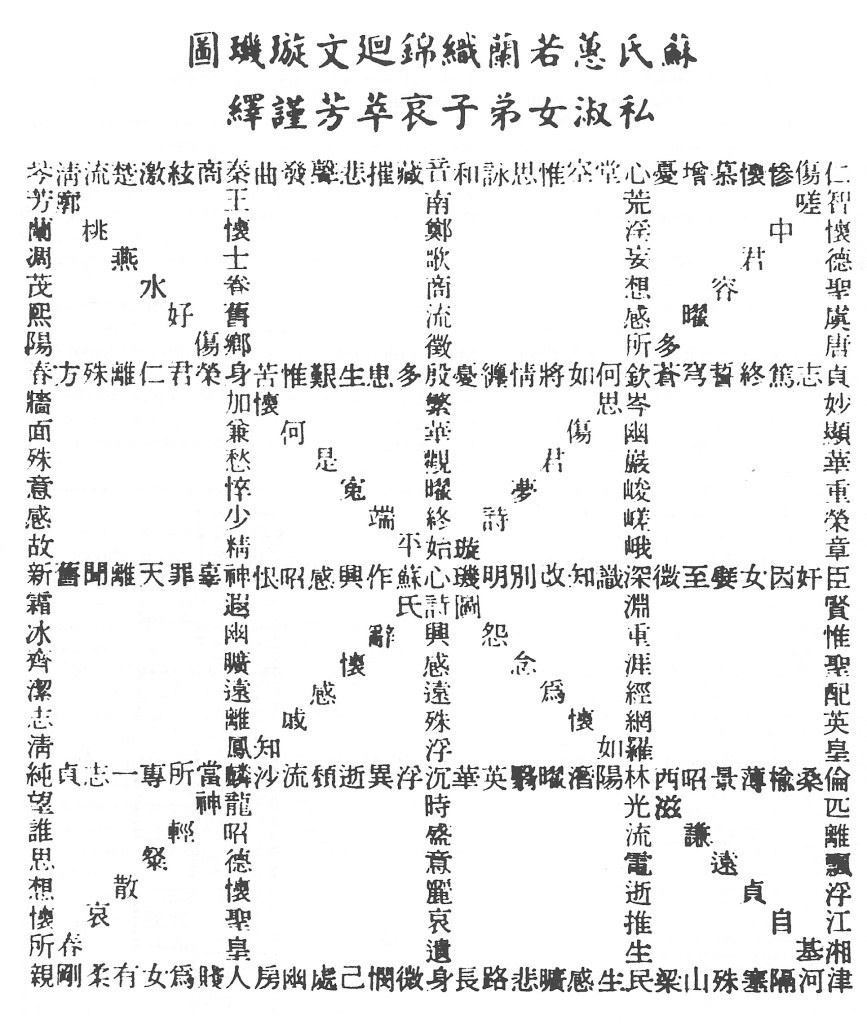
This Chinese “poem block” was written by Su Hui c. 300s AD. It can be read in dozen of combinations — backwards, forwards, diagonally, in squares, etc. It expresses “sorrow and love” for her husband who had taken up with a concubine. (Higgins, p. 212) This could be seen as the forerunner to acrostics, symbolists, and concrete poetry, etc.
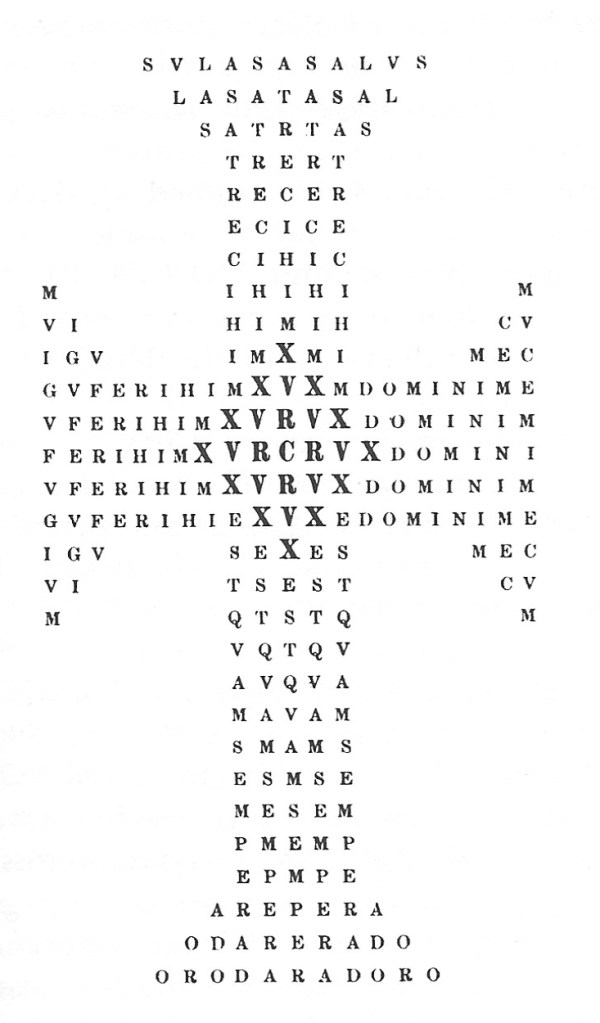
Cross-shaped poem by poet and hymn writer Venantius Forunatus c.late 500s. Along with the chalice, the cross poem continued to be used as a pattern poem through the ensuing centuries. (Higgins, p. 36)
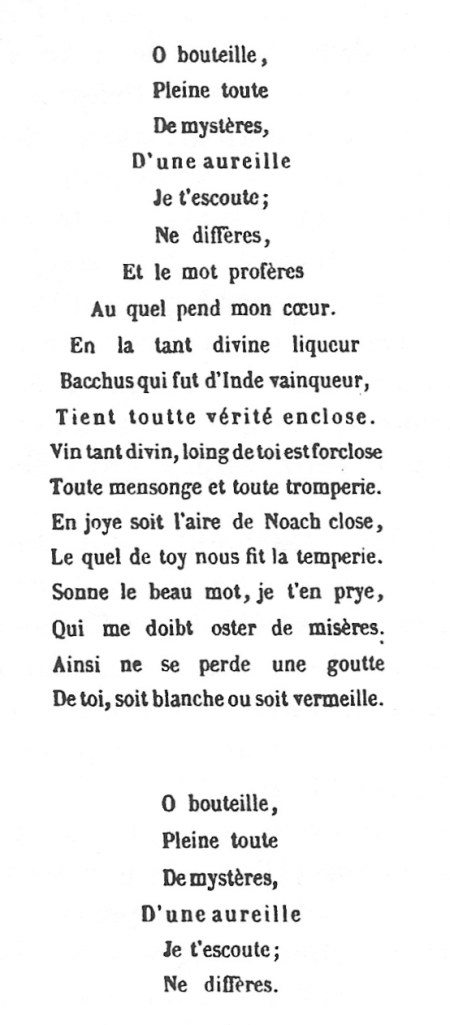
Bottle and cork pattern poem is attributed to French writer Francois Rabelais c. early 1500s. It has become one of the best known pattern poems in French. (Higgins, p. 67) The French Symbolists built on this in the 1800s (see AHOPC #24). Other shapes in early French patterns poems include the pyramid, hour glass, wing, and cross.
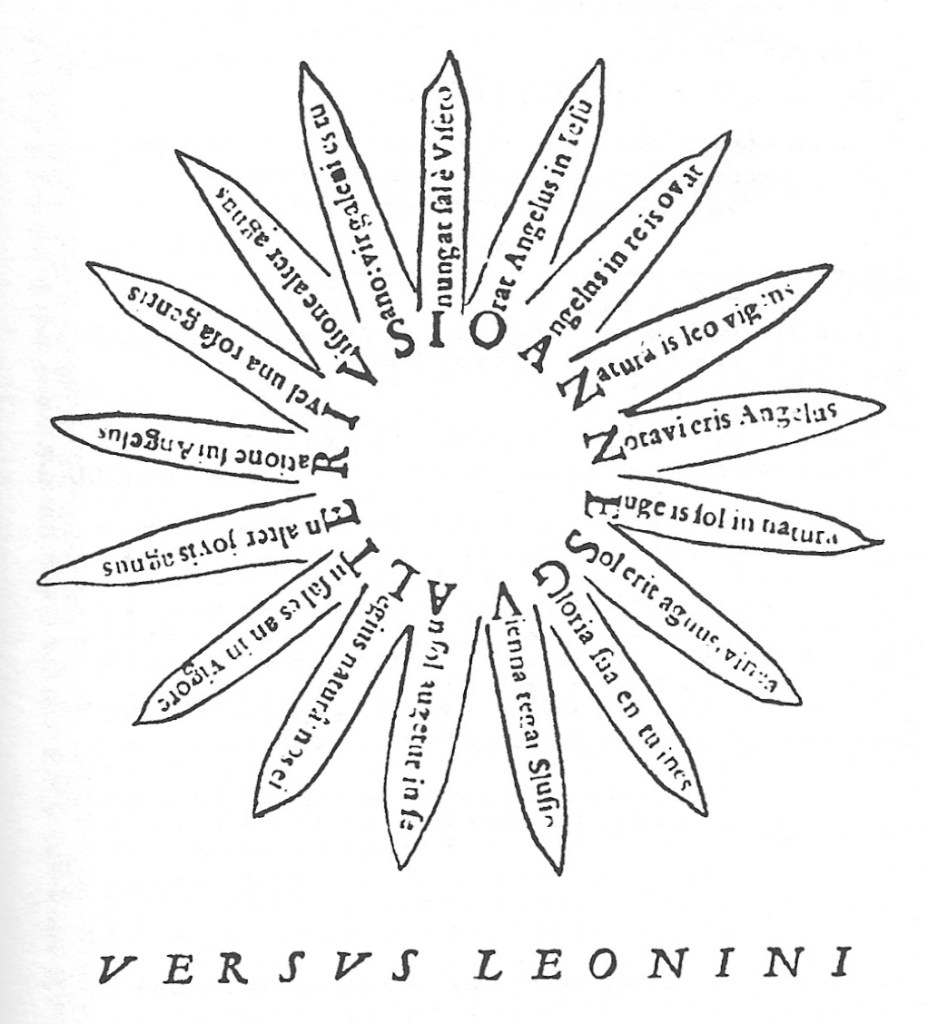
Sun-shaped poem in Latin by Hermannus de Santa Barbara c. early 1600s. Sun, star and chalice shapes are ubiquitous in pattern poems. Higgins notes this one is also an acrostic. (Higgins, p. 37)
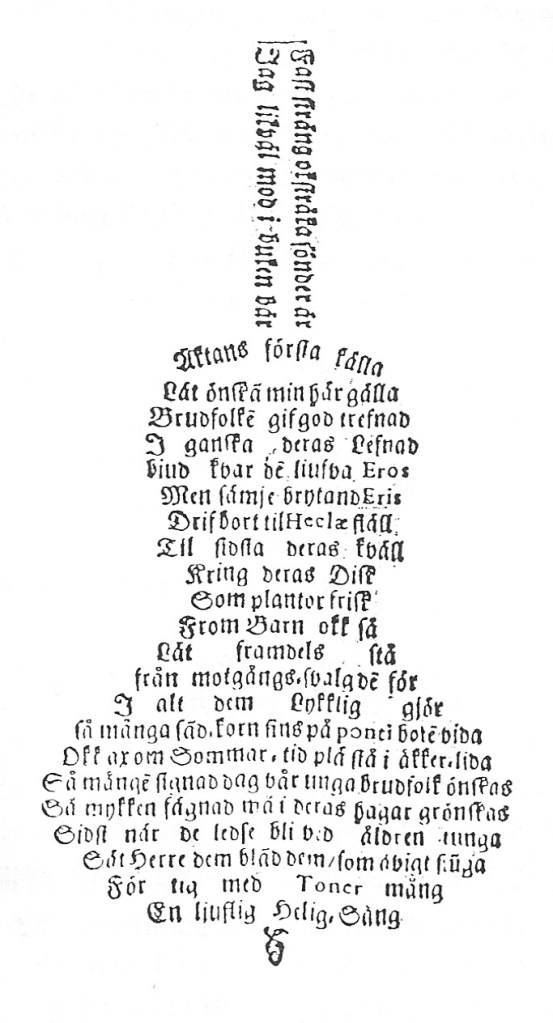
Viol-shaped poem by Swedish poet Israel Phalleen 1697. It was created to celebrate his nephew’s wedding (Higgins, p. 93) Mazes, heart shapes, chalices, pyramids and figures were also created in Scandinavia.
The Berlin Bear by German Johann Leonard Frish c. early 1700s. Ironically, this pattern poem is in part an attack on patterns poems and has become one of the works Frish is most remembered for. (Higgins, p. 86)

Timeline: Prehistory

Warning: This incomplete history maps my journey as a poet learning about comics and doesn’t follow a strict chronological order.
A History of Poetry Comics

Comics Had To Come First …

I have an assumption: There can’t be poetry comics before there were comics. So what and when was the first comics? And consequently what and when was the first poetry comics?

Let’s start by defining comics (not an uncontroversial task!).

  • Wikipedia’s definition of comics reads, “Comics are a medium used to express ideas with images, often combined with text or other visual information. It typically takes the form of a sequence of panels of images.”
  • In his seminal “Understanding Comics” (p20) comics artist Scott McCloud landed on: “Juxtaposed pictorial and other images in deliberate sequence intended to convey information and/or produce an aesthetic response in the viewer.”
  • Risking oversimplification, I’ve been using “sequential narrative drawings” as a good starting definition and one that makes sense to me, eventhough I recognize there are single-panel comics, abstract comics, graphic novels, often text (e.g. speech bubbles) with the drawings, etc. etc.

Now let’s look for early example of comics (or what could be called early comics or progenitors) that generally fit these definitions.

Among the earliest — and often called precursors to comic books — are Swiss caricaturist Rodolphe Topffer‘s (1799-1846) publications in the 1830s and 1840s. He used the terms “comedic story” and “picture story.” He’s often considered as the father of comic books for his work “Historie de Mr. Vieux Bois” (first published c. 1837). The story, told in drawings with text captions, moves from panel to panel. An uncredited translation of this work appeared in English c. 1842 as “The Adventures of Mr. Obadiah Oldbuck,” considered the first American comic book.

Comic books mass popularity continued to grow in America in the late 19th Century, starting with comics weeklies in the 1870s, which paralleled the rise of the number of newspapers. In the U.S. Sunday comics first appeared in 1889 followed by the first color comics in 1893. What we label as the golden age of comic books today started in the late 1930s with Action Comics (introducing Superman in Issue 1) in 1938 and Marvel Comics in 1939 (and still creating today). (For far more details than my condensed version provides, I recommend “American Comics: A History” by Jeremy Dauber (Norton, 2022). It’s a great primer.)

Book artist Lynd Ward (1905-1985) created six stories using sequences of woodcut prints between 1929 and 1937; works that ushered in the graphic novel. Basically sequential narratives, they use no words as they move from panel to panel (or in this case: page to page, print to print). There could be the case made that his “Song Without Words” (1936) is the first poetry comic, if our definition is wide enough to exclude sequential narratives without text. Ward noted in writing about this work, “The nearest I can come to identifying it is to say that if a sequence of images can be called prose, this could be considered a kind of prose poem.” Indeed.

I’m inclined to look for the first poetry comics among poets and artists who came to age in the 1930s, 1940s and 1950s and who created work with words and drawings. New York School artist Joe Brainard (1942-1984), San Francisco Renaisance poet Kenneth Patchen (1911-1972), Canadian poet bpNichol (1944-1988), and late in his writing life New York School poet Kenneth Koch (1925-2002), for example, created work directly influenced by comics and/or picture poems. Their work could arguably fall under the umbrella of poetry comics, and be counted among the earliest, although the term didn’t come into play until David Morice (b. 1946) used it in the late 1970s for his DIY work.

Timeline: Prehistory

Warning: This incomplete history maps my journey as a poet learning about comics and doesn’t follow a strict chronological order.
A History of Poetry Comics

Summer Reading Book Reviews

Poetry comics continue to be a way of illuminating thoughts, adding context to text (if that isn’t redundant), and helping the reader make that leap from what is said to what is possible. Here are three poet-artists I read this summer that continue to make things new.

Cover of Puddles by Tomas Cisternas (Bored Wolves, 2024) Puddles by Tomas Cisternas (Bored Wolves, 2024). Translated from the original Spanish, these comics by Tomas Cisternas perfectly illuminate his often spare text that focuses on nature, solitude and solace, and being human in the natural world. The work is black-and-white with a simplicity of line that matches the sentiment of the work (totally my sensibility).  If you don’t want to call them poetry comics then call them poetic comics.

Along with diary comics of walks, which are often multi-page, the single page comics are particularly poetic. In one panel he writes: “Throughout my life I have wasted time magnificently.” Indeed

Here’s one of my favorite comics from this collection (it was hard to pick just one) that speaks to the poetry in Cisternas’s work. He adeptly uses the last frame as a “silent” panel (i.e. a picture that doesn’t need words) that puncuates the poem perfectly.

From Puddles by Tomas Cisternas (Bored Wolves, 2024)

Shout out to Bored Wolves for the translation and making Cisternas work available in English. It’s a beautiful production. Check out the other works the Krakow-based press offers, many of which combine words and pictures.

Cover to Metamorphic Door by Carolyn Supinka (Buckman Publishing, 2024) Metamorphic Door by Carolyn Supinka (Buckman Publishing, 2024) Wild poetry comics are sandwiched between equally wild poems (some illuminated) in Metamorphic Door by Portland poet-artist Carolyn Supinka. In one poetry comic, she writes: “The question / of / who am I / if I’m not / constantly / creating / something.” It’s a question she keeps answering throughout the collection with both words and pictures.

The six poetry comics included here span from two to 10 pages of one-panel or two-panels each. Each panel is multi-layered, drawings of objects that morph intertwined and interrelated, and can disappear totally at times. The text too can’t be contained by the panel. Instead it hovers above, intertwines, and fills empty spaces as it spills down the page. (See AHOPC #12 to compare how bpNichol exploded the frame of the panel in his poetry comics.)

Here’s a representative page from Supinka’s “Earth Tide” that illustrates her style: 

Panel from poetry comic "Earth Tide" by Carolyn Supinka
From “Earth Tide” in Metamorphic Door by Carolyn Supinka (Buckman Publishing, 2024)

Her poetry is more experimental than it may first appear, which perfectly matches her illustrations/illuminations. There are poems that ignore the gutter and spill across the spread; and poems that are literary photo-negatives of each other. The Index is a work of art as well!

BTW I came across Supinka’s collection while browsing the poetry stacks at Powell’s City of Books on Burnside in downtown Portland. Browsing at Powell’s is one of my favorite things to do!

Cover of THE TEST #50 by Blaise Moritz (Urban Farm Print and Sound, 2023) THE TEST #50: In Prasie of Shogun Warriors by Blaise Moritz (Urban Farm Print and Sound, 2023)

East Toronto artist Blaise Moritz creates poetry comics that are engaging, explosive, and original. He has published two books of poetry (without pictures) in addition to his monthly comic book, THE TEST, and graphic novels, including his latest Bar Delicious (Conundrum Press, 2023). Call Moritz a poet-artist or an artist-poet — either way he smartly uses words and pictures to illuminate and expand context.

His piece “In Praise of Shogun Warriors” in THE TEST #50 (Urban Farm Print and Sound, 2023) features linked haiku stanzas (from 2015) that Moritz illustrated in 2023 with Gundam-inspired robots remembered from his childhood (including Shogun Warriors fan art he made when he was 8 or 9 years old). Japanese haiku (three lines of 5-7-5 syllables) aptly fit this subject matter; it’s perfectly played. Here’s a sample from the 16-page poetry comic:

Other examples of his poetry comics can be found online by following Moritz on Instagram. Some of his single-panel poetry comics are reminiscent of Kenneth Patchen’s picture poems. He also makes music as The New Birds of America (underscoring the poet-artist drive to build additional context for when we’re asked, “What does it mean?”)

Thanks to David Lasky for recommending Blaise and sharing his THE TEST comics with me.

Timeline: Current

Warning: This incomplete history maps my journey as a poet learning about comics and doesn’t follow a strict chronological order. 
A History of Poetry Comics

Rise in comics paralleled experimental poetry

It’s notable that concurrent with the rise in popularity and proliferation of comics in the years between about 1870 and 1920 poetry was becoming more experiemental. Possibilities for poetry were opening up, starting with how the page and text could be used to add context and illuminate meaning.

Two early (perhaps the first modern?) examples of poets experimenting with page and type are both French: Stephane Mallarme (1842-1892) and Guillaume Apollinaire (1880-1918).

Mallarme created poems that broke the constraints of the line and the page. His late poems would run down the page, across the gutter, and even page to page. Considered a Symbolist master in France in the 1890s, Mallarme created poems toward the end of his life that were concerned with meaning and how text placement, type face, and font size could convey meaning — or at least provide graphical clues to meaning.

Here’s a two-page spread from Mallarme’s “Throw of the Dice” (1897) that illustrates the poet’s breaking with expected norms of poetry and creating what he said had “the look of a constellation.”

From “A Throw of the Dice” by Mallarme as reproduced in Speaking Pictures (Harmony Books, 1975)

Apollinaire, who was influenced by the Symbolist and the more ancient pattern poetry, created poems that built on the use of the page as a canvas (as a painter would use). His calligrams left behind the linear (as in lines) of poetry, opting instead for creating meaning through graphic display of the text. He also created poems in own handwriting, which are closest to poetry comics.

Here’s an example from Apollinaire’s Calligrammes:

“It’s Raining” by Apollinaire; translated by Anne Hyde Greet in Calligrammes (University of California Press, 1980)

As a footnote, experimental poetry based on text and space became fertile ground first for concrete poetry which in turn was a forerunner of visual poetry (vispo) which continues today. See A History of Poetry Comics #10 https://punkpoet.net/2023/02/17/a-history-of-poetry-comics-10/

And BTW, in 1958 artist-poet Brion Gysin who added cut-up and collage to the poet’s toolkit, said “Writing is 50 years behind painting.” Perhaps.

Timeline: Pre-history (1897 & 1912-1913)

Warning: This incomplete history maps my journey as a poet learning about comics and doesn’t follow a strict chronological order.