A History of Poetry Comics

here’s the first use of term ‘poetry comics’

The first use of the term “poetry comics” was quite literal. In 1979 poet Dave Morice created “Poetry Comics,” a 22-page comic book of comic-ized poems from the (then) English canon. He drew comics that illustrated poems by Emily Dickinson, Sylvia Plath, Walt Whitman, Allen Ginsberg and others we elders know from high school English class. Each poem got a different treatment, covering many comics styles, that uniquely illuminated that particular poem.

Morice created 17 comic books of poetry comics between 1979 and 1982, which he photocopied and mailed to other poets. His poetry comics werre collected in “Poetry Comics: A Cartooniverse of Poems” (Simon and Schuster, 1985). The same year, he published “How to Make Poetry Comics (Teachers & Writers, 1985), a guide for teachers.

At the time, a review by Bruce Brooks professed: “By the time Ebenezer Cooke was snapping off wry hudibrastics in the early 1700s, the Greek had been chuckling over Aristophanes for twenty-one centuries. But now America has initiated another tradition equally amusing, if not equally honorabler: poetry comics.”

In an essay “Poetry Comics: Taking Poems Out of Church” for Teachers and Writers magazine in 2008, Morice tells about the birth of his poetry comics:

One autumn night in 1977, I went over to the apartment of a friend who was in the Iowa Writers Workshop. She had hundreds of poems stuffed into twelve black binders on her writing desk and I had about as many of those same binders filled with poetry at home, so what else could we begin the evening with but a discussion of poetry? At one point she said in a serious tone, “Great poems should paint pictures in the mind.” And I said, partly to tease her, “Great poems would make great cartoons.” After a short pause, she smiled and said, “Hey, you know you’re right. You should draw some.”

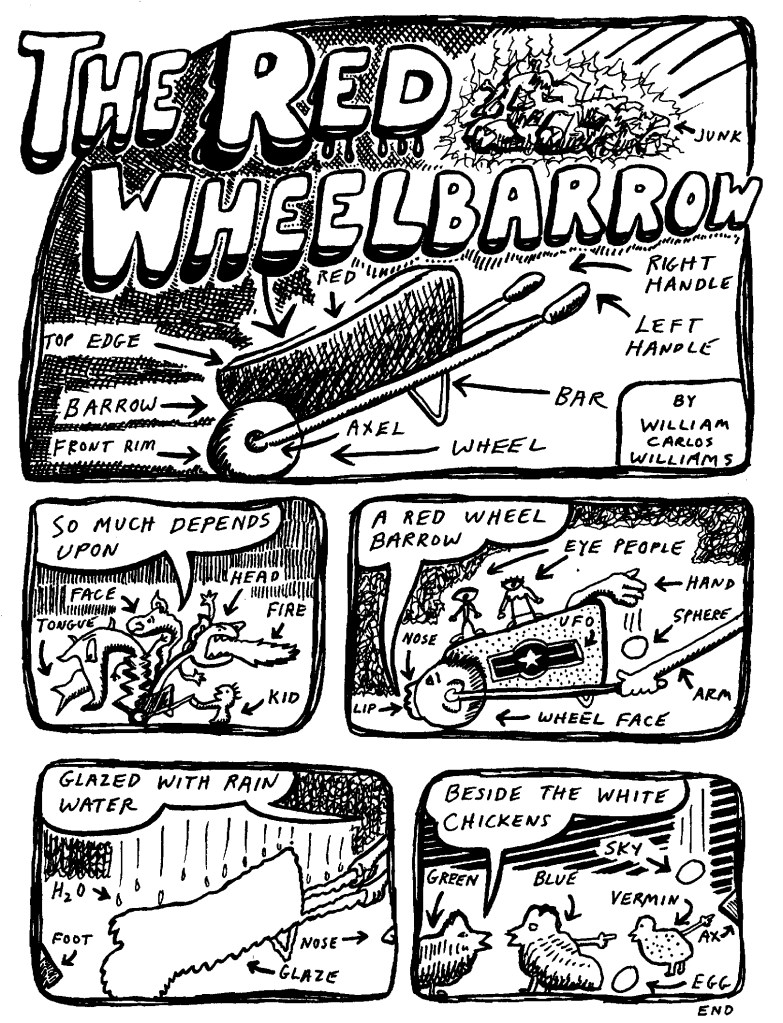
Here’s one example of Morice’s poetry comics:

from Poetry Comics: A Cartooniverse of Poems by Dave Morice (Simon and Schuster, 1985)

Timeline: 1979 – so far, first documented use of the term “poetry comics”

Warning: This incomplete history maps my journey as a poet learning about comics and doesn’t follow a strict chronological order.
A History of Poetry Comics

first-known, published haiku comic!

Among the many genres of poetry, haiku (the short poem that originated in Japan) is well suited to comics. Generally (and perhaps stereotypically), haiku speak to one moment, use just a few words to communicate an idea, and often make a (meta) leap between lines (or after grammatical marker). These traits lend themselves to techniques often used in comics — short dialogue (often contained in speech bubbles), a shift between panels (a different perspective or point of view, for example), and the punchline (prevalent in daily comic strips).

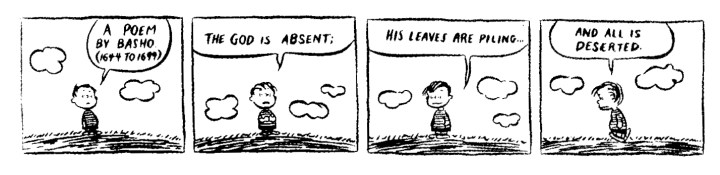
Definitely one of the earliest haiku comics was by Seth, the Canadian cartoonist known for his series Palookaville. He used a well-known comic strip character to recite a haiku by the Japanese master Bashō, expressing it in the popular four-panel strip format:

by Seth, published in Drawn and Quarterly, Vol. 2, Issue 4 (1995)

Comics artist and poet David Lasky, who creates and teaches haiku comics as part of his repertoire, suggests this is probably the first haiku comic, writing:

My first experience of a haiku comic was probably Seth’s short comic of Linus, from ‘Peanuts,’ illegally but respectfully reciting a poem by Bashō in four panels. The poem appeared as a ‘topper’ above Seth’s one-page comic, ‘Good Grief,’ in the Drawn and Quarterly anthology, Volume 2, Issue 4, in 1995. When I first saw that tiny, fake ‘Peanuts’ strip, a small electrical charge went off in my brain and I knew I needed to learn who this Bashō person was.

Source: David Lasky in his Introduction to Less Desolate by Shin Yu Pai and Justin Rueff

In a 2006 interview with Marc Ngui in Carousel 19, Seth says :

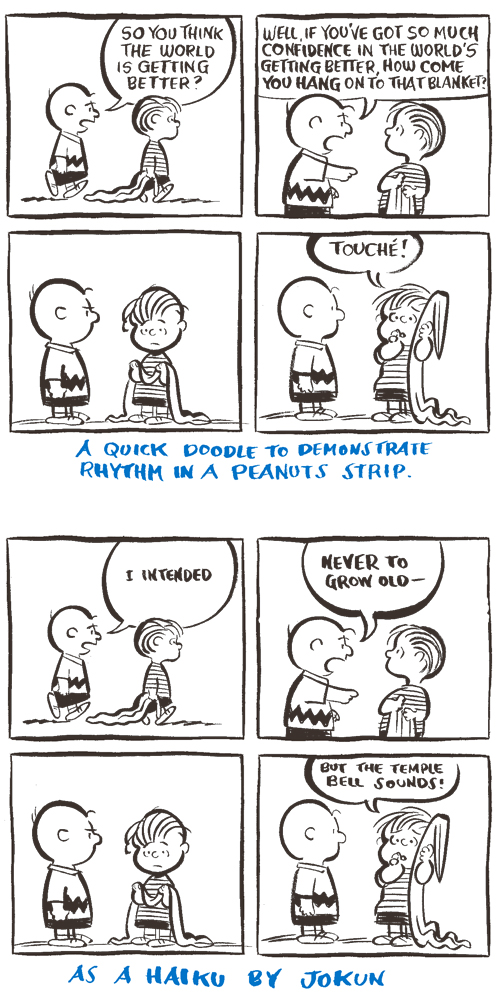
“I have felt, for some time, a connection between comics and poetry. It’s an obvious connection to anyone who has ever sat down and tried to write a comic strip. I think the idea first occurred to me way back in the late 80’s when I was studying Charles Schulz’s Peanuts strips. It seemed so clear that his four-panel setup was just like reading a haiku; it had a specific rhythm to how he set up the panels and the dialogue. Three beats: doot doot doot— followed by an infinitesimal pause, and then the final beat: doot. Anyone can recognize this when reading a Peanuts strip. These strips have that sameness of rhythm that haikus have— the haikus mostly ending with a nature reference separated off in the final line.

Source:  “Poetry, Design and Comics: An Interview with Seth” by Marc Ngui in Carousel 19 (Spring-Summer 2006) [archived PDF]

Accompanying that interview was this example by Seth:

*Full disclosure: My teacher and friend David Lasky continues to be instrumental in shaping this “A History of Poetry Comics” blog with tips, insights, and suggestions. In this case, his research has led to Seth as the creator of the first haiku comic. This poet hasn’t found any earler examples of haiku comics. So be it.

Timeline: 1995 (the first haiku comic)

Warning: This incomplete history maps my journey as a poet learning about comics and doesn’t follow a strict chronological order.

A History of Poetry Comics

book reviewS – recent collaborations

Collaboration has a long history in American comics. Until the underground comix movement in the 1960s and 1970s, a team of writers and illustrators was the norm (the team also often included support from an editor, penciler, inker, colorist, and letterer). Perhaps the most (in)famous duo is Stan Lee (writer/editor) and Jack Kirby (comics artist) and their work at Marvel Comics. The tradition continues today but with a more equitable and transparent sharing of credit.

Collaborations between poets and artists have shown up in poetry comics since at least the early 1960s. Just three examples: Poet/artist Joe Brainard creating comics collaborations (often featuring Nancy) with poets Ted Berrigan and Ron Padgett (see History of Poetry Comics #08). KAPOW! zine pairing spokenword poets with cartoonist in the late 1990s (see History of Poetry Comics #16.) And poetry comics creator Bianca Stone illustrating Anne Carson’s translation of Antigonick by Sophokles in 2012 (see History of Poetry Comics #04.)

Here are two recent noteworthy collaborations between poet and comics artist.

THE STONEWARE JUG

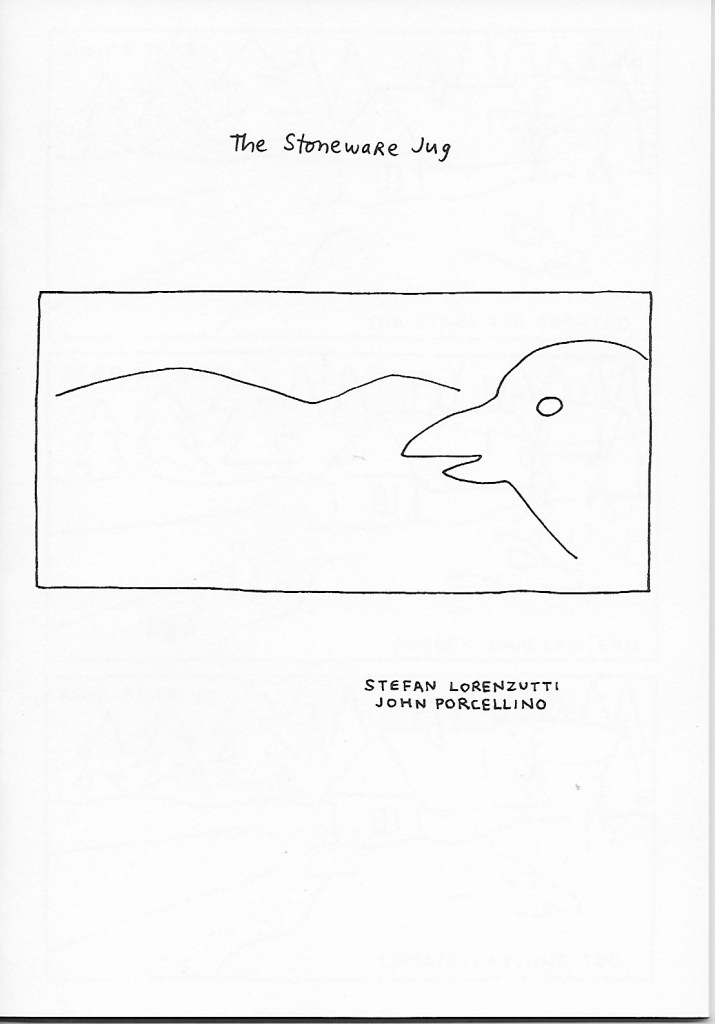
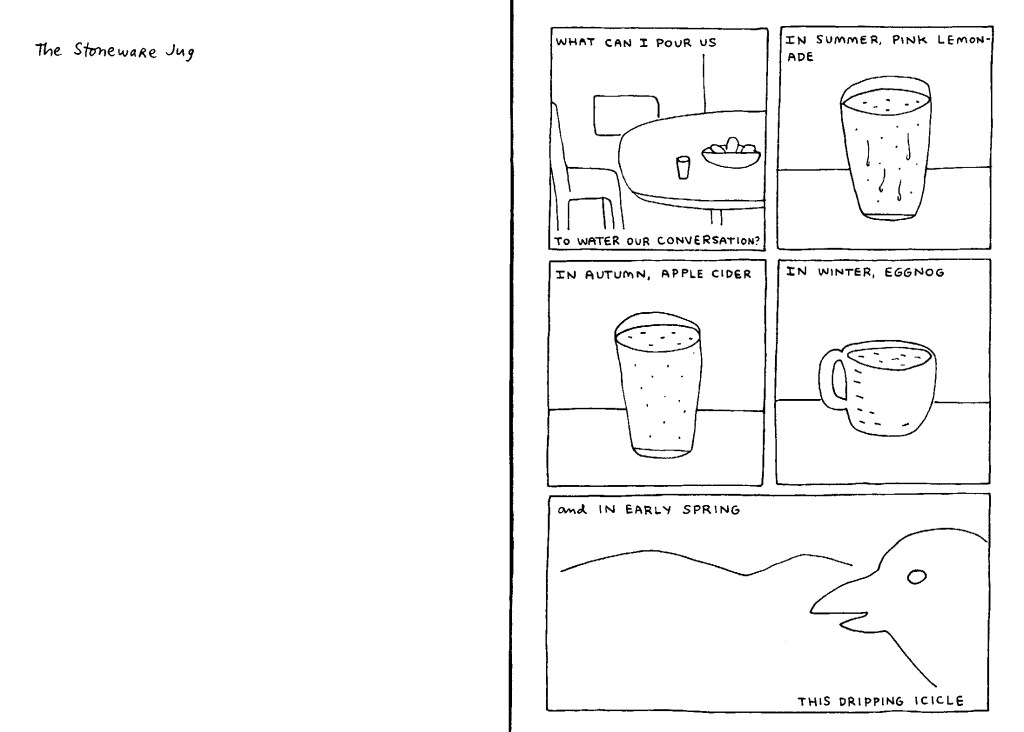
The Stoneware Jug by Stefan Lorenzutti (words) and John Porcellino (pictures) (Nieves, Bored Wolves, and Spit and a Half, 2022). In this collection of poems illustrated with 1- to 6-panel, 1-page comics, Stefan Lorenzutti provides simple, direct poems about being cold, the end of winter, and memories of (seemingly) empty places. Titles include “The Iceberg,” “When I Lived in Krakow,” and “On a Night of Cruel Frost.” The 13 poems in the collection are perfectly illuminated by John Porcellino in the simple, direct line drawings that he’s known for. Here’s the title poem from the collection:

from The Stoneware Jug by Stefan Lorenzutti and John Porcellino.

LESS DESOLATE

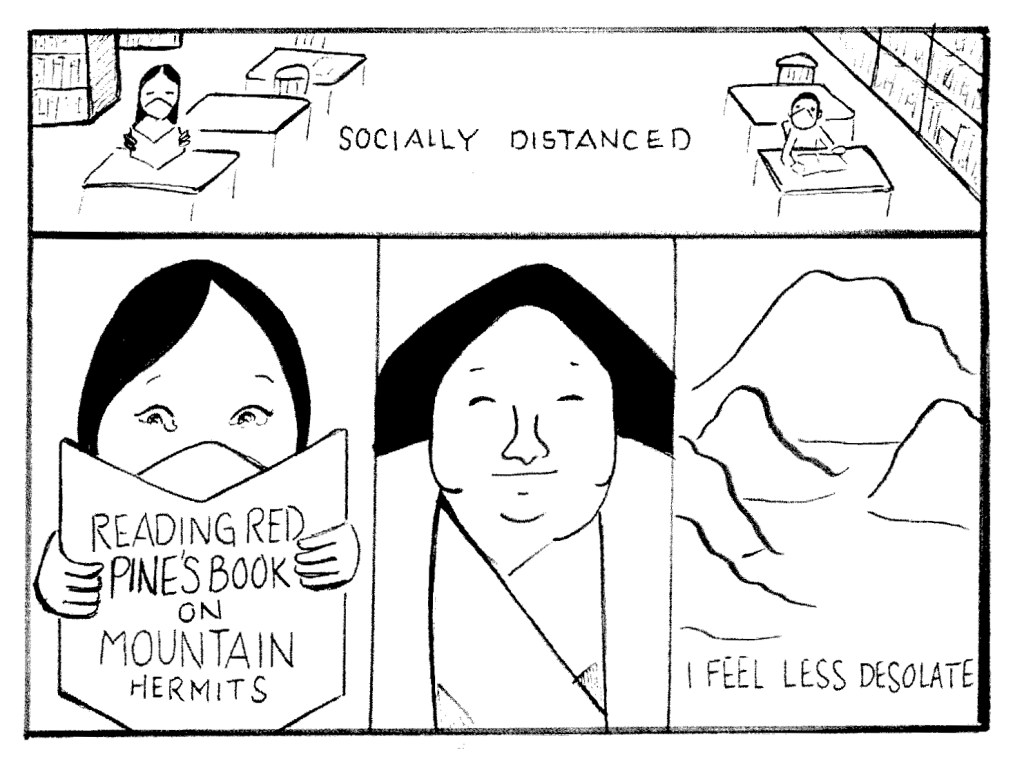
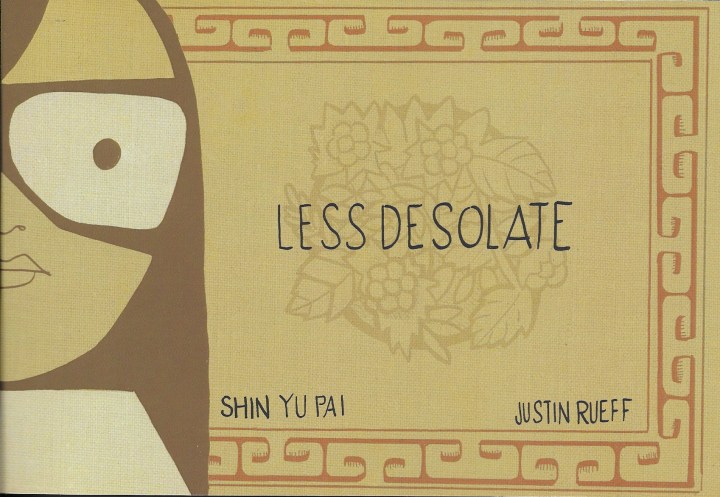
Less Desolate by Shin Yu Pai (haiku) and Justin Rueff (illustrator) (Blue Cactus Press, 2023). Poet/artist/podcaster Shin Yu Pai collects haiku she wrote during the pandemic, including the concurrent social unrest and her personal search for being present. Her haiku flow from rituals to yoga, from social distancing to social justice, and from being at home to being part of a wider community and world. The haiku are minimal yet pack a lot of meaning in a few words (12 words or fewer in most cases). Justin Rueff provides comics-inspired illustrations ranging fron 1 to 4 frames for the 1-page haiku comics, giving us just the right amount of context — and occasionally a touch of color. Here’s the title haiku comic from the collection:

from Less Desolate by Shin Yu Pai and Justin Rueff

Timeline: Current (2022-2023)

Warning: This incomplete history maps my journey as a poet learning about comics and doesn’t follow a strict chronological order.
A History of Poetry Comics

the haiku comics of matt madden

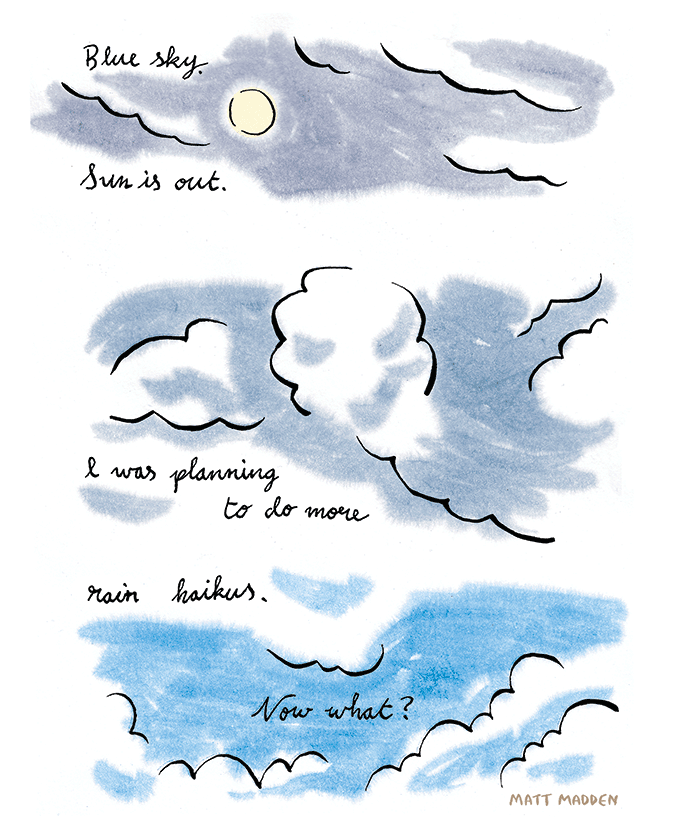
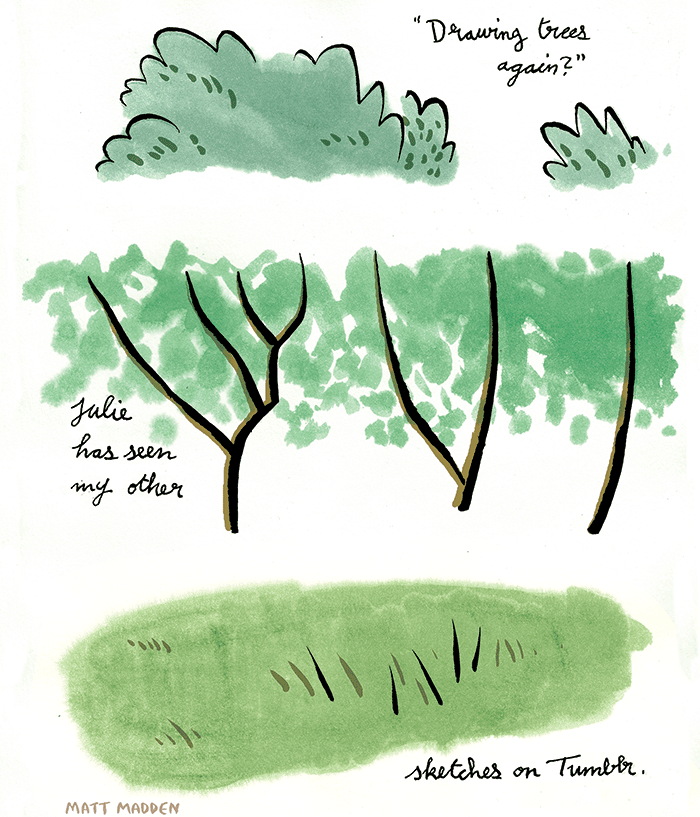
Comics artist Matt Madden, known for his  99 Ways to Tell a Story (Penguin, 2005), has created haiku comics that capture the simplicity of both pictures and words.

His use of color perfectly underscores the haiku and illuminates it in a way that adds to its meaning. He mostly uses thirds for his layout which aligns with the 3-linw break of what’s become English-language haiku style. While the image may follow the three-lines “rule” his text breaks into smaller lines (while maintaning the 5-7-5 syllable count across the lines).

In the examples below, he foregoes frames, using white space and color to beautifully define the haiku count.

There’s so much to admire about these – their simplicity foremost. Also, they’re unique in their approach. (For compare/contrast, see the haiku comics of Susanne Reece, featured in AHOPC #11.) The implied panels as the haiku moves down the page work really well. They’re humorous and current. And they’re a direct reflection of the poet’s mind. For me, they’re the perfect examples of what poetry comics can and should do.

Timeline: Current  

Warning: This incomplete history maps my journey as a poet learning about comics and doesn’t follow a strict chronological order.
A History of Poetry Comics

musings on words + pictures by R.H. Blyth

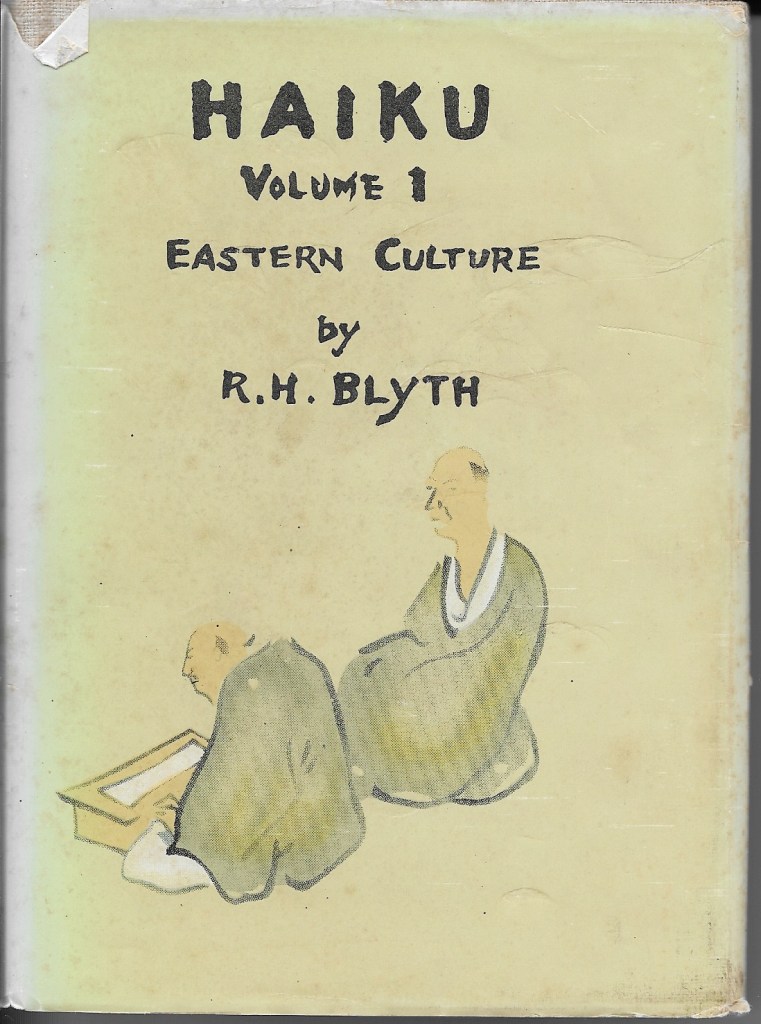
Here’s some found text that provides additional thoughts on words and pictures from R.H. Blyth in the classic Haiku Vol. 1 Eastern Culture published in 1949.

Although Blyth is discussing painting and poetry in context in terms of Japanese haiga – brush paintings that illuminate a poem, often times a haiku (first discussed in AHOPC #03) – I think it’s relevant to poetry comics. His comments support my belief that drawing and writing together can illuminate and transcend what they can’t always accomplish singularly. (See also “What are poetry comics” in AHOPC #05.)

Haiku Volume 1 Eastern Culture by R.H. Blyth (Hokuseido, 1959)

The qualities of haiga are rather vague and negative. The lines and masses are reduced to a minimum. The subjects are usually small things, or large things seen in a small way. The simplicity of the mind of the artist is perceived in the simplicity of the object. Technical skill is rather avoided, and the picture gives an impression of a certain awkwardness of treatment that reveals the inner meaning of the thing painted.

pp. 89-90

Applied to poetry comics: The simplicity and directness of comics and line drawings are perfectly aligned with poetry, even more so with the “small” haiku. Comics – underground comics especially – often celebrate the honest, the real, the creative over the technical skills of the artist/poet. Words and drawing together can transcend inherent limitations of each.

The combination of haiku and haiga is perhaps the most important practical question. One may spoil the other; but in the case of a complete success, how does one help the other? There seem to be two main ways of doing this. The haiga may be an illustration of the haiku, and say the same thing in line and form; or it may have a more independent existence, and yet an even deeper connection with the poem.

p. 90

Applied to poetry comics: This aligns with what Scott McCloud lists in his classic Understanding Comics (William Morrow, 1993) as categories for “the different ways in which words and pictures can combine in comics:” Word specific (illustrative); picture specific (words add a soundtrack); duo specific (words and pictures say the same thing); additive; parallel (words and pictures follow very different courses); montage; and interdependent (“words and pictures go hand-in-hand to convey an idea that neither could convey alone”). (See pp. 152-155.) The last three are closest to what Blyth calls independent existence and can express something neither could do on their own.

Art comes down to earth; we are not transported into some fairy, unreal world of pure aesthetic please. The roughness gives it that peculiar quality of sabi without age; unfinished pictures, half-built houses, broken statuary tell the same story. It corresponds in poetry to the fact that what we wish to say is just that which escapes the words. Haiku and haiga therefore do not try to express it, and succeed in doing what they have not attempted.

p. 104

Applied to poetry comics: Comics are down-to-earth and can make even the most difficult topics accessible. Comics span decades and can still hold an audience (e.g., Peanuts). Poetry can convey difficult or sublime concepts in just a few words. Poetry too can move through generations. Words and pictures together, as in poetry comics, open up the possibility for “yet an even deeper connection.”

Timeline: Prehistory

Warning: This incomplete history maps my journey as a poet learning about comics and doesn’t follow a strict chronological order.
A History of Poetry Comics

kapow! paired poets with cartoon artists

I admire zinesters on many fronts. Their DIY attitude. Their willingness to work outside traditional publishing and distribution channels. Their strong sense of community. Their courageous sharing of what catches their attention or what they’re obsessing on. And always, their ideas.

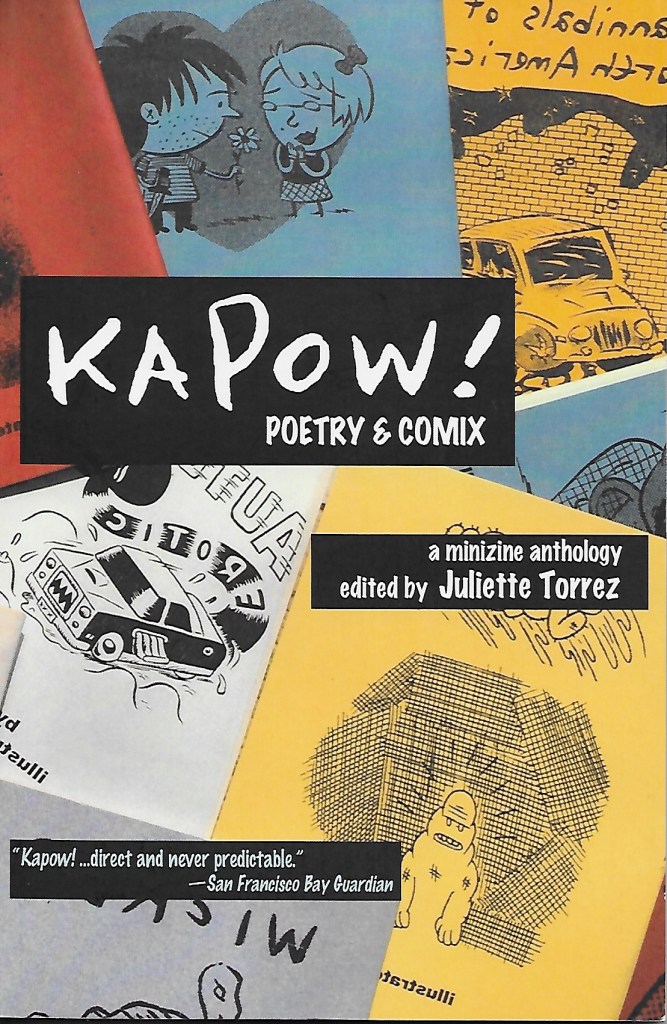
So it was soul-affirming to be led to Juliette Torrez and her idea to match slam poets’ work with comic artists’ drawings. She published these match-ups originally in her hand-stapled zine (are there any others?) Kapow! in the late 1990s. Eventually these collaborations (or actually illuminated poems) were collected in Kapow! Poetry & Comix (Manic D Press, 2017).

Kapow! Poetry & Comix, edited by Juliette Torrez (Manic D Press, 2017)

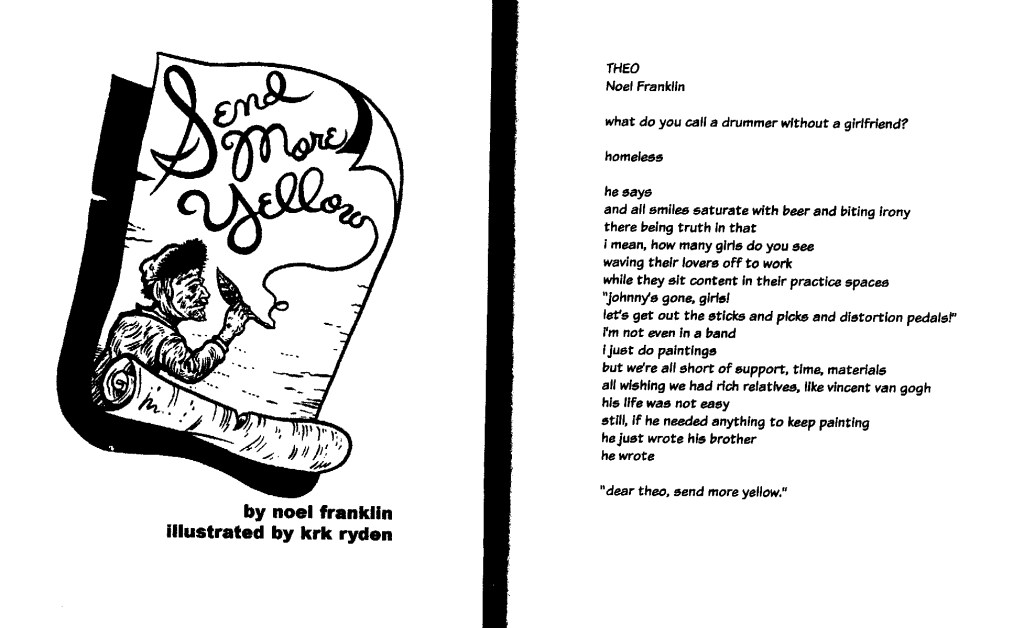
Here are a couple of examples from the anthology. (Both are facing pages.)

From Kapow! Poetry & Comix (Manic D Press, 2017)

The matches made here are right on thanks to Torrez’s knack for pairing the right comics artist with the right spoken word poet. These pairings showcase the edginess/ directness/ openness of the work in a way that goes beyond illustration. The comics provide context, a moment in time, new ways to consider the text, and a willingness to accept outside influence.

Collaboration between artists and writers has been a part of the comics canon almost since the beginning of comic books (e.g., perhaps most famously, Stan Lee and Jack Kirby). Zine culture – and Kapow! specifically – gave it an updated twist. More on collaboration in a future AHOPC.

Timeline: 1990s

Warning: This incomplete history maps my journey as a poet learning about comics and doesn’t follow a strict chronological order.
A History of Poetry Comics

Porcellino on connection between poetry and comics

John Porcellino is one of my comics heroes and major inspiration when I started drawing. His cartoons done in black lines are direct, uncluttered, achingly beautiful simple. His style is perfectly matched to the directness of his narratives, thinkings, observations, and poetry. He’s known for his King Cat Comics, which he has self-published since 1989 and have been reissued as collections. Among these pages are gems of poetry comics, many evoking haiku.

In an April 2018 interview with The Herald, Porcellino talks about the connection between poetry and comics: Comics, especially self-published comics, broke down the barriers between artist and audience the way punk rock did. It allowed for a more direct connection. / Many cartoonists note the similarities between comics and music, which I agree with. In the same way, there are similarities between comics and poetry. As I mentioned, I’ve studied and written poetry throughout my life – it has always been a creative part of me. / Somewhere around the late nineties I started to more consciously begin to integrate my comics with my poetry. Around this time, many of my comics began life as straight poems – text on a page in poetic form – that I adapted into comics.

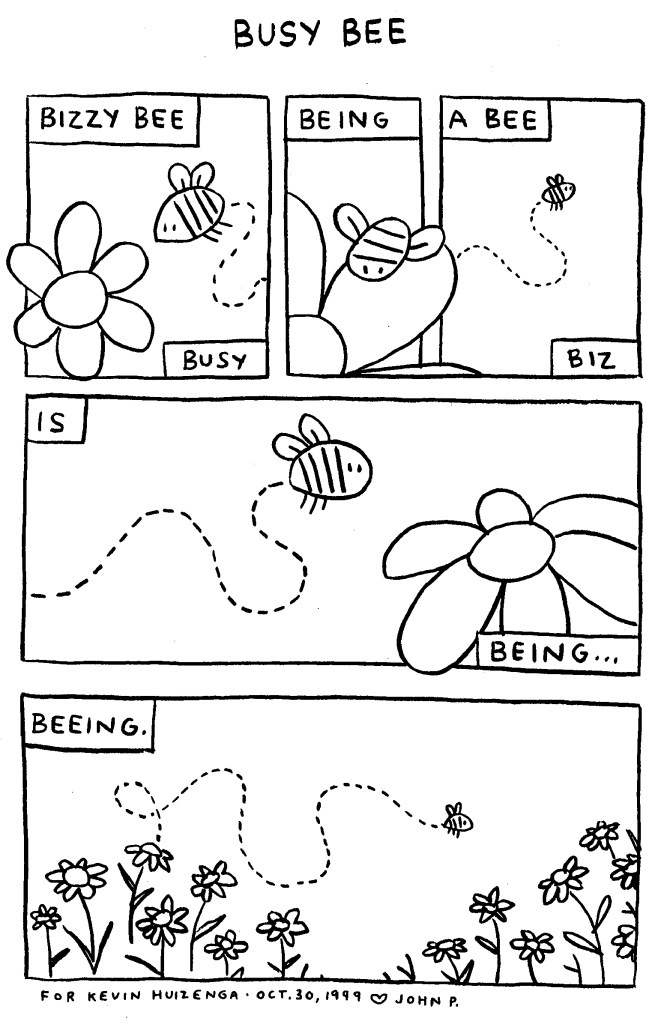
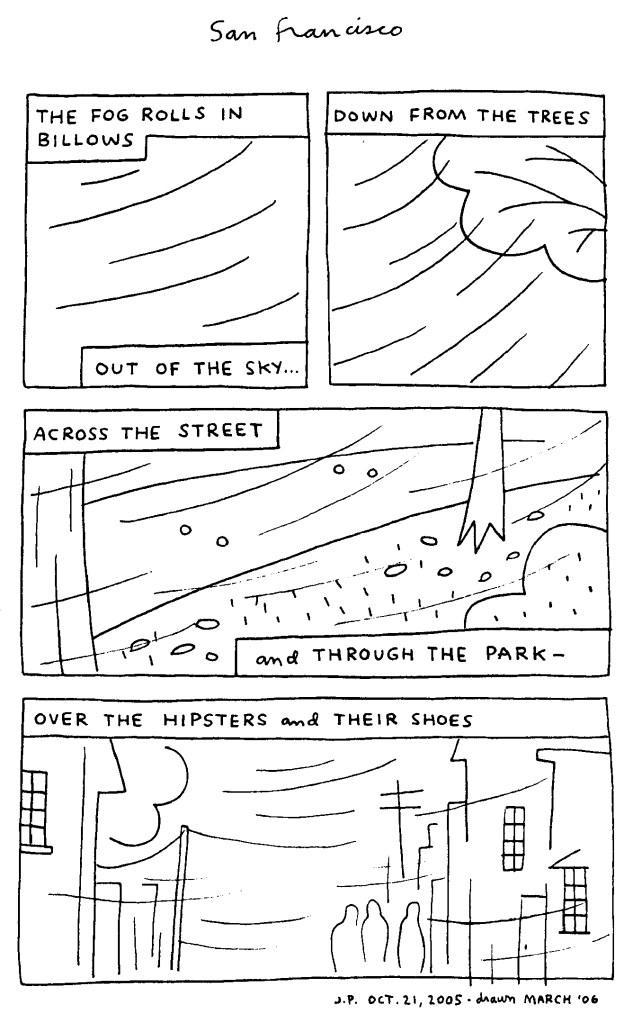
There are way too many to share all my favorites, so here are just two of his poetry comics:

“Busy Bee” collected in “Map of My Heart – Best of King Cat Comics & Stories 1996-2002” (Drawn and Quarterly 2009)
“3 Poems about Fog – San Francisco” collected in “From Lone Mountain – King Cat Comics and Stories 2003-2007” (Drawn and Quarterly 2018)

Both of these poetry comics perfectly capture small moments – just enough words with the right accompanying drawings – balanced – leaving us simply to hear the bee and feel the fog.

Porcellino’s website KING CAT COMICS is where you’ll find more about his world. Check it out!

Timeline: 1989-Present

Warning: This incomplete history maps my journey as a poet learning about comics and doesn’t follow a strict chronological order.
A History of Poetry Comics

Book review – illuminated poems of moni-sauri

Book review: “From the Shore” by Alex Moni-Sauri (Gasher Press, 2020)

Throughout From the Shore, Alex Moni-Sauri’s drawings perfectly complement her handwritten poems adding illumination, punctuation, and thoughtful pauses. Artfully and simply, the poet/artist uses line drawings and squiggles to explain and expand the meaning of her poems.

Her drawings – I should say, cartoons – wouldn’t be out of place in the New Yorker. Whole panels stand alone at times as a kind of coda to the proceeding poem. My favorite poems/panels in the collection are ones where the words and drawings are integrated. The street lamp accompanying “Late from Work” (see below). The horizon line with the sun barely rising/setting in “From the Shore.” The lines of poetry with no distinction from the lines of the sea in “Wet Morning.” The security camera aimed at the poem in “Scene at the Mall.” There are more.

Her poems in this collection are mostly set outside. There are beaches, shorelines, barren (i.e. treeless) landscapes, ocean (which appears to be engulfing the poem), sky, manicured lawns, strata, power lines, and birds, which appear throughout these poems. Even when showing an interior space, like a room, birds are present, as in “Vulcan City” where the poems goes: Crows pass by like arrows / between buildings / that were dropped from air. And there’s the bird on a string hanging from the top frame of the cartoon in “A Thank You to the Empty Land.”

Late from Work - Alex Moni-Sauri
“Late from Work” by Alex Moni-Sauri from “From the Shore” (Gasher Press, 2020)

In an interview with Gasher Press, Moni-Sauri shares her approach: “Making poems and making drawings are distinct processes for me, although they talk to each other a lot. Using the same medium (pen and paper) for both connects them in a basic way, and my writing and drawings always exist in the same sketchbooks no matter how much I try to designate separate spaces for them. But in the end it is much more curatorial, or like collage.”

Find more images of her work on her Instagram page.

Timeline: 2020

Warning: This incomplete history maps my journey as a poet learning about comics and doesn’t follow a strict chronological order.
A History of Poetry Comics

poetry comics of bp Nichol (part 2)

(Our first two-parter! bpNichol continued …)

There’s so much more to blow your mind about the poetry comics of bpNichol.

Nichol brought his obsession with language and words to his comics and drawing. One of the restraints of comics Nichol explored was frames (see AHOPC #12). Drawing also gave him a way to make words tangible for the reader. He’s quoted in the introduction for bpNichol Comics (Talonbooks, 2002): “how can the poet reach out and touch you physically as say the sculptor does by caressing you with objects you caress?”

To that end, he found ways to incorporate letters, the alphabet, and words into his drawings and comics – blurring the line between pictures and words. Here are examples of Nichol’s use of letters/lettering in his art.

Frame 3 by bpNichol originally from love: a book of remembrances (1974) reprinted in a book of variations (Coach House Books, 2013)
Allegory #1 by bpNichol originally from love: a book of remembrances (1974) reprinted in a book of variations (Coach House Books, 2013)
Sixteen Lilypads by bpNichol originally from art facts (1990) reprinted in a book of variations (Coach House Books, 2013)
Unititled by bpNichol originally from art facts (1990) reprinted in a book of variations (Coach House Books, 2013)

I admire the wit and the humor in these poems. A comic written with just words and a horizon line. Is the Z missing or is the Z sleeping? The erasure of the word frog until we’re left questioning (did we even see a frog?). The witty homage to Basho’s famous haiku (old pond / a frog jumps in / splash!) where you can also see the motion.

bpNichol makes us think about poetry and comics differently. He adeptly used the two to create something new. Fusing words and pictures, he found ways to transcend both.

Recommended: Lots more to explore in the bpNichol Archives.

Timeline: 1960-1980+

Warning: This incomplete history maps my journey as a poet learning about comics and doesn’t follow a strict chronological order.