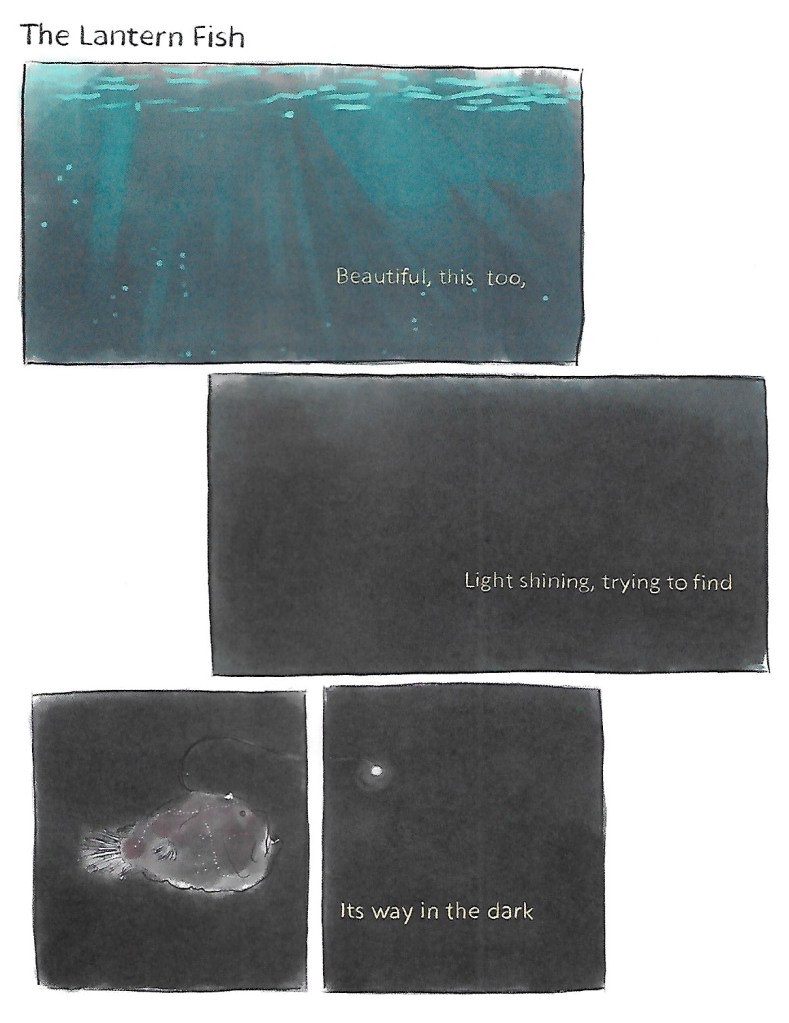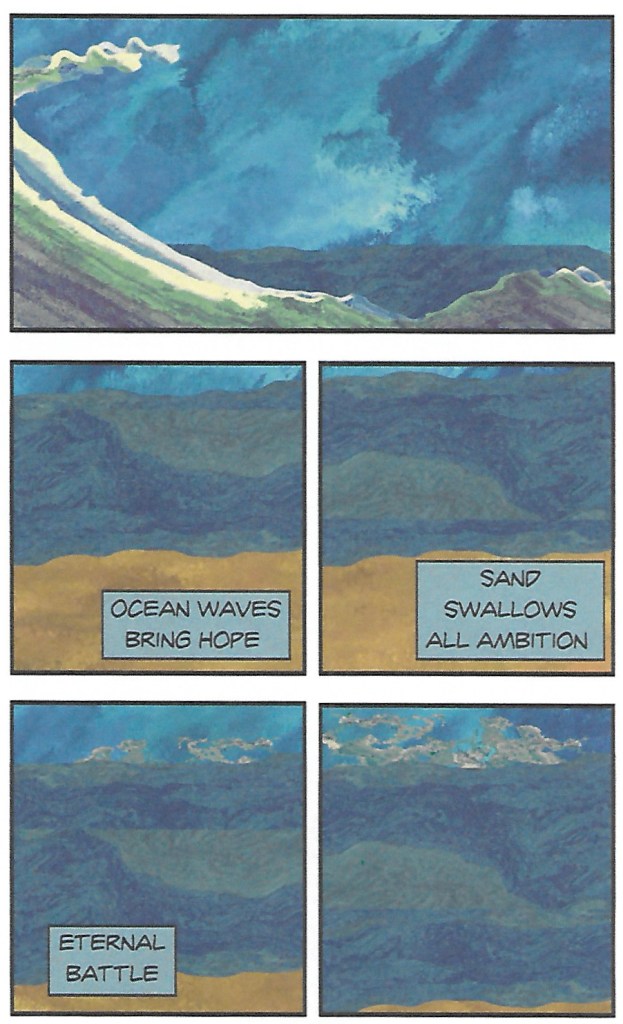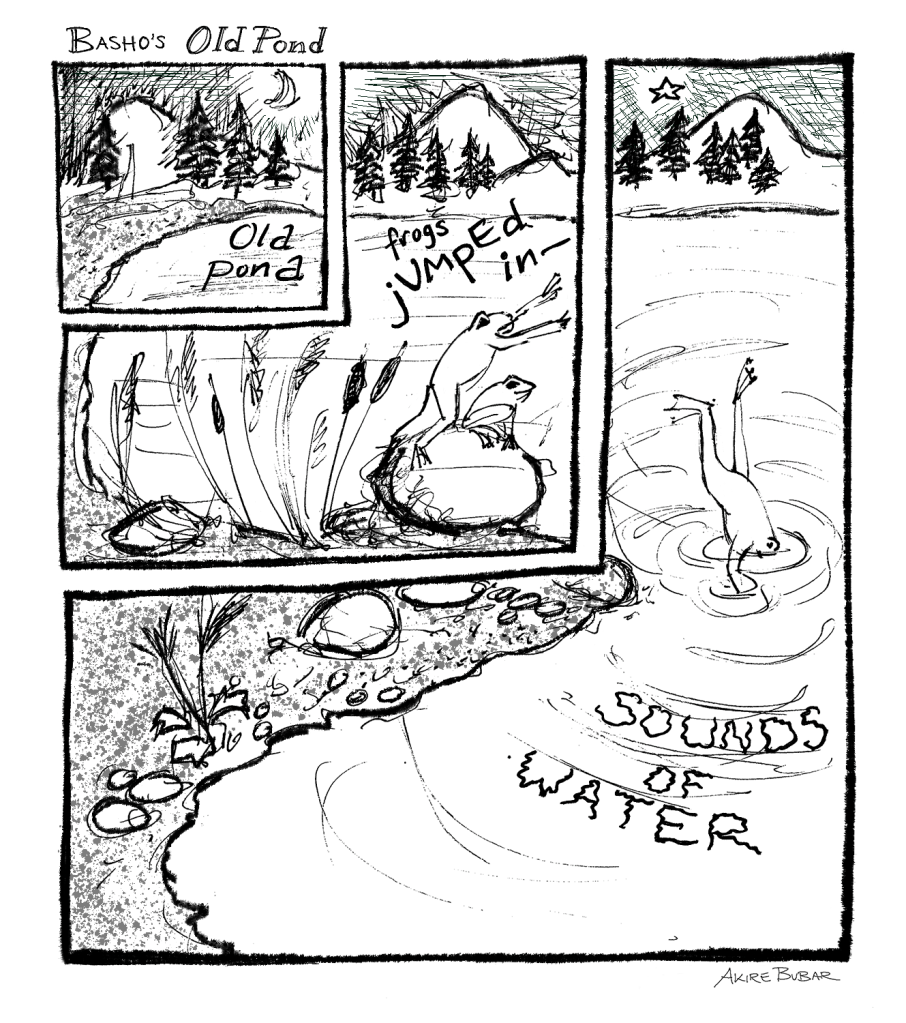
A History of Poetry Comics

THE BOOK of Death Haiku Comics

Haiku comics are a relatively new development in the history of poetry comics. While a scattering of forerunners can be found in the 1970s and 1980s, we consider the first haiku comic to be a four-panel rendering of a Basho haiku by the Canadian comics artist Seth published in Drawn & Quarterly in 1995. (See AHOPC #21 for a closer look at this.) Since then there has been markedly more comics artists/poets creating haiku comics.

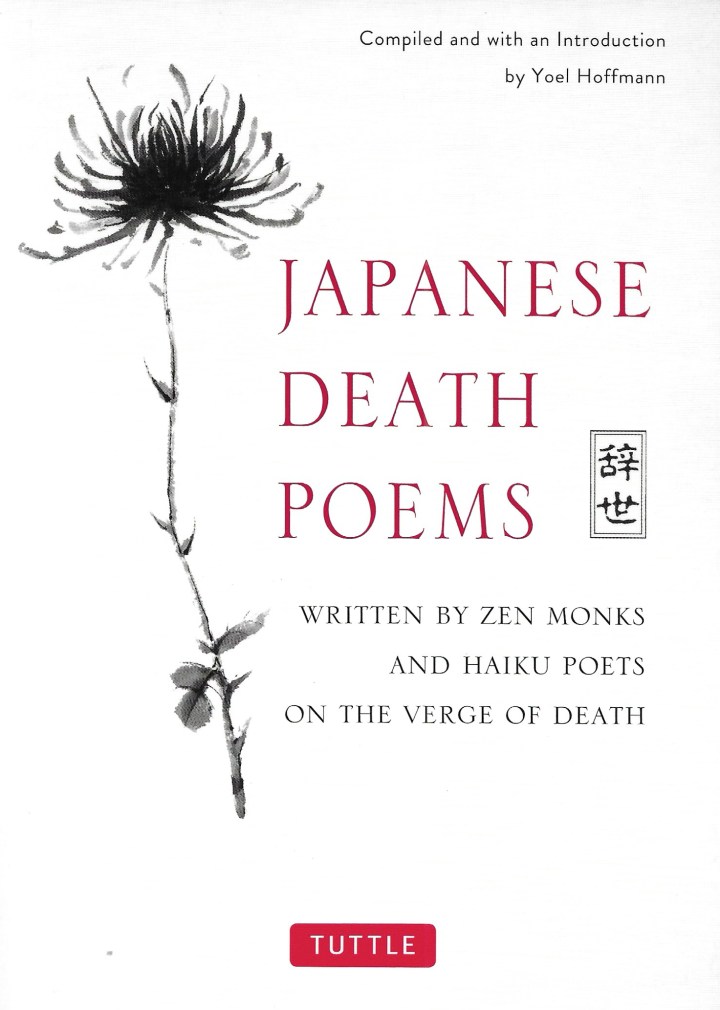
Cover of Japanese Death Poems compiled by Yoel Hoffman

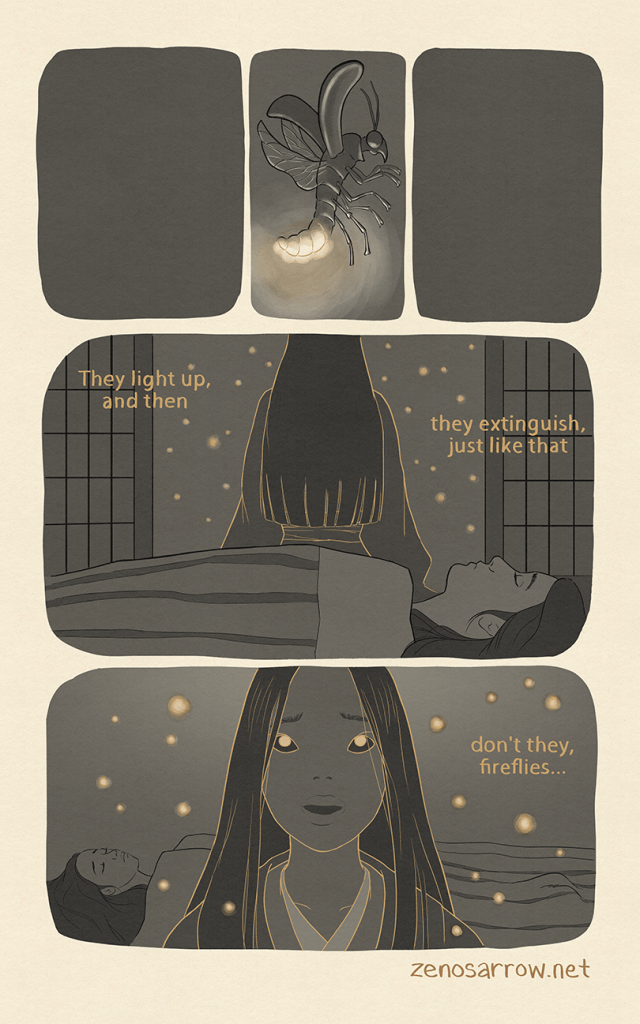
Joining the movement is Seattle artist/writer William Chen, whose new work is The Book of Death Haiku Comics. Using as a resource Japanese Death Poems (Tuttle, 1986) compiled by Yoel Hoffman, Chen has made his own translations to which he adds skillfully executed drawings that feel like a whole graphic novel in one page.

Chen talks about his project: “Jisei, which come from Japan, are poems written on the occasion of one’s own death. I don’t remember how I stumbled on them, but when I did, death haiku immediately struck me as a fascinating subject for interpreting and illustrating as poetry comics.”

Chen lived in Otsu, Japan (just a 10-minute, local train ride from Kyoto) for about a year. He made a living teaching at an English conversation school to people of all ages. While there he saw sites, studied Japanese, and learned to Pop (Popping, the dance style).

Here’s one example from his forthcoming chapbook:

ChinE’s Fleeting Fireflies

For a copy of “The Book of Death Haiku Comics” visit his table at Short Run (Nov. 1, 2025, in Seattle). After that, you can go to Chen’s Ko-Fi store here. He will also have copies in a few local comic shops around Seattle (Fantagraphics, Phoenix, Outsider).

Follow Chen on Bluesky @zenosarrow.net.

READ MORE: I came across “Japanese Death Poems” in 2006. I was staying with a poet-friend in San Francisco while doing readings for “Punk Poems,” and he had a copy in his library. I couldn’t put it down and had to get my own copy so I could finish consuming it. Hoffman’s background introduction is essential. The poems are in two large sections: Death Poems by Zen Monks and Death Poems by Haiku Poets. And the Index of Poetic Terms at the end of the book provides additional context and cultural insights. Recommended.

Timeline: 2025

Warning: This incomplete history maps my journey as a poet learning about comics and doesn’t follow a strict chronological order.
A History of Poetry Comics

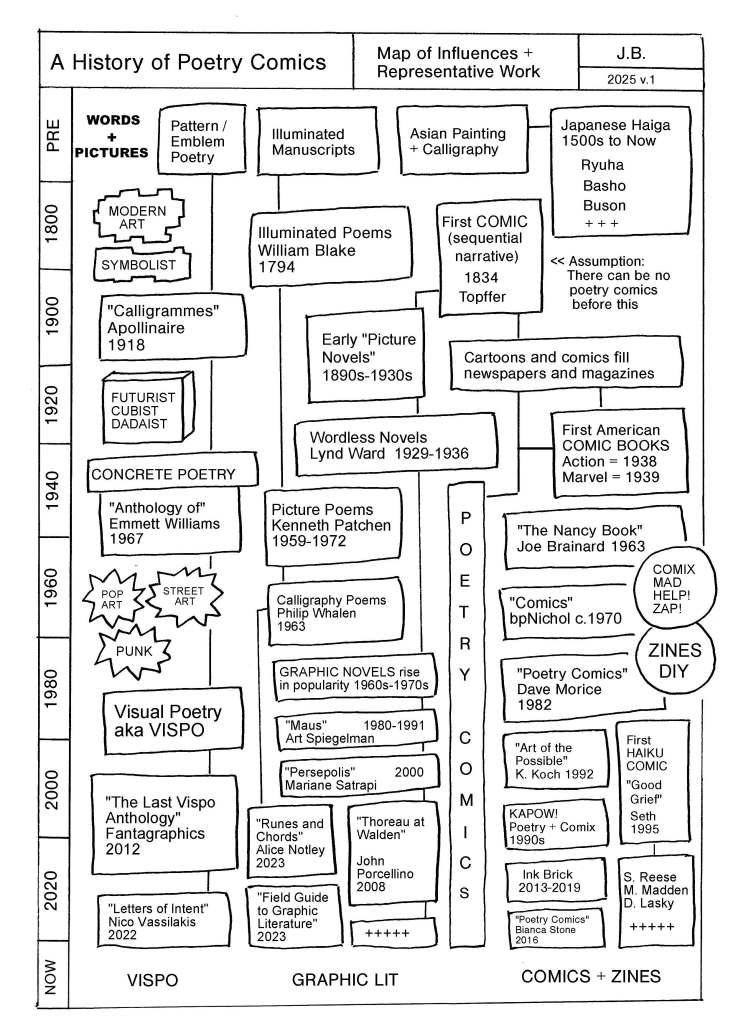
A Map of Roots & Influences


Poetry comics and haiku comics are a relatively new development in the historical context of artists and writers using words and pictures together to create meaning deeper than either could do on its own.

Historical roots can be traced back centuries to pattern poems and illuminated texts in Europe and calligraphic pictures and poems in Asia, Japanese haiga for example. By the 1800s painters and poets were looking at things differently and becoming more experimental and more accepting of non-traditional influences. This led to the concrete poetry movement in poetry and the pop art aesthetic in painting.

Comics, which can be defined as drawings that tell a sequential narrative, started in the (mostly agreed to) 1870s. The rise of comics and comic strips, which were going full bore by the 1940s in newspapers and magazines, provided source materials for poets and artists who used influences from comic book aesthetics, comic strip characters, and comics’ mechanics.

Poetry comics, a term finally coined in the 1970s, have continued through today, running parallel with the mainstream acceptance and interest in graphic literature, DIY, and zines. Haiku comics, starting around 1995 as a natural outgrowth of poetry comics, have been recently popularized by poets/comic artists.

I’m sharing the first draft of my map of “A History of Poetry Comics” that attempts to show related roots, influences and representative practitioners of poetry comics. While definitely not definitive, hopefully it will serve to illuminate and inspire further investigation. This is what I’ve learned so far.

Timeline: 2025

Warning: This incomplete history maps my journey as a poet learning about comics and doesn’t follow a strict chronological order.
A History of Poetry Comics

Naming Poetry Comics

“Rose is a rose is a rose is a rose.” -Gertrude Stein

Although labeled differently by poets, artists, and historians, work that investigates the relationship between pictures and words (i.e. drawing and poetry) strives for the same result: create meaning that’s not possible with words or pictures alone.

Here are terms “A History of Poetry Comics” has uncovered that each point in their own way to the practice of incorporating words and pictures into art.

TermRepresented byTimeline
haiga (Japanese haiku drawings)Bashō, Buson1500s on
illuminated poemsWilliam Blake1780s
sequential narrativesRodolphe Topffer1830s
comic books, comic strips, comics Various*1890s-1930s
pictorial prose poems (without words)Lynd Ward1930s
picture poemsKenneth Patchen1940s-70s
concrete poems –> vispo (visual poetry)Augusto deCampos,
Nico Vassilakis
1950s-70s on
graphic novelscoined by Richard Kyle1960s
hand-drawn poemsbpNichol1970s
poetry comics (drawings w/ other’s poems)Coined by Dave Morice1980s
comics mainly without picturesKenneth Koch1990s
haiku comicsSeth1995
poetry comics** (drawings w/ own poems)Bianca Stone2010s
poem/drawingsAlice Notley2020s
graphic poetryNaoko Fujimoto2021

*A good starting point to get perspective on when these terms were first use is Wikipedia’s History of Comics. For U.S.-centric perspective, American Comics: A History by Jeremy Dauber (W.W. Norton & Co., 2022) comes recommended.

**See A History of Poetry Comics #05 for suggested ways to identify poetry comics.

Timeline: Pre-history to Current

Warning: This incomplete history maps my journey as a poet learning about comics and doesn’t follow a strict chronological order.
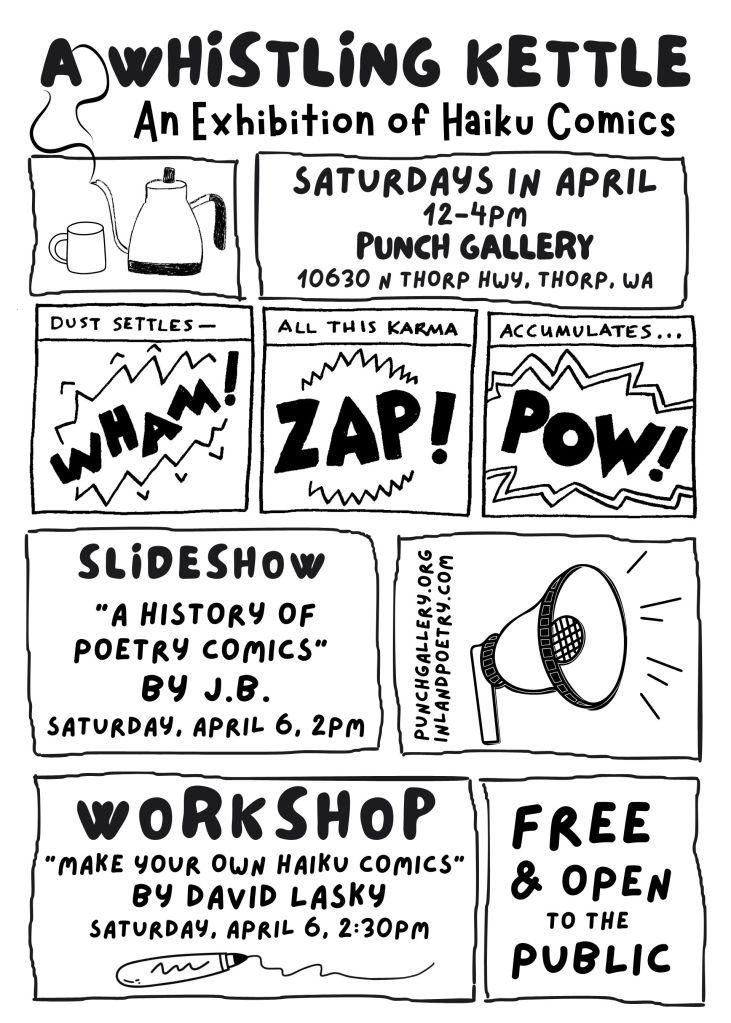
Curated by David Lasky and J.B., this exhibition features 22 poet-artists with 69 haiku comics.

Artist statement

“A Whistling Kettle: An Exhibition of Haiku Comics,” that I co-curated with David Lasky, provokes a mixed bag of feelings. It’s like when I heard the punk band Ramones broadcast on radio for the first time. And when I saw 1970s street art and graffiti were taken inside to be exhibited and sold in art galleries (RIP Keith Haring). And when I discovered I wasn’t the only angst-riddled teenager that read MAD magazine (thanks to my dentist’s office).

It’s feelings of disbelief that the things I identified with were now being mass marketed. Disappointment at losing another counter-culture fixture to the mainstream. But also pride that things I admire and worship were deemed worthy and valuable. In the end, this validation increased my hip credentials — I knew about an art movement, a music scene, a zine before a lot of others caught on.

We are all students and explorers. The haiku comics here are the direct result of classes taught by Lasky, a comics artist learning about haiku. I’m seeing first-hand, as a poet learning about comics (and trying some myself), the transformative power that pictures and words have together. (See the note on “Illumination” in A History of Poetry Comics #05, part of my attempt to define poetry comics.) I believe the best poetry comics create a third meaning that words or pictures can’t do on their own.

This show collects works that transcend what’s hung on the gallery wall. There are underscores and counterpoints. There are kireji (the “cut” in Japanese haiku) and kigo (the season word in Japanese haiku). There’s context, witnessing, confessions. There’s complexity and simplicity sometimes in the same work. And there’s illumination — that “third meaning” that happens when your mind jumps beyond the words and pictures.

For me, this show is validation of the exploration we poet-artists have been doing on the fringes of both comics and poetry. It expands the audience for our work. And it makes us feel (perhaps) a little less like outsiders.

Enjoy the hip credentials!

A History of Poetry Comics

first-known, published haiku comic!

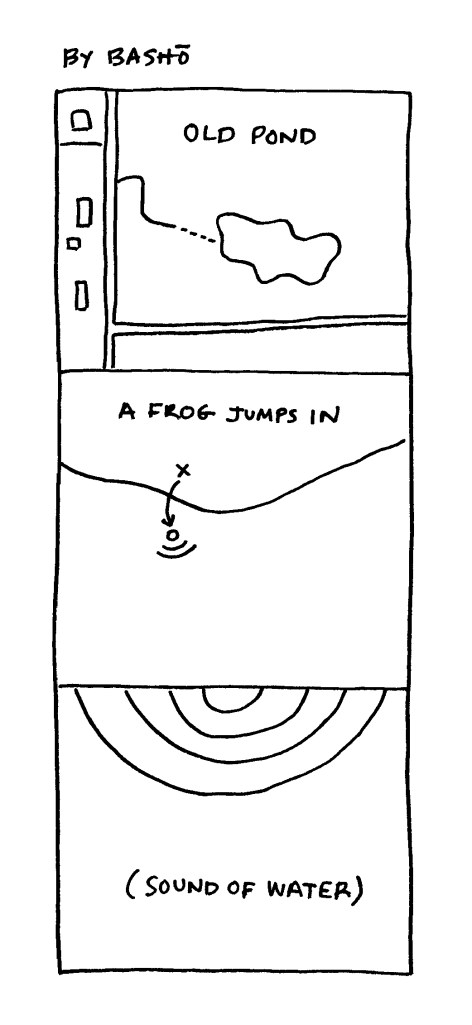
Among the many genres of poetry, haiku (the short poem that originated in Japan) is well suited to comics. Generally (and perhaps stereotypically), haiku speak to one moment, use just a few words to communicate an idea, and often make a (meta) leap between lines (or after grammatical marker). These traits lend themselves to techniques often used in comics — short dialogue (often contained in speech bubbles), a shift between panels (a different perspective or point of view, for example), and the punchline (prevalent in daily comic strips).

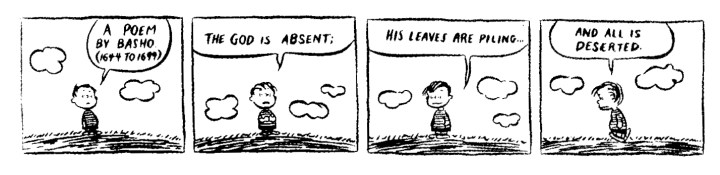
Definitely one of the earliest haiku comics was by Seth, the Canadian cartoonist known for his series Palookaville. He used a well-known comic strip character to recite a haiku by the Japanese master Bashō, expressing it in the popular four-panel strip format:

by Seth, published in Drawn and Quarterly, Vol. 2, Issue 4 (1995)

Comics artist and poet David Lasky, who creates and teaches haiku comics as part of his repertoire, suggests this is probably the first haiku comic, writing:

My first experience of a haiku comic was probably Seth’s short comic of Linus, from ‘Peanuts,’ illegally but respectfully reciting a poem by Bashō in four panels. The poem appeared as a ‘topper’ above Seth’s one-page comic, ‘Good Grief,’ in the Drawn and Quarterly anthology, Volume 2, Issue 4, in 1995. When I first saw that tiny, fake ‘Peanuts’ strip, a small electrical charge went off in my brain and I knew I needed to learn who this Bashō person was.

Source: David Lasky in his Introduction to Less Desolate by Shin Yu Pai and Justin Rueff

In a 2006 interview with Marc Ngui in Carousel 19, Seth says :

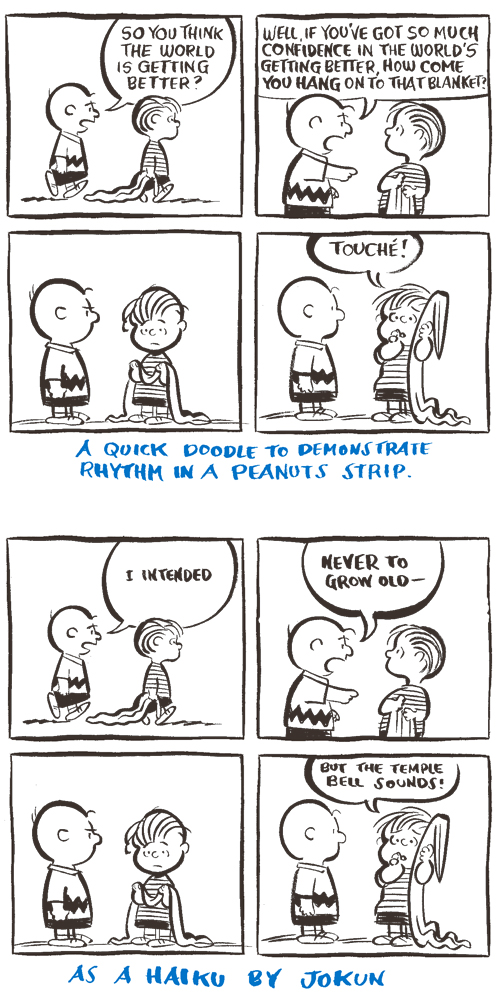
“I have felt, for some time, a connection between comics and poetry. It’s an obvious connection to anyone who has ever sat down and tried to write a comic strip. I think the idea first occurred to me way back in the late 80’s when I was studying Charles Schulz’s Peanuts strips. It seemed so clear that his four-panel setup was just like reading a haiku; it had a specific rhythm to how he set up the panels and the dialogue. Three beats: doot doot doot— followed by an infinitesimal pause, and then the final beat: doot. Anyone can recognize this when reading a Peanuts strip. These strips have that sameness of rhythm that haikus have— the haikus mostly ending with a nature reference separated off in the final line.

Source:  “Poetry, Design and Comics: An Interview with Seth” by Marc Ngui in Carousel 19 (Spring-Summer 2006) [archived PDF]

Accompanying that interview was this example by Seth:

*Full disclosure: My teacher and friend David Lasky continues to be instrumental in shaping this “A History of Poetry Comics” blog with tips, insights, and suggestions. In this case, his research has led to Seth as the creator of the first haiku comic. This poet hasn’t found any earler examples of haiku comics. So be it.

Timeline: 1995 (the first haiku comic)

Warning: This incomplete history maps my journey as a poet learning about comics and doesn’t follow a strict chronological order.
A History of Poetry Comics

book reviewS – recent collaborations

Collaboration has a long history in American comics. Until the underground comix movement in the 1960s and 1970s, a team of writers and illustrators was the norm (the team also often included support from an editor, penciler, inker, colorist, and letterer). Perhaps the most (in)famous duo is Stan Lee (writer/editor) and Jack Kirby (comics artist) and their work at Marvel Comics. The tradition continues today but with a more equitable and transparent sharing of credit.

Collaborations between poets and artists have shown up in poetry comics since at least the early 1960s. Just three examples: Poet/artist Joe Brainard creating comics collaborations (often featuring Nancy) with poets Ted Berrigan and Ron Padgett (see History of Poetry Comics #08). KAPOW! zine pairing spokenword poets with cartoonist in the late 1990s (see History of Poetry Comics #16.) And poetry comics creator Bianca Stone illustrating Anne Carson’s translation of Antigonick by Sophokles in 2012 (see History of Poetry Comics #04.)

Here are two recent noteworthy collaborations between poet and comics artist.

THE STONEWARE JUG

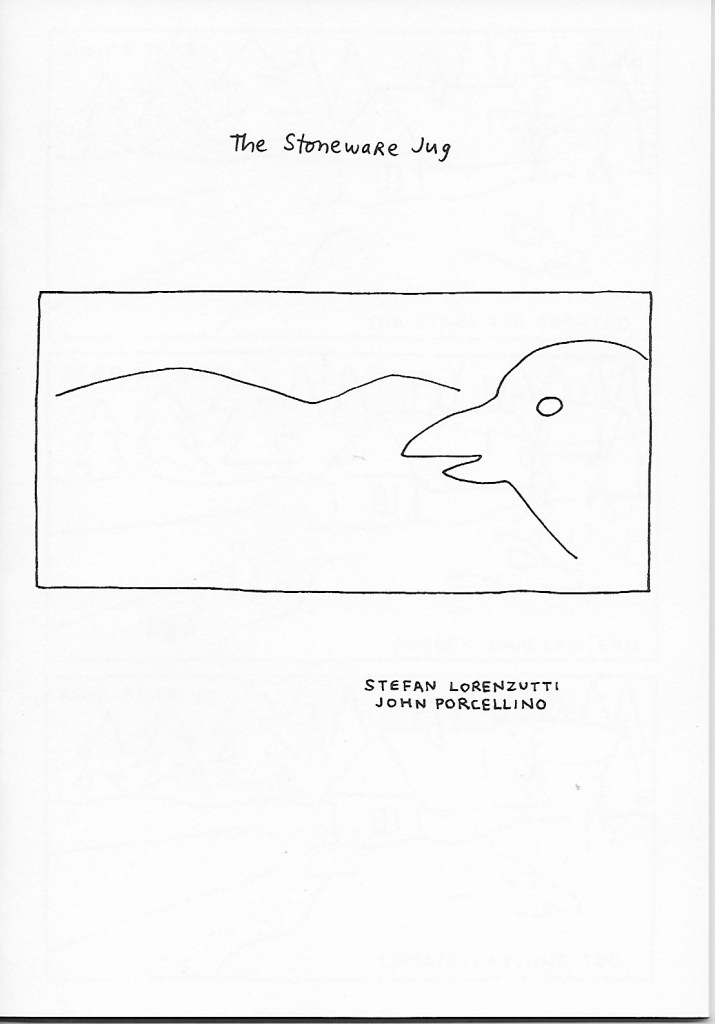
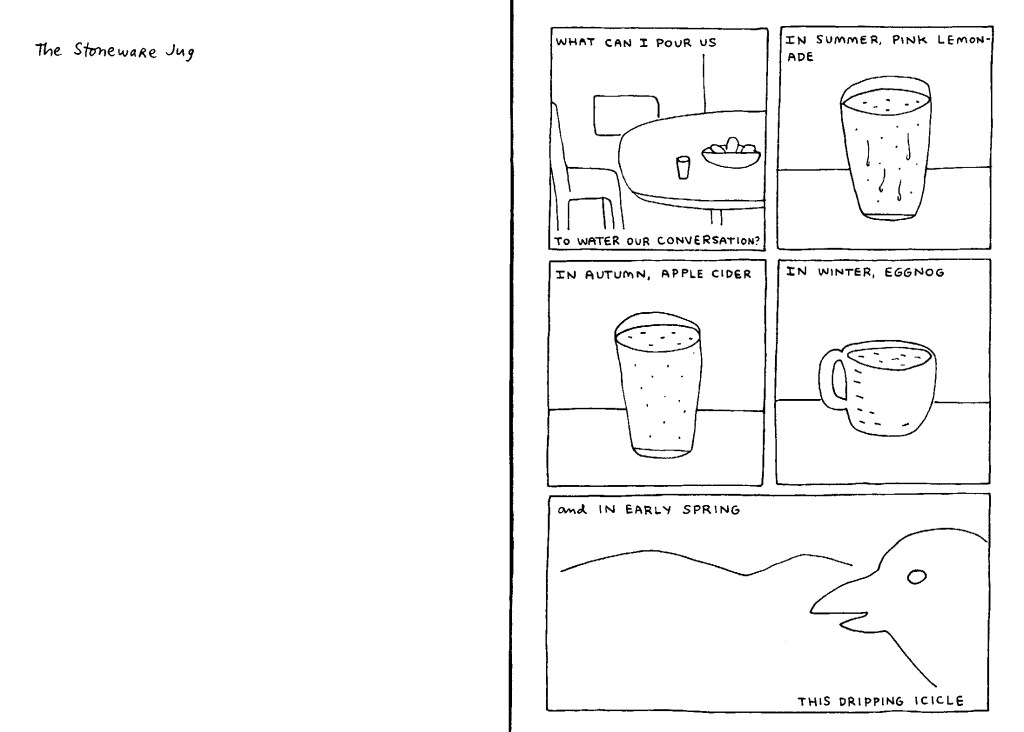
The Stoneware Jug by Stefan Lorenzutti (words) and John Porcellino (pictures) (Nieves, Bored Wolves, and Spit and a Half, 2022). In this collection of poems illustrated with 1- to 6-panel, 1-page comics, Stefan Lorenzutti provides simple, direct poems about being cold, the end of winter, and memories of (seemingly) empty places. Titles include “The Iceberg,” “When I Lived in Krakow,” and “On a Night of Cruel Frost.” The 13 poems in the collection are perfectly illuminated by John Porcellino in the simple, direct line drawings that he’s known for. Here’s the title poem from the collection:

from The Stoneware Jug by Stefan Lorenzutti and John Porcellino.

LESS DESOLATE

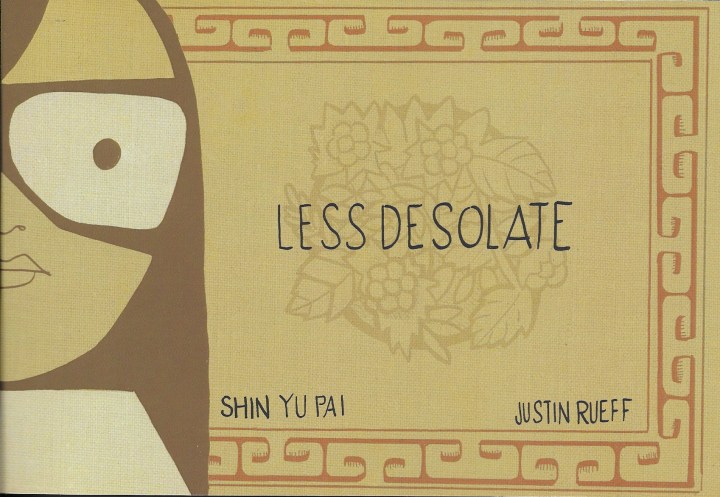
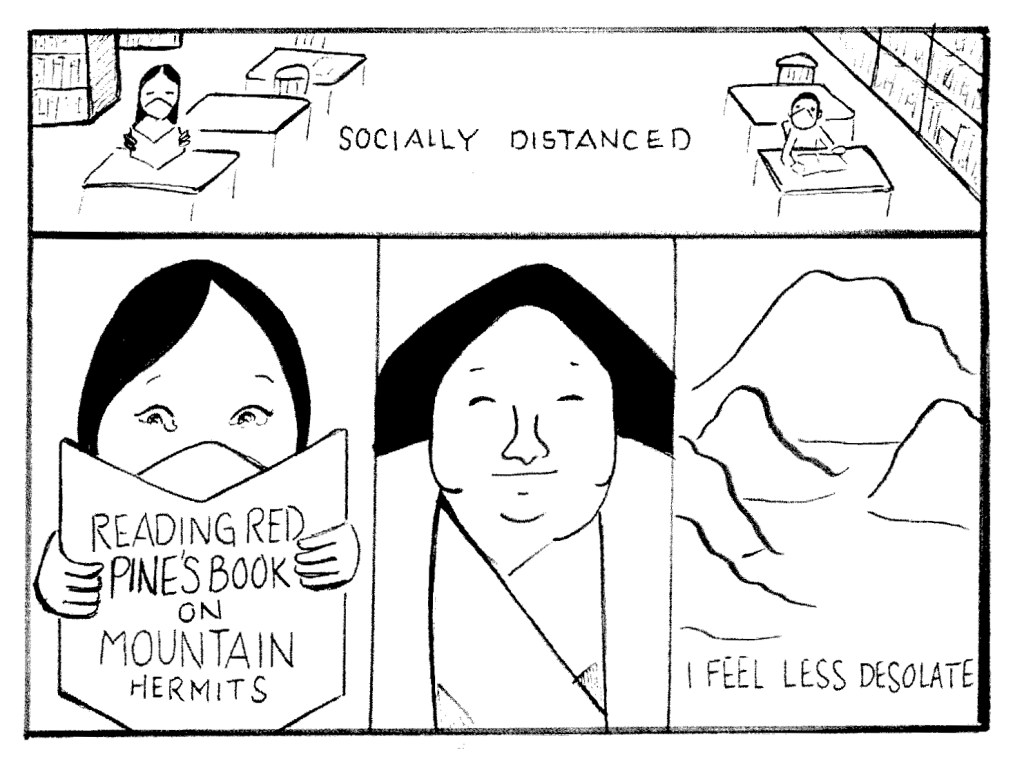
Less Desolate by Shin Yu Pai (haiku) and Justin Rueff (illustrator) (Blue Cactus Press, 2023). Poet/artist/podcaster Shin Yu Pai collects haiku she wrote during the pandemic, including the concurrent social unrest and her personal search for being present. Her haiku flow from rituals to yoga, from social distancing to social justice, and from being at home to being part of a wider community and world. The haiku are minimal yet pack a lot of meaning in a few words (12 words or fewer in most cases). Justin Rueff provides comics-inspired illustrations ranging fron 1 to 4 frames for the 1-page haiku comics, giving us just the right amount of context — and occasionally a touch of color. Here’s the title haiku comic from the collection:

from Less Desolate by Shin Yu Pai and Justin Rueff

Timeline: Current (2022-2023)

Warning: This incomplete history maps my journey as a poet learning about comics and doesn’t follow a strict chronological order.
A History of Poetry Comics

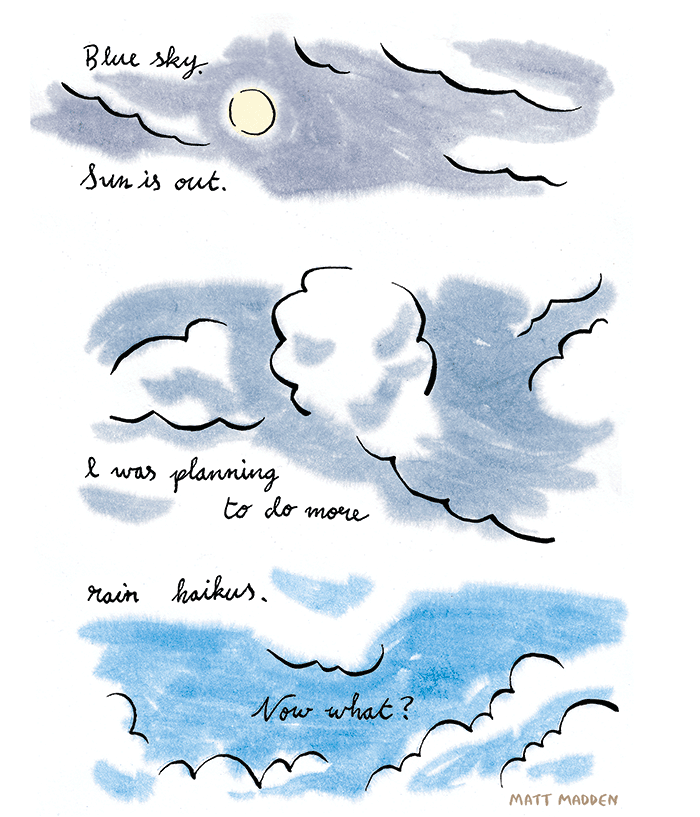
the haiku comics of matt madden

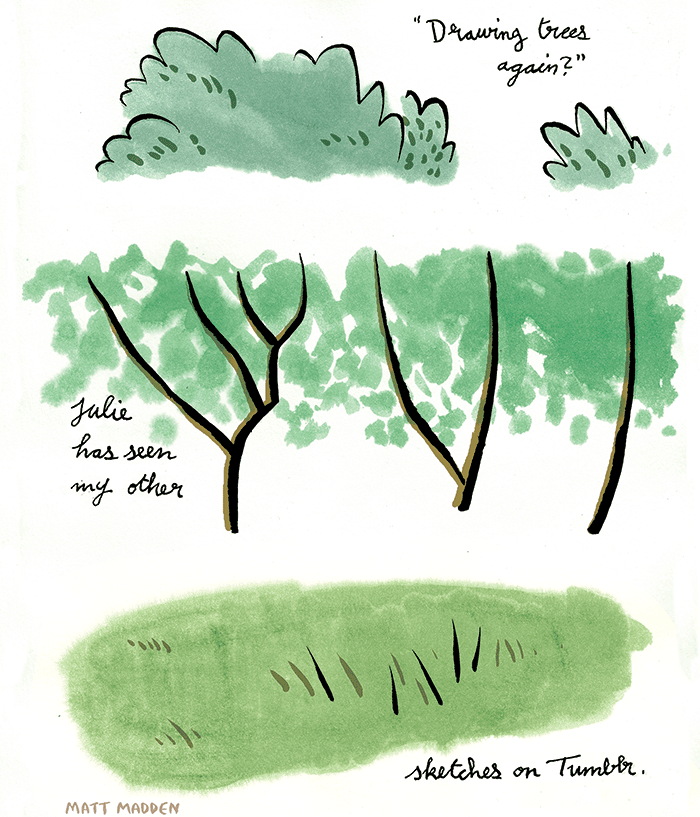
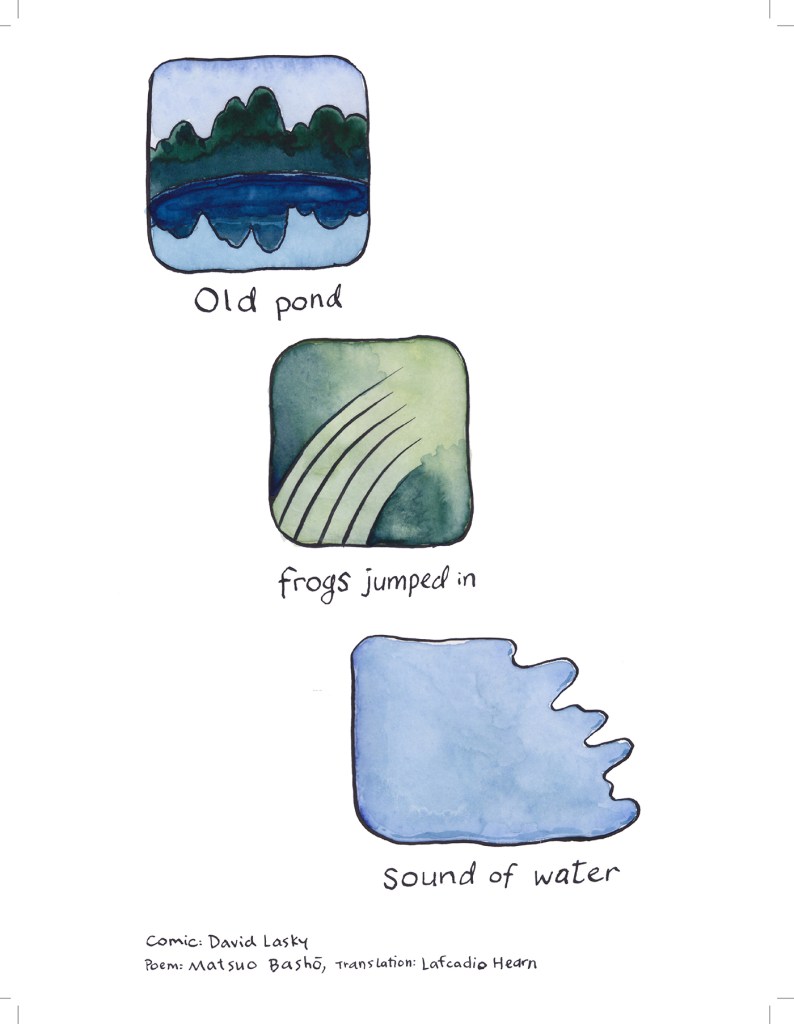
Comics artist Matt Madden, known for his  99 Ways to Tell a Story (Penguin, 2005), has created haiku comics that capture the simplicity of both pictures and words.

His use of color perfectly underscores the haiku and illuminates it in a way that adds to its meaning. He mostly uses thirds for his layout which aligns with the 3-linw break of what’s become English-language haiku style. While the image may follow the three-lines “rule” his text breaks into smaller lines (while maintaning the 5-7-5 syllable count across the lines).

In the examples below, he foregoes frames, using white space and color to beautifully define the haiku count.

There’s so much to admire about these – their simplicity foremost. Also, they’re unique in their approach. (For compare/contrast, see the haiku comics of Susanne Reece, featured in AHOPC #11.) The implied panels as the haiku moves down the page work really well. They’re humorous and current. And they’re a direct reflection of the poet’s mind. For me, they’re the perfect examples of what poetry comics can and should do.

Timeline: Current  

Warning: This incomplete history maps my journey as a poet learning about comics and doesn’t follow a strict chronological order.
A History of Poetry Comics

musings on words + pictures by R.H. Blyth

Here’s some found text that provides additional thoughts on words and pictures from R.H. Blyth in the classic Haiku Vol. 1 Eastern Culture published in 1949.

Although Blyth is discussing painting and poetry in context in terms of Japanese haiga – brush paintings that illuminate a poem, often times a haiku (first discussed in AHOPC #03) – I think it’s relevant to poetry comics. His comments support my belief that drawing and writing together can illuminate and transcend what they can’t always accomplish singularly. (See also “What are poetry comics” in AHOPC #05.)

Haiku Volume 1 Eastern Culture by R.H. Blyth (Hokuseido, 1959)

The qualities of haiga are rather vague and negative. The lines and masses are reduced to a minimum. The subjects are usually small things, or large things seen in a small way. The simplicity of the mind of the artist is perceived in the simplicity of the object. Technical skill is rather avoided, and the picture gives an impression of a certain awkwardness of treatment that reveals the inner meaning of the thing painted.

pp. 89-90

Applied to poetry comics: The simplicity and directness of comics and line drawings are perfectly aligned with poetry, even more so with the “small” haiku. Comics – underground comics especially – often celebrate the honest, the real, the creative over the technical skills of the artist/poet. Words and drawing together can transcend inherent limitations of each.

The combination of haiku and haiga is perhaps the most important practical question. One may spoil the other; but in the case of a complete success, how does one help the other? There seem to be two main ways of doing this. The haiga may be an illustration of the haiku, and say the same thing in line and form; or it may have a more independent existence, and yet an even deeper connection with the poem.

p. 90

Applied to poetry comics: This aligns with what Scott McCloud lists in his classic Understanding Comics (William Morrow, 1993) as categories for “the different ways in which words and pictures can combine in comics:” Word specific (illustrative); picture specific (words add a soundtrack); duo specific (words and pictures say the same thing); additive; parallel (words and pictures follow very different courses); montage; and interdependent (“words and pictures go hand-in-hand to convey an idea that neither could convey alone”). (See pp. 152-155.) The last three are closest to what Blyth calls independent existence and can express something neither could do on their own.

Art comes down to earth; we are not transported into some fairy, unreal world of pure aesthetic please. The roughness gives it that peculiar quality of sabi without age; unfinished pictures, half-built houses, broken statuary tell the same story. It corresponds in poetry to the fact that what we wish to say is just that which escapes the words. Haiku and haiga therefore do not try to express it, and succeed in doing what they have not attempted.

p. 104

Applied to poetry comics: Comics are down-to-earth and can make even the most difficult topics accessible. Comics span decades and can still hold an audience (e.g., Peanuts). Poetry can convey difficult or sublime concepts in just a few words. Poetry too can move through generations. Words and pictures together, as in poetry comics, open up the possibility for “yet an even deeper connection.”

Timeline: Prehistory

Warning: This incomplete history maps my journey as a poet learning about comics and doesn’t follow a strict chronological order.
A History of Poetry Comics

Porcellino on connection between poetry and comics

John Porcellino is one of my comics heroes and major inspiration when I started drawing. His cartoons done in black lines are direct, uncluttered, achingly beautiful simple. His style is perfectly matched to the directness of his narratives, thinkings, observations, and poetry. He’s known for his King Cat Comics, which he has self-published since 1989 and have been reissued as collections. Among these pages are gems of poetry comics, many evoking haiku.

In an April 2018 interview with The Herald, Porcellino talks about the connection between poetry and comics: Comics, especially self-published comics, broke down the barriers between artist and audience the way punk rock did. It allowed for a more direct connection. / Many cartoonists note the similarities between comics and music, which I agree with. In the same way, there are similarities between comics and poetry. As I mentioned, I’ve studied and written poetry throughout my life – it has always been a creative part of me. / Somewhere around the late nineties I started to more consciously begin to integrate my comics with my poetry. Around this time, many of my comics began life as straight poems – text on a page in poetic form – that I adapted into comics.

There are way too many to share all my favorites, so here are just two of his poetry comics:

“Busy Bee” collected in “Map of My Heart – Best of King Cat Comics & Stories 1996-2002” (Drawn and Quarterly 2009)
“3 Poems about Fog – San Francisco” collected in “From Lone Mountain – King Cat Comics and Stories 2003-2007” (Drawn and Quarterly 2018)

Both of these poetry comics perfectly capture small moments – just enough words with the right accompanying drawings – balanced – leaving us simply to hear the bee and feel the fog.

Porcellino’s website KING CAT COMICS is where you’ll find more about his world. Check it out!

Timeline: 1989-Present

Warning: This incomplete history maps my journey as a poet learning about comics and doesn’t follow a strict chronological order.