Poetry comics and haiku comics are a relatively new development in the historical context of artists and writers using words and pictures together to create meaning deeper than either could do on its own.
Historical roots can be traced back centuries to pattern poems and illuminated texts in Europe and calligraphic pictures and poems in Asia, Japanese haiga for example. By the 1800s painters and poets were looking at things differently and becoming more experimental and more accepting of non-traditional influences. This led to the concrete poetry movement in poetry and the pop art aesthetic in painting.
Comics, which can be defined as drawings that tell a sequential narrative, started in the (mostly agreed to) 1870s. The rise of comics and comic strips, which were going full bore by the 1940s in newspapers and magazines, provided source materials for poets and artists who used influences from comic book aesthetics, comic strip characters, and comics’ mechanics.
Poetry comics, a term finally coined in the 1970s, have continued through today, running parallel with the mainstream acceptance and interest in graphic literature, DIY, and zines. Haiku comics, starting around 1995 as a natural outgrowth of poetry comics, have been recently popularized by poets/comic artists.
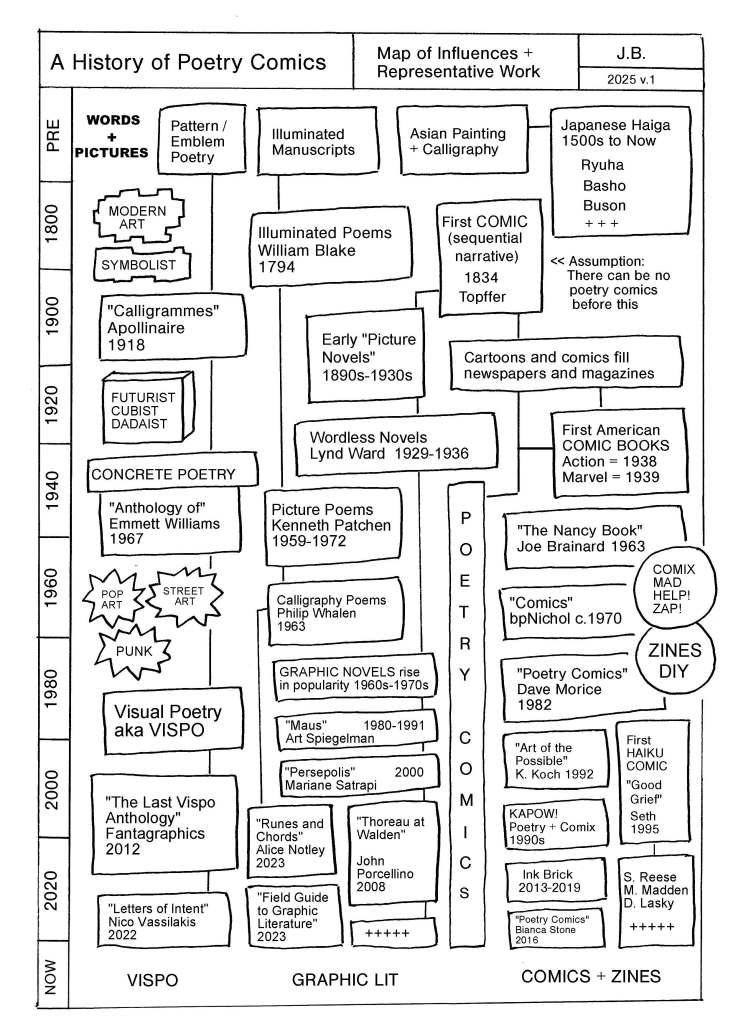
I’m sharing the first draft of my map of “A History of Poetry Comics” that attempts to show related roots, influences and representative practitioners of poetry comics. While definitely not definitive, hopefully it will serve to illuminate and inspire further investigation. This is what I’ve learned so far.
Timeline: 2025
Warning: This incomplete history maps my journey as a poet learning about comics and doesn’t follow a strict chronological order.
“Rose is a rose is a rose is a rose.” -Gertrude Stein
Although labeled differently by poets, artists, and historians, work that investigates the relationship between pictures and words (i.e. drawing and poetry) strives for the same result: create meaning that’s not possible with words or pictures alone.
Here are terms “A History of Poetry Comics” has uncovered that each point in their own way to the practice of incorporating words and pictures into art.
Term
Represented by
Timeline
haiga (Japanese haiku drawings)
Bashō, Buson
1500s on
illuminated poems
William Blake
1780s
sequential narratives
Rodolphe Topffer
1830s
comic books, comic strips, comics
Various*
1890s-1930s
pictorial prose poems (without words)
Lynd Ward
1930s
picture poems
Kenneth Patchen
1940s-70s
concrete poems –> vispo (visual poetry)
Augusto deCampos, Nico Vassilakis
1950s-70s on
graphic novels
coined by Richard Kyle
1960s
hand-drawn poems
bpNichol
1970s
poetry comics (drawings w/ other’s poems)
Coined by Dave Morice
1980s
comics mainly without pictures
Kenneth Koch
1990s
haiku comics
Seth
1995
poetry comics** (drawings w/ own poems)
Bianca Stone
2010s
poem/drawings
Alice Notley
2020s
graphic poetry
Naoko Fujimoto
2021
*A good starting point to get perspective on when these terms were first use is Wikipedia’s History of Comics. For U.S.-centric perspective, American Comics: A History by Jeremy Dauber (W.W. Norton & Co., 2022) comes recommended.
It’s notable that concurrent with the rise in popularity and proliferation of comics in the years between about 1870 and 1920 poetry was becoming more experiemental. Possibilities for poetry were opening up, starting with how the page and text could be used to add context and illuminate meaning.
Two early (perhaps the first modern?) examples of poets experimenting with page and type are both French: Stephane Mallarme (1842-1892) and Guillaume Apollinaire (1880-1918).
Mallarme created poems that broke the constraints of the line and the page. His late poems would run down the page, across the gutter, and even page to page. Considered a Symbolist master in France in the 1890s, Mallarme created poems toward the end of his life that were concerned with meaning and how text placement, type face, and font size could convey meaning — or at least provide graphical clues to meaning.
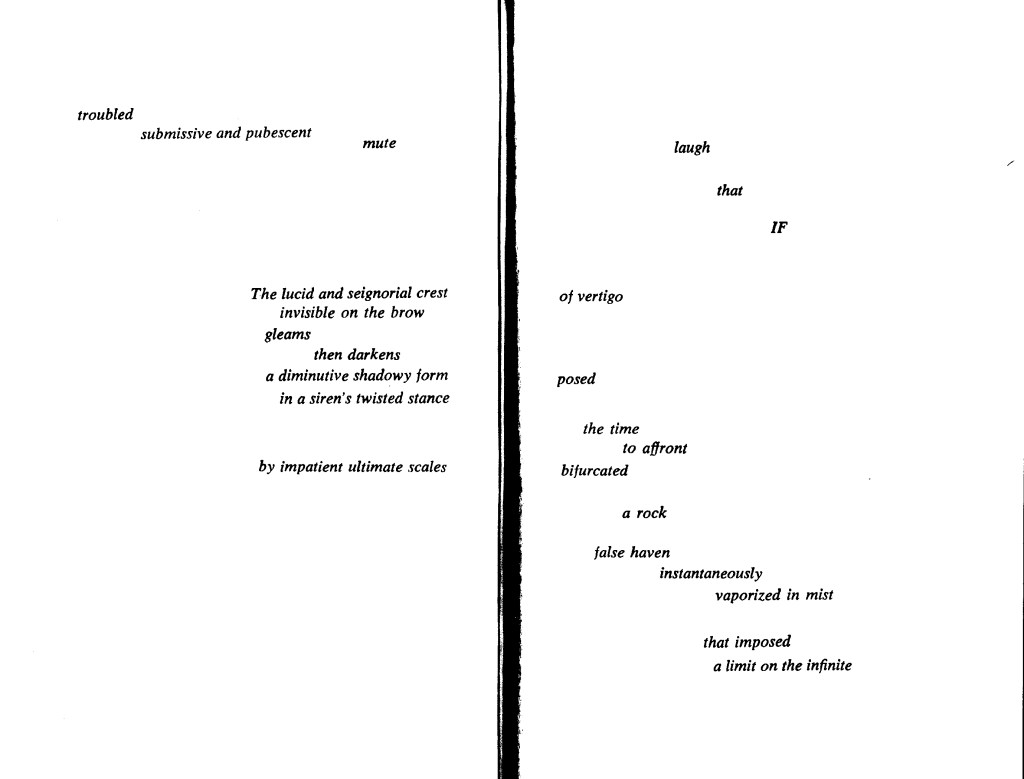
Here’s a two-page spread from Mallarme’s “Throw of the Dice” (1897) that illustrates the poet’s breaking with expected norms of poetry and creating what he said had “the look of a constellation.”
From “A Throw of the Dice” by Mallarme as reproduced in Speaking Pictures (Harmony Books, 1975)
Apollinaire, who was influenced by the Symbolist and the more ancient pattern poetry, created poems that built on the use of the page as a canvas (as a painter would use). His calligrams left behind the linear (as in lines) of poetry, opting instead for creating meaning through graphic display of the text. He also created poems in own handwriting, which are closest to poetry comics.
Here’s an example from Apollinaire’s Calligrammes:
“It’s Raining” by Apollinaire; translated by Anne Hyde Greet in Calligrammes (University of California Press, 1980)
As a footnote, experimental poetry based on text and space became fertile ground first for concrete poetry which in turn was a forerunner of visual poetry (vispo) which continues today. See A History of Poetry Comics #10 https://punkpoet.net/2023/02/17/a-history-of-poetry-comics-10/
And BTW, in 1958 artist-poet Brion Gysin who added cut-up and collage to the poet’s toolkit, said “Writing is 50 years behind painting.” Perhaps.
Timeline: Pre-history (1897 & 1912-1913)
Warning: This incomplete history maps my journey as a poet learning about comics and doesn’t follow a strict chronological order.
The first use of the term “poetry comics” was quite literal. In 1979 poet Dave Morice created “Poetry Comics,” a 22-page comic book of comic-ized poems from the (then) English canon. He drew comics that illustrated poems by Emily Dickinson, Sylvia Plath, Walt Whitman, Allen Ginsberg and others we elders know from high school English class. Each poem got a different treatment, covering many comics styles, that uniquely illuminated that particular poem.
Morice created 17 comic books of poetry comics between 1979 and 1982, which he photocopied and mailed to other poets. His poetry comics werre collected in “Poetry Comics: A Cartooniverse of Poems” (Simon and Schuster, 1985). The same year, he published “How to Make Poetry Comics (Teachers & Writers, 1985), a guide for teachers.
At the time, a review by Bruce Brooks professed: “By the time Ebenezer Cooke was snapping off wry hudibrastics in the early 1700s, the Greek had been chuckling over Aristophanes for twenty-one centuries. But now America has initiated another tradition equally amusing, if not equally honorabler: poetry comics.”
One autumn night in 1977, I went over to the apartment of a friend who was in the Iowa Writers Workshop. She had hundreds of poems stuffed into twelve black binders on her writing desk and I had about as many of those same binders filled with poetry at home, so what else could we begin the evening with but a discussion of poetry? At one point she said in a serious tone, “Great poems should paint pictures in the mind.” And I said, partly to tease her, “Great poems would make great cartoons.” After a short pause, she smiled and said, “Hey, you know you’re right. You should draw some.”
Here’s one example of Morice’s poetry comics:
from Poetry Comics: A Cartooniverse of Poems by Dave Morice (Simon and Schuster, 1985)
Timeline: 1979 – so far, first documented use of the term “poetry comics”
Warning: This incomplete history maps my journey as a poet learning about comics and doesn’t follow a strict chronological order.
Among the many genres of poetry, haiku (the short poem that originated in Japan) is well suited to comics. Generally (and perhaps stereotypically), haiku speak to one moment, use just a few words to communicate an idea, and often make a (meta) leap between lines (or after grammatical marker). These traits lend themselves to techniques often used in comics — short dialogue (often contained in speech bubbles), a shift between panels (a different perspective or point of view, for example), and the punchline (prevalent in daily comic strips).
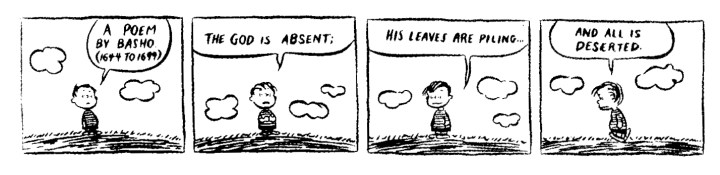
Definitely one of the earliest haiku comics was by Seth, the Canadian cartoonist known for his series Palookaville. He used a well-known comic strip character to recite a haiku by the Japanese master Bashō, expressing it in the popular four-panel strip format:
by Seth, published in Drawn and Quarterly, Vol. 2, Issue 4 (1995)
Comics artist and poet David Lasky, who creates and teaches haiku comics as part of his repertoire, suggests this is probably the first haiku comic, writing:
My first experience of a haiku comic was probably Seth’s short comic of Linus, from ‘Peanuts,’ illegally but respectfully reciting a poem by Bashō in four panels. The poem appeared as a ‘topper’ above Seth’s one-page comic, ‘Good Grief,’ in the Drawn and Quarterly anthology, Volume 2, Issue 4, in 1995. When I first saw that tiny, fake ‘Peanuts’ strip, a small electrical charge went off in my brain and I knew I needed to learn who this Bashō person was.
Source: David Lasky in his Introduction to Less Desolate by Shin Yu Pai and Justin Rueff
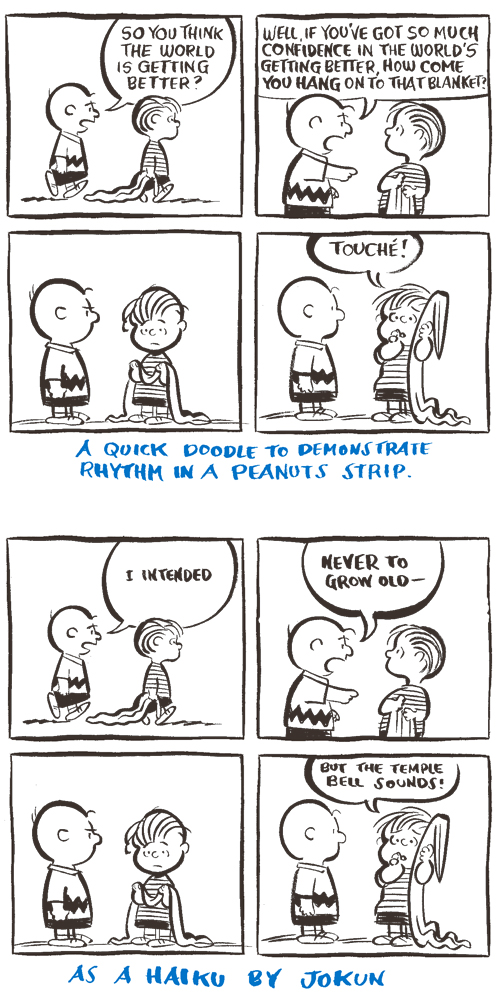
In a 2006 interview with Marc Ngui in Carousel 19, Seth says :
“I have felt, for some time, a connection between comics and poetry. It’s an obvious connection to anyone who has ever sat down and tried to write a comic strip. I think the idea first occurred to me way back in the late 80’s when I was studying Charles Schulz’s Peanuts strips. It seemed so clear that his four-panel setup was just like reading a haiku; it had a specific rhythm to how he set up the panels and the dialogue. Three beats: doot doot doot— followed by an infinitesimal pause, and then the final beat: doot. Anyone can recognize this when reading a Peanuts strip. These strips have that sameness of rhythm that haikus have— the haikus mostly ending with a nature reference separated off in the final line.
Source: “Poetry, Design and Comics: An Interview with Seth” by Marc Ngui in Carousel 19 (Spring-Summer 2006) [archived PDF]
Accompanying that interview was this example by Seth:
*Full disclosure: My teacher and friend David Lasky continues to be instrumental in shaping this “A History of Poetry Comics” blog with tips, insights, and suggestions. In this case, his research has led to Seth as the creator of the first haiku comic. This poet hasn’t found any earler examples of haiku comics. So be it.
Timeline: 1995 (the first haiku comic)
Warning: This incomplete history maps my journey as a poet learning about comics and doesn’t follow a strict chronological order.
End of summer means the end of summer reading! Here are some of the poetry comics (and books on poetry comics) I read this summer.
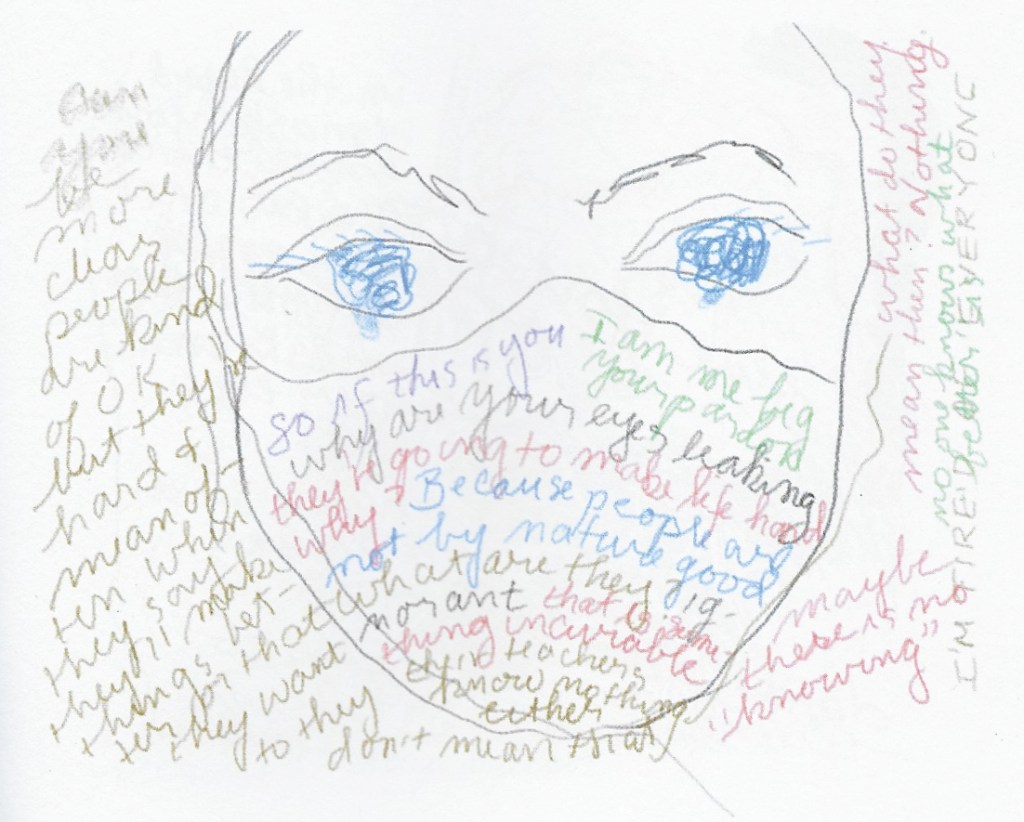
>Runes and Chords by Alice Notley (Archway Editions, 2023). Poet Alice Notley started posting these “poem/drawings” on Instagram in 2019 during the pandemic. As she writes in the introduction, “They seemed to portray my state of mind better than a selfie, they wasted more time than a selfie, and were generally fun.” Done in her own handwriting, her words are interlaced with pictures of masked faces, portraits, flowers, and doodles; and the lettering piles on top of each other, becomes crosswords, and/or change colors in each panel, sometimes obscuring the drawings and vice versa. They comment on current affairs both political and personal. Most importantly, they directly reveal what the artist is thinking in her own voice. Here’s one example:
From Runes and Chords by Alice Notley (Archway Editions, 2023)
>Field Guide to Graphic Literature edited by Kelcey Ervick and Tom Hart (Rose Metal Press, 2023). Wow! A book for instructors, students, and writers who are looking to create “graphic narratives, poetry comics, and literary collage.” Each of the 28 essays/lessons is by a poet/writer/artist working in a specific aspect of combining pictures and words; each comes with an example of their work; and each comes with an exercise to guide your own creation. In total, these comprise a great survey of current state of affairs. I couldn’t put it down! My favorite aspect of the book is the “Alternate Table of Contents by Form,” which makes it easy to navigate to the form you want to explore, such as “Poetry Comics & Comics Poetry.”
>The Stoneware Jug, by Stefan Lorenzutti and John Porcellino (Nieves, Bored Wolves, and Spit and a Half, 2022). Stefan Lorenzutti, poet and publisher (with Joanna Osiewicz-Lorenzutti) of Bored Wolves in Krakow and the Polish Highlands, provided the words. John Porcellino, poet and comics artist of King Cat fame, provided the drawings. The collaboration works on a number of levels. The haiku-esque poetry is perfectly illumninated by elegantly simple pictures in comic-book panels settings. This work encapsulates my sensibilities of poetry comics. (More on collaborations in a future post.) Get your copy now!
>Riot Comics & “I’m a Cop” No. 2 by Johnny Damm (2023). Johnny Damm continues his hybrid-comics-collages using found text with two new works this year. Riot Comics combines cut-up classic cops comics and Depression-era photos with quotes from those who participated or witnessed the Tompkins Square Park riot in 1988. “I’m a Cop” No. 2 directly quotes “actual statements of police union leaders.” Both resonate with current events.
By placing these “law and order” comics in the context of a real-world police, Riot Comics seeks to challenge the carceral logic that dominates the vast majority of U.S. comic books and to question if this medium might also serve as a space of abolitionist possibility.
>Team Photograph by Lauren Haldeman (Sarabande Books, 2022). Graphic novelist/poet Lauren Haldeman interleaves poems between chapters of this graphic memoir and ghost story. While not fully integrated visually, the poems serve as a soundtrack to the narrative she’s telling in graphic novel format, providing context, depth and space for the story to unfold. Or perhaps it’s the other way around — the graphic novel provides context for the poems. Either way, this work made me realize there are different ways to think about the relationship between poetry and comics; a welcomed reminder to keep an eye on the overall.
>St. Art: The Visual Poetry of bpNichol curated by Gil McElroy (Confederation Centre Art Gallery and Museum, 2000). This catalog to an exhibit of bp Nichol‘s visual poetry features three insightful essays, his “mech sheet for pome objects,” and a detailed list of his works. Here are three insights I gleened from the essays and bp Nichol in his own words:
My earliest visual poems I called “ideopomes” because I had read Fenellosa on the Chinese written character as a medium for poetry, because I was very interested in Chinese, Japanese, Haida & Kwakiutl poetic modes, & because I saw myself as consciously working with the ideogrammatic potential of the arabic alphabet … This interest in the ideogrammatic & (as I later saw) runic capacity of the alphabet, ran parallel to an interest in the comic strip & its narrative & syntactic convention. (bp Nichol)
Within the realm of the literary arts, visual poetry, a poetic form with a history that arguably stretches back to at least 1700 B.C.E., truly came of age in the century with the work of the French poet (and first major theoretician of Cubism) Guillaume Apollinaire, his Dadaist contemporary, Tristan Tzara, and the Italian Futurist, F.T. Marinetti. (Gil McElroy)
While painter Roy Lichtenstein moved into the comics frame to work at a kind of molecular level of technique, Nichol pushed out against the frame and other comic conventions to a more panoramic approach. The simply drawn, minimally detailed figures of the characters and scenes in Nichol’s comics contrast with the sophisticated play occurring with the panels themselves. (Paul Dutton)
Timeline: 2000, 2022, 2023
Warning: This incomplete history maps my journey as a poet learning about comics and doesn’t follow a strict chronological order.
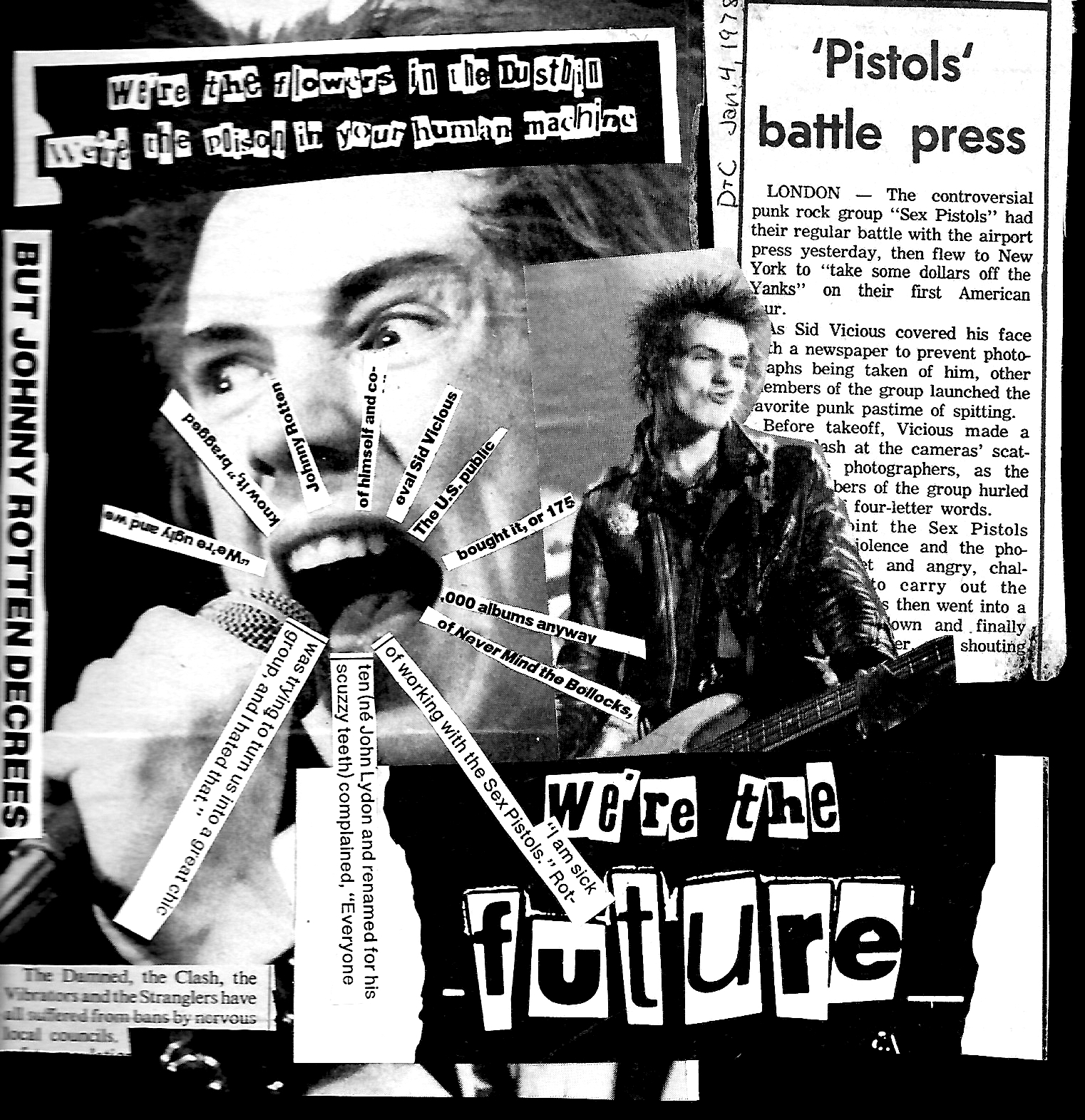
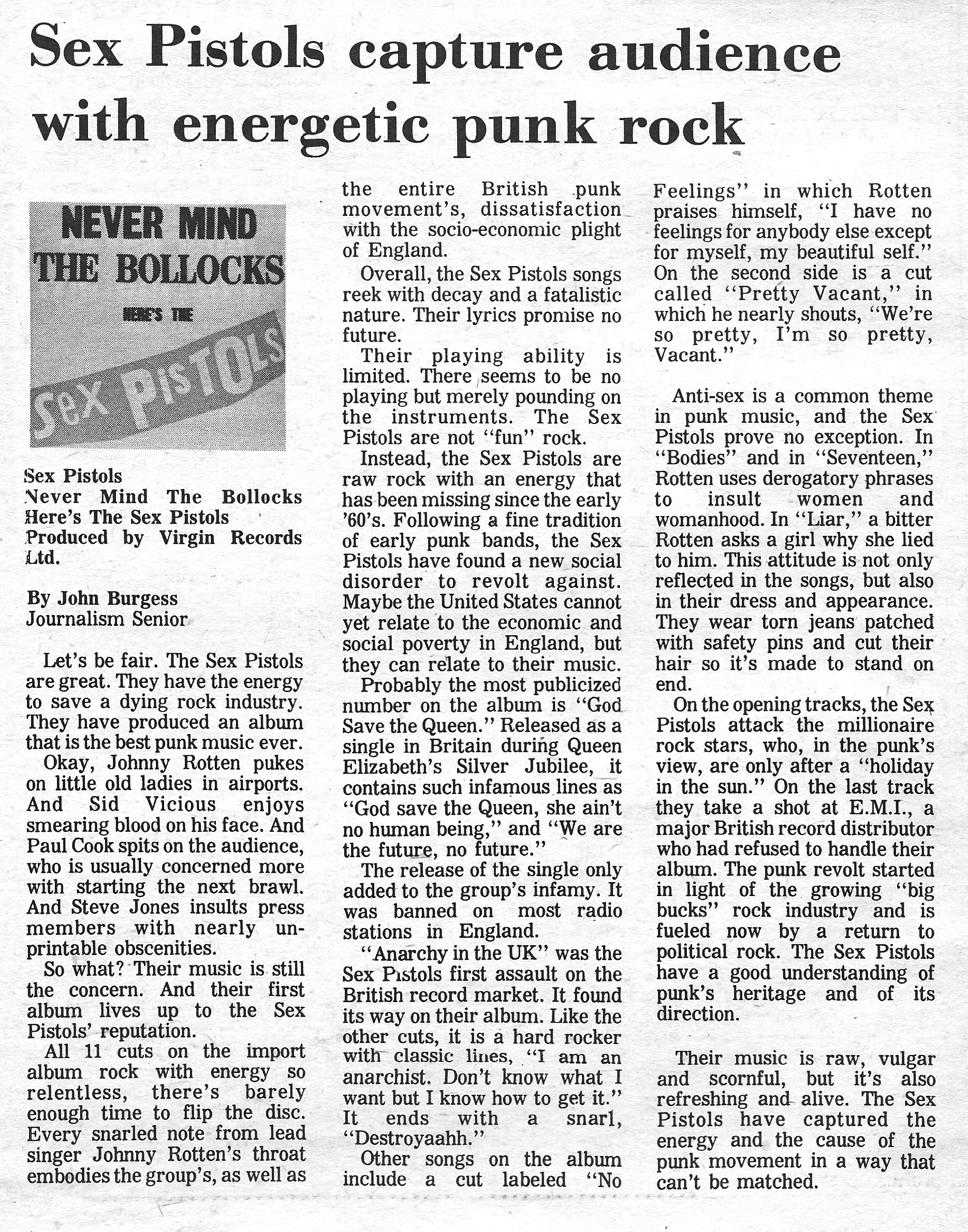
I reviewed Never Mind The Bullocks Here’s The Sex Pistols (released by Virgin on Oct. 28, 1977) for The Chimes, the student newspaper at SUNY Morrisville, Feb. 13, 1978, edition.
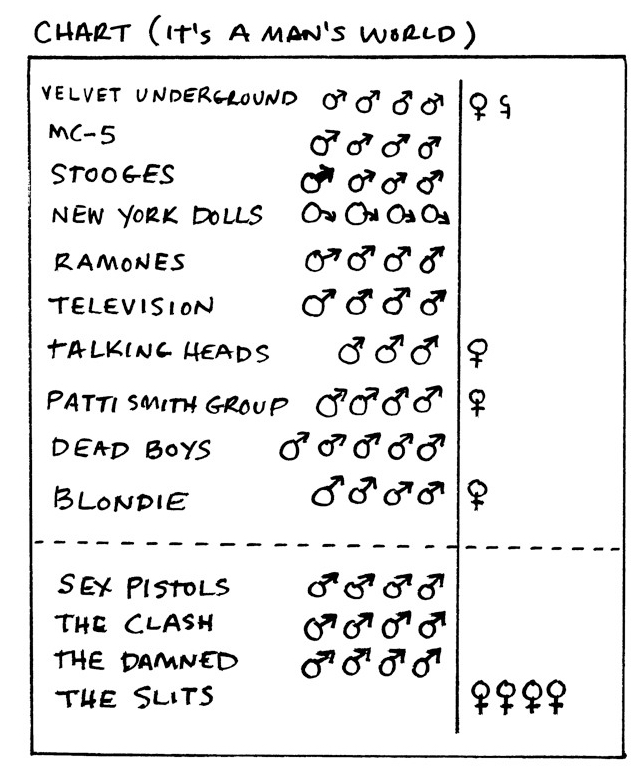
Chart shows the gender make-up of punk bands that I listened to c. 1977. You could count the women musicians on one hand — Moe Tucker, Patti Smith, Deborah Harry, Tina Weymouth. Later I heard the Slits (1979) and the Go-Gos (early 1980s ). In the 1990s my daughter showed me the light with Sleater-Kinney, The Gossip, Bratmobile, Bikini Kill. Punk got better over the years!


 JB
JB 