A History of Poetry Comics

Book Review: Joe Brainard’s C Comics: among earliest poetry comics

There’s not a stronger link between poetry and comics than the poetry comics created by poet-artist Joe Brainard in collaboration with other poets in the New York School in the mid 1960s.
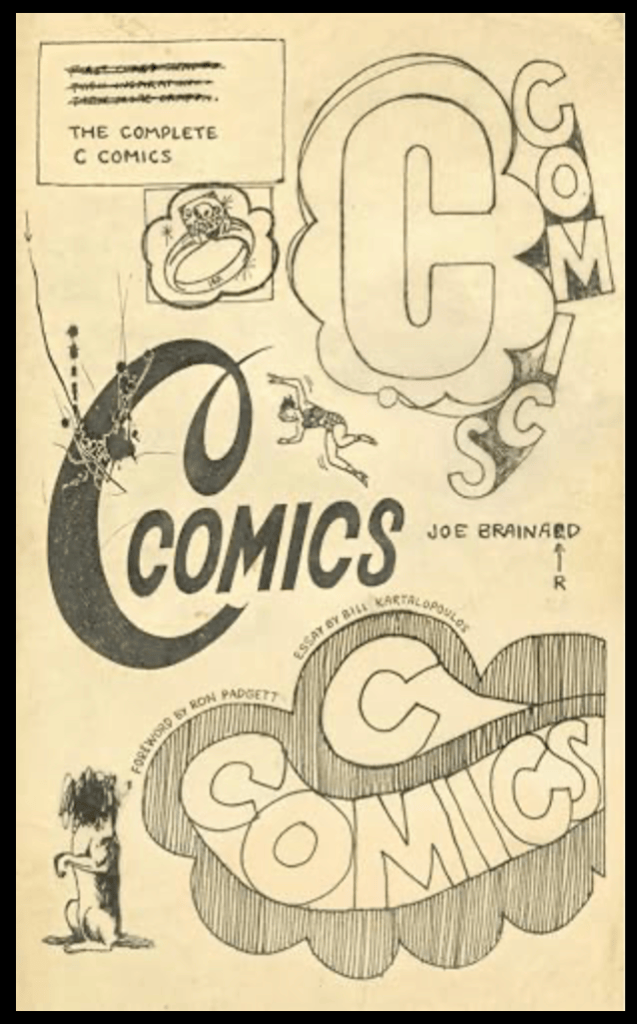
We first touched on Brainard’s work in A History of Poetry Comics #08 where we looked at his Nancy comics. (Yes, the popular comic strip Nancy but presented in contemporary contexts.) We now have his two comic books collected in an affordable* reprint: The Complete C Comics from New York Review Books (2025).

In a lot of ways, this was a generation of artists who lived the Golden Age of comics, and Brainard was able to translate this into his own manifestation of a comic book. C Comics Issue #1 was mimeographed legal-sized; Issue #2 was 8.5×11 and saddle-sticked–both reflecting a DIY ethos that still persists in today’s zine culture.

The poetry comics themselves are varied–some just one page, some multiple pages. Many are constructed on a familiar comic book page grid of frames; many more break the restraints of frame. Sometimes the poets wrote directly on the comics Brainard drew; other times Brainard would handletter their poem into his comic himself. There are homages to superheroes, romance (both heterosexual and homosexual), Nancy and Archie, popular culture, and horror. While not beholden to them, he uses the trappings of comics here in innovative ways, including speech bubbles, lettering of various sizes, sequental narratives, and caption boxes. And there’s advertising pages like the offers in the back of classic comic books.

All that said, it still isn’t easy to categorize these comics. They feel very much like forerunners to the underground comix movement of the 1970s. In a lot of ways they make art (in this case drawings and poems) accessible by using a known framework. Here’s an example by Brainard and poet Kenneth Koch. (See a post about Koch’s own poetry comics here: A History of Poetry Comics #07.)
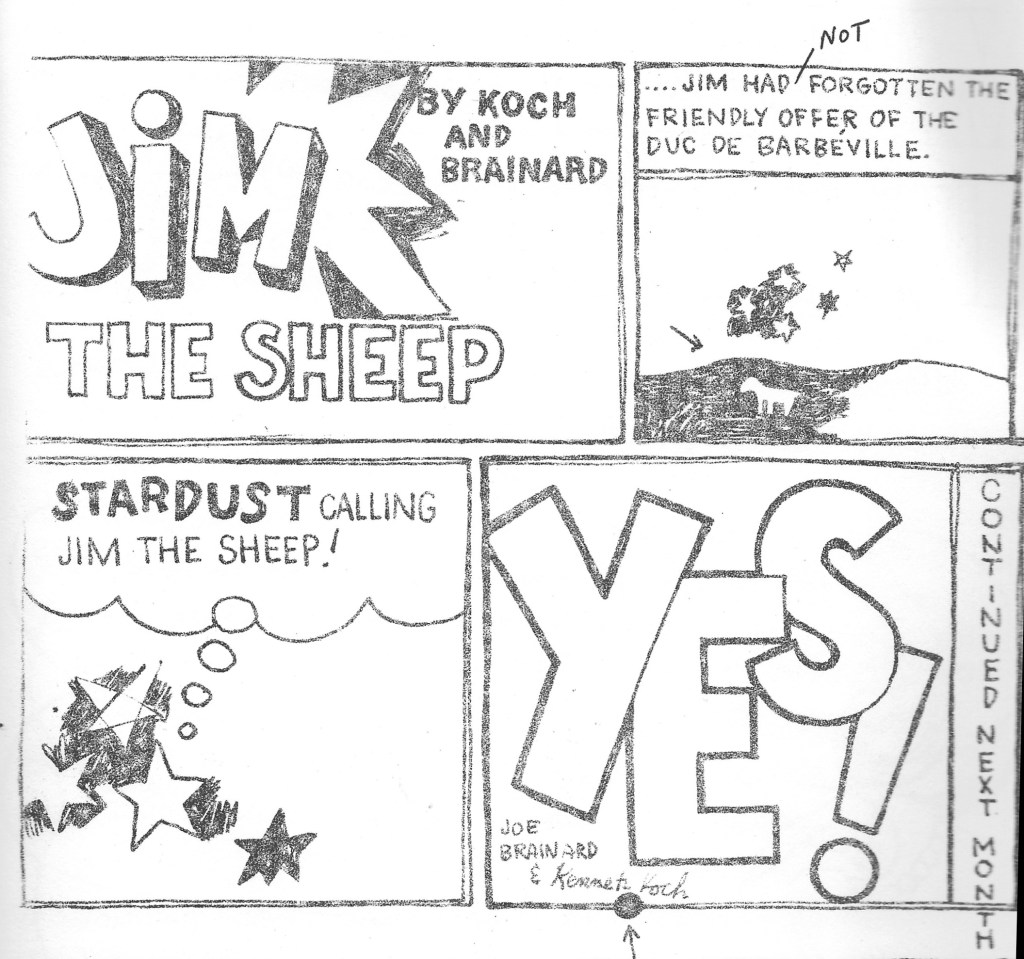
“JIM THE SHEEP” from The Complete C Comics by Joe Brainard and Kenneth Koch (New York Review Books, 2025)

In his essay “C, Joe Brainard, and Comics” at the back of this collection, comics scholar** Bill Kartalopoulos sums it up: “Working together in an unlikely form, they produced a singular body of comics that is arresting, funny, confounding, and beautiful. Their collaborative works were utterly unlike the commercial comics from which they drew inspiration, and distinct from the more visible Pop Art of the era.”

Indeed. C Comics still inspire!

*Affordable at $45 in the sense that on eBay the original C Comics are out of reach of most of us, going as high as $2,750 for Issue #1 and $695 for Issue #2.

**Doesn’t that sound like a great career! Comics scholar!

Timeline: 1964-1966

Warning: This incomplete history maps my journey as a poet learning about comics and doesn’t follow a strict chronological order.
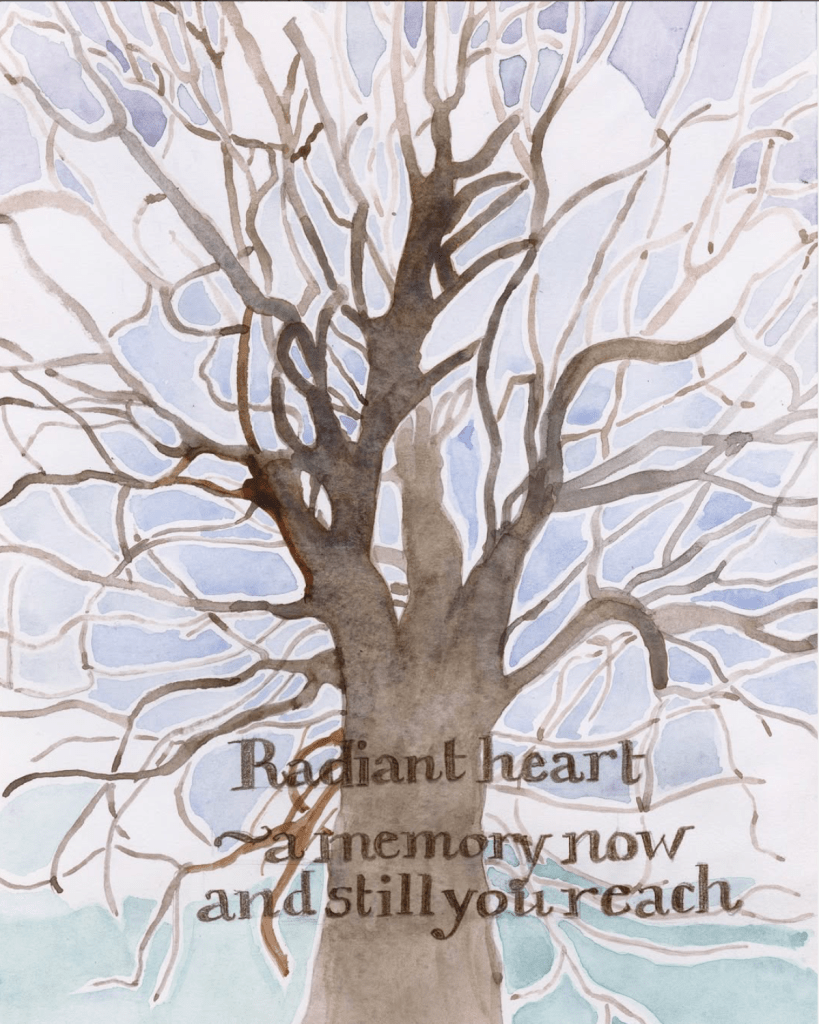
Variations in Panel Layouts for Haiku Comics

Haiku is one of the shortest poetry forms. Haiku Society of America defines haiku as “a short poem that uses imagistic language to convey the essence of an experience…” Originating in Japan, classic haiku (1600s-1900s) almost always followed a 5-7-5 syllabry count; often included a kireji (cutting word) that emphasized or set up the haiku’s “a-ha moment;” and used a kigo (season word) to indicate the time of year. The classic syllabry count of 5-7-5 translated into English-language haiku as three lines with a syllable count of 5-7-5. And that’s how many of us learned to write haiku.

Haiku comics creators have brought unique approaches to addressing the restraints of the form. While it seems natural to spread the haiku over three panels, aligning with the traditional syllabry count, there are one-panel, four-panel, and multiple-panel examples that show the creativity of the poet-artist and the elasticity of haiku.

One-Panel

One-panel haiku comics often evoke haiga, the Japanese art form that combines haiku with a picture. The best examples are ones where the picture complement the poem or adds a second (or even third) meaning. (See AHOPC #03 for a classic example of haiga.) Artist Monica Plant, who creates Haiku Comics of the Hamilton Bay, has great examples of haiku comics, including one-panel ones that evoke haiga.

Monica Plant (2024)

Two-Panel

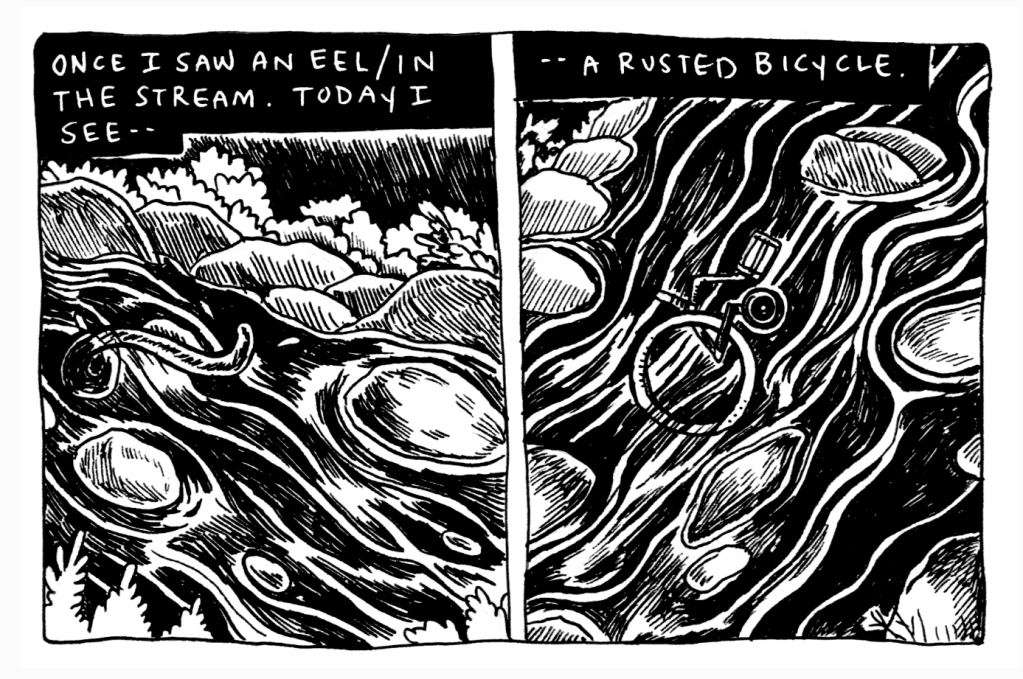
Two-panel haiku comics are perhaps the most challenging–at least at first glance. Most classic haiku are in two parts (despite the three-line trope) and almost always cut after the first or second “line.” (Yes, there are haiku that cut in the middle of the second line too.) In two-panel haiku comics then, the “cut” is between the one panel transition. Summer Pierre has great examples of this approach and notes on her blog, “Its one- to two-panel format makes it a brief and doable way to record something in my day.”

Summer Pierre (2018)

Three-Panel

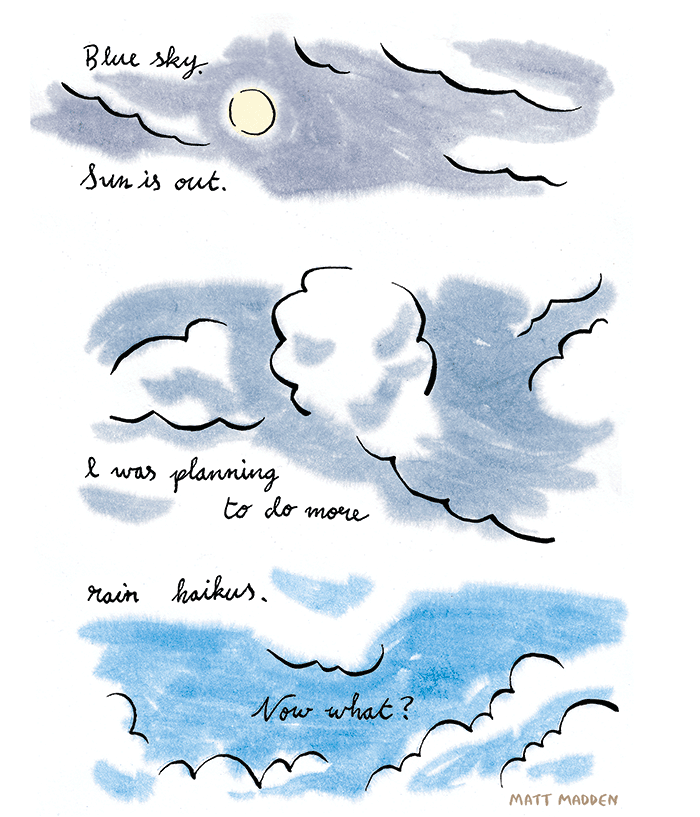
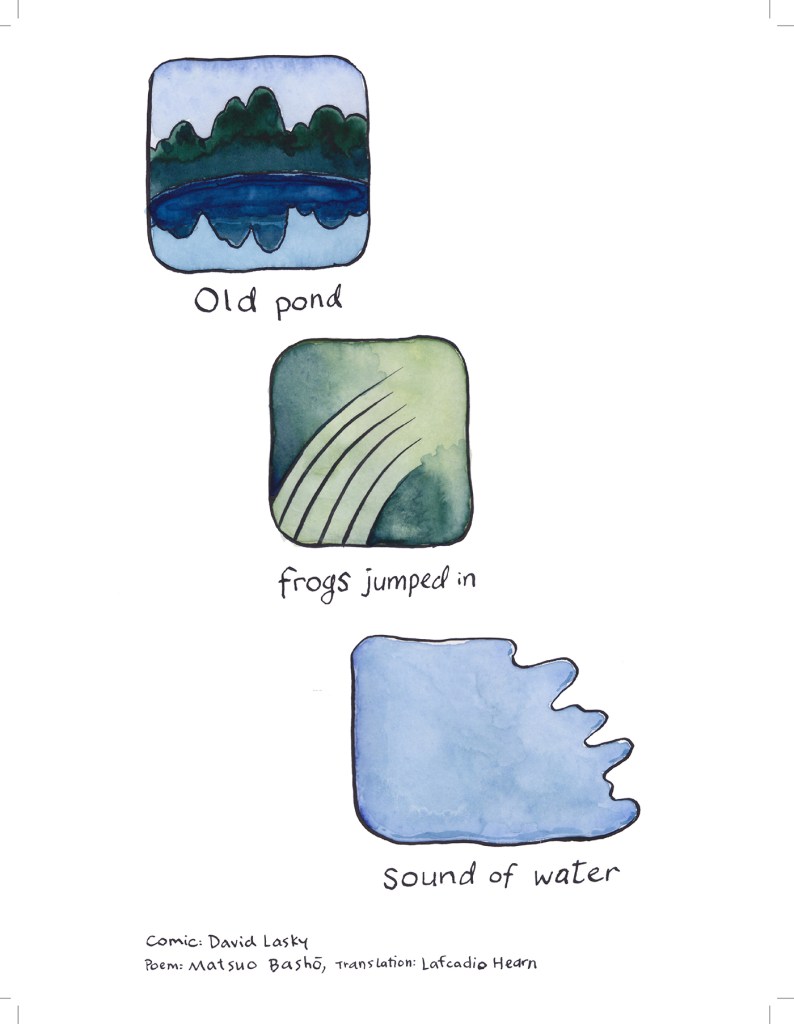
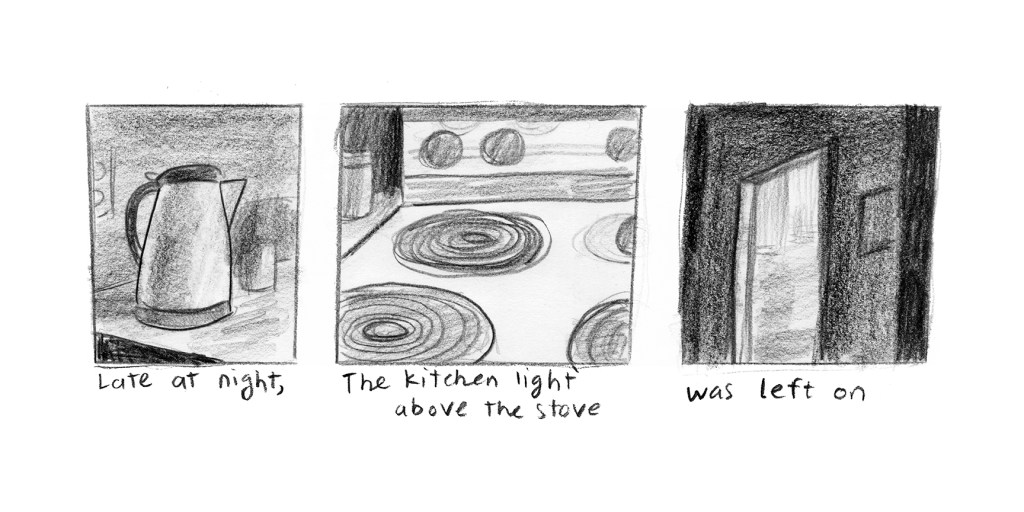
Three-panel haiku comics may seem the most obvious since the panel count matches the line count of a classic haiku. Not surprisingly though, comics artists have brought various approaches to this format. David Lasky (full disclosure: he’s my comics teacher) evokes the feel of a comic strip, while Matt Madden implies three stacked panels that coalesce into a whole.

David Lasky (2023)

Matt Madden (2013)

Four-Panel

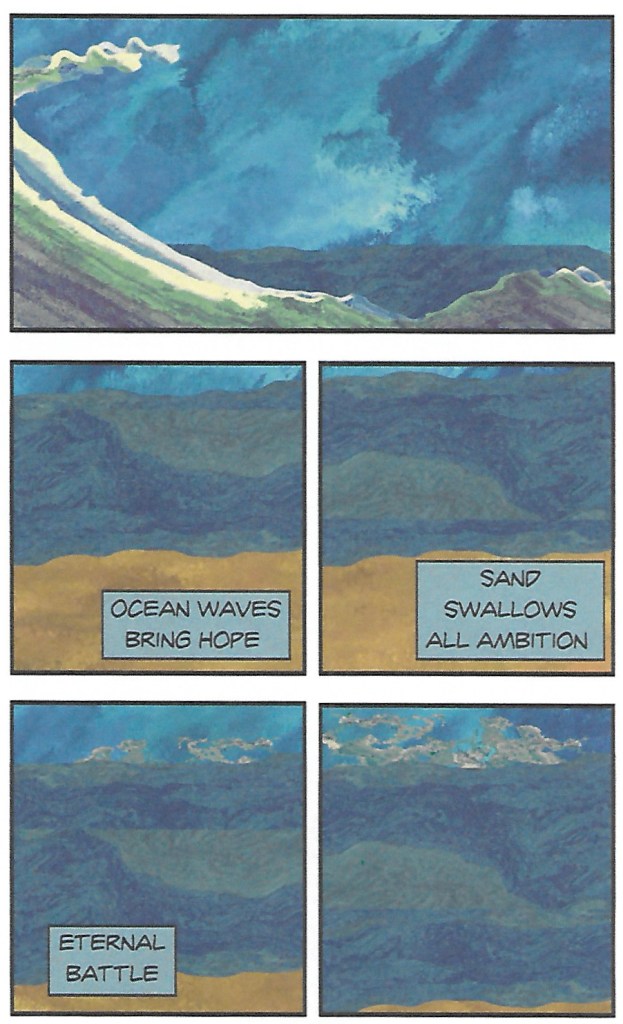
For good reason, four-panel comics are a great match for haiku. Four panels give the comics artist the chance to create a pause in the haiku that mimics the kireji, the cutting word. It can also bring in additional information, visually complete a thought, and/or extend the meaning. In this example by Susanne Reece, she uses the panel without a line of the haiku to set up the final reveal.

Susanne Reece (2022)

Multiple-Panel

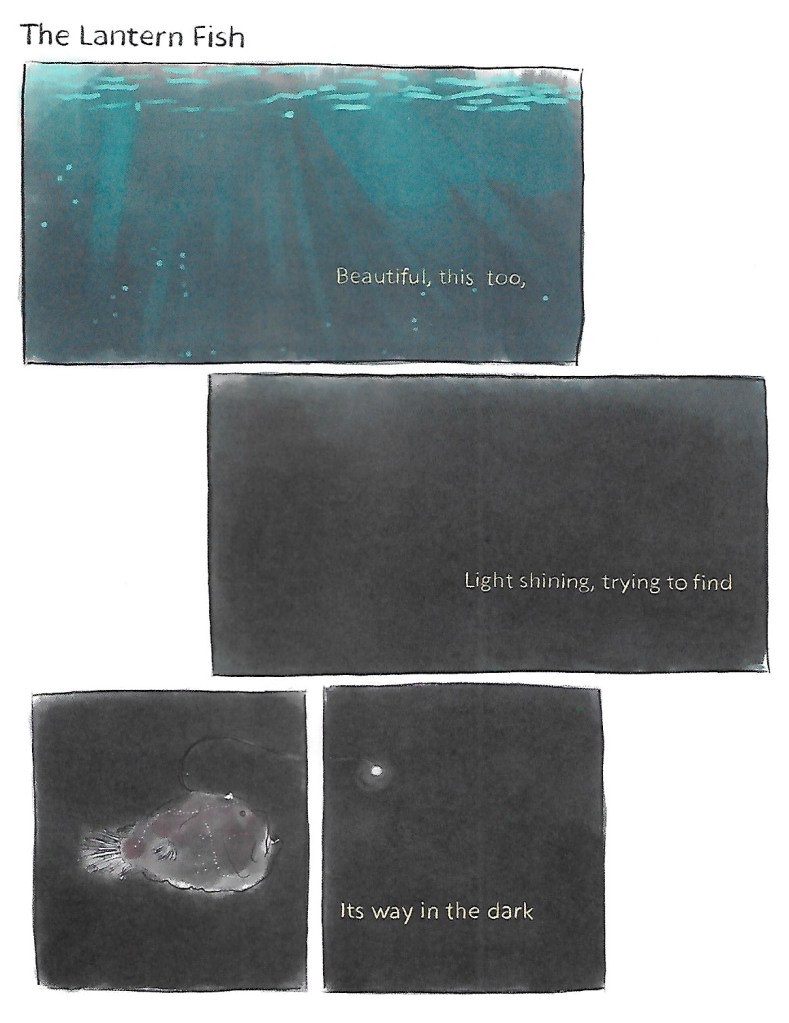
Using more than four panels give the comics artist room to add context, set the scene or season, and/or indicate a cut or leap in the haiku. They often have the feel of a graphic novel. Conjuring the look and feel of a page from a comic book, Jason McBride uses multiple panels to expand his haiku.

Jason McBride from “Wild Divinity” (2023)

It’s fun to think that a short poetry form such as haiku can be the catalyst for so much variation! Haiku comics creators are continuing the long history of pictures and words working together to add context, deepen meaning, and capture moments in ways that words or pictures can’t always do by themselves.

Timeline: Current

Warning: This incomplete history maps my journey as a poet learning about comics and doesn’t follow a strict chronological order.
100 Frogs

More than 100 Frogs

old pond
a frog jumps in
(sound of water)

–Basho

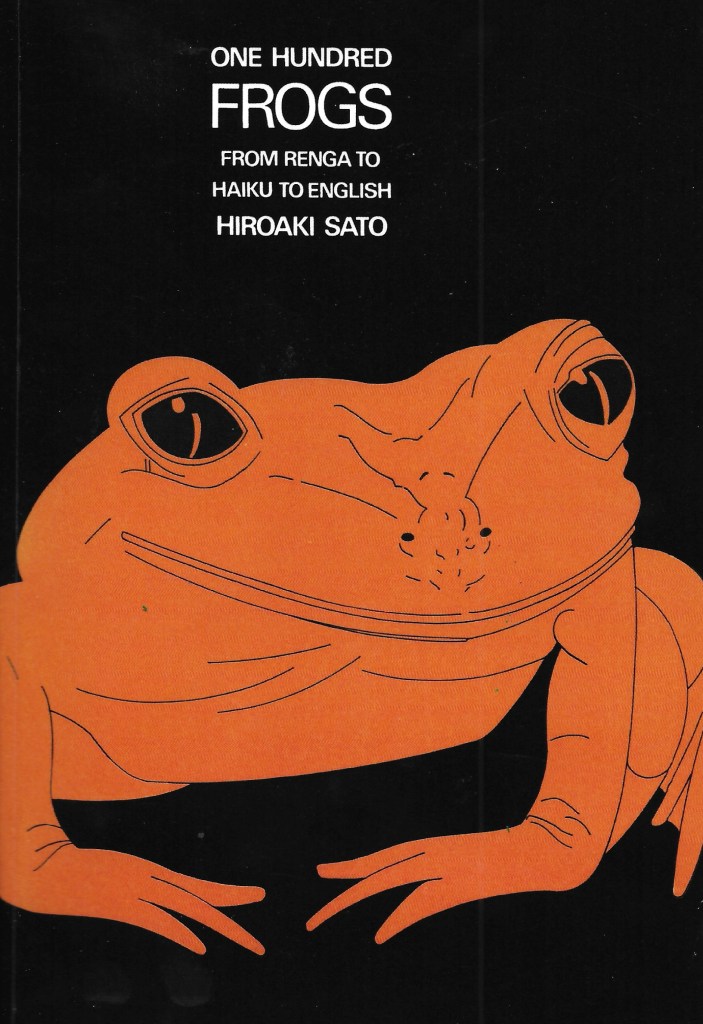
Cover of One Hundred Frogs by Hiroaki Sato

That haiku by Matsuo Basho (1644-1694) is perhaps the best known haiku in the world. In fact, there’s a now classic collection One Hundred Frogs by Hiroaki Sato (Weatherhill, 1983) that has 100 different interpretations/translations of Basho’s haiku. They cover more than a century’s worth of poets from Shiki to Allen Ginsberg and range from literal translations to prose and sonnet versions.

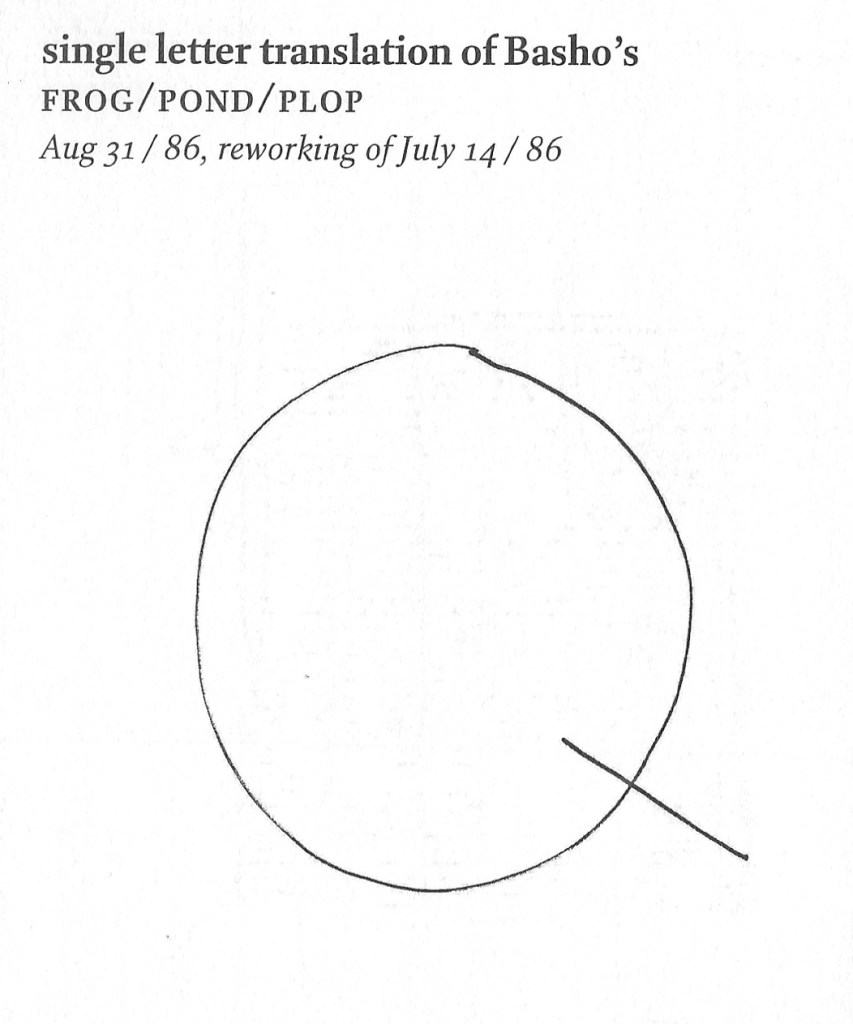
I was drawn back to this compilation by the recent publication of notebook pages by Canadian poet bpNichol (1944-1988). Published on the occasion of what would have been his 80th birthday, some lines of poetry from the notebooks of bpNichol (Coach House Books, 2024) includes 80 pieces of work from the 1980s. Among the selections is this:

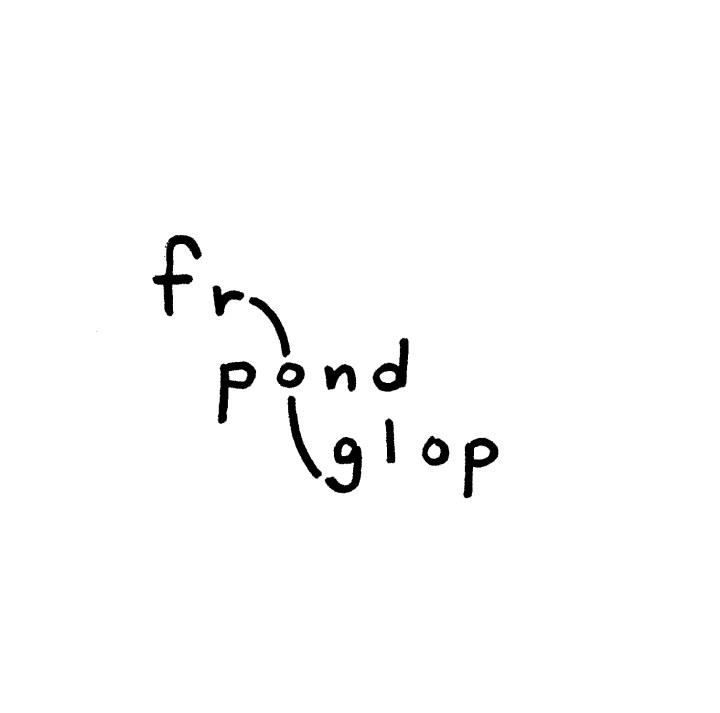
He translated Basho’s haiku with one letter! (Thinking about the title, the use of the word “plop” to translate “the sound of water” was used by RH Blyth in his translation, which in the 1950s and 1960s were well known. See AHOPC #18.) Discovering this in turn led me back to a book of variations by bpNichol (Coach House Books, 2013) and another interpretation of Basho’s haiku (which also appeared in AHOPC #13) by Nichol:

Which then circled me back to 100 Frogs — and an idea: Let’s create a haiku comics version of 100 Frogs! Send me your interpretation/translation of Basho’s haiku as a comic and I’ll share them here as they come in. Send as jpg to clash1958@gmail.com. Ed. note: Scroll to bottom to see submissions so far.

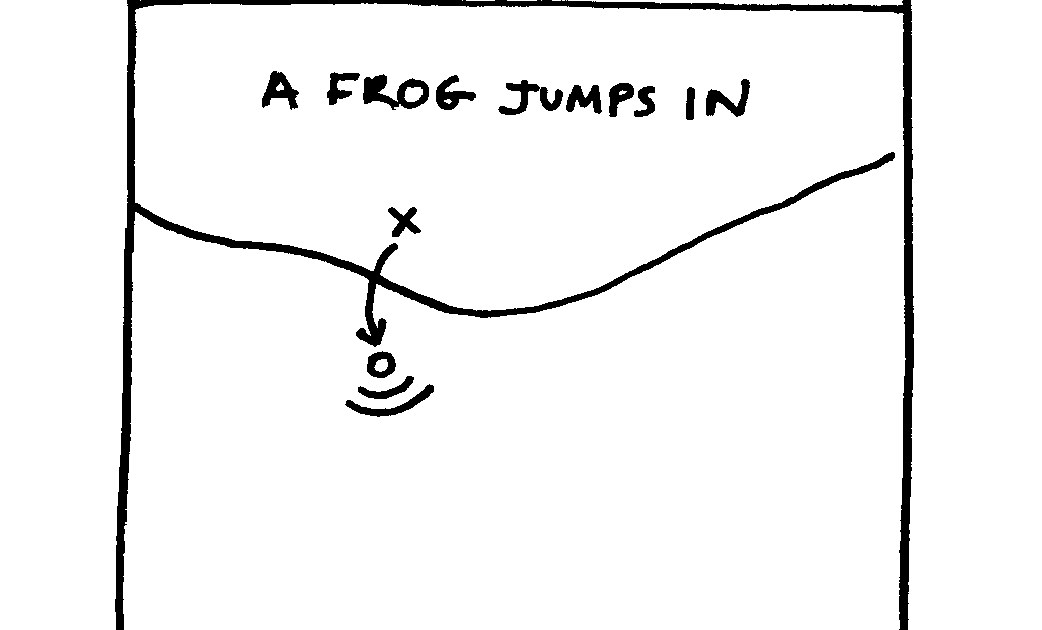
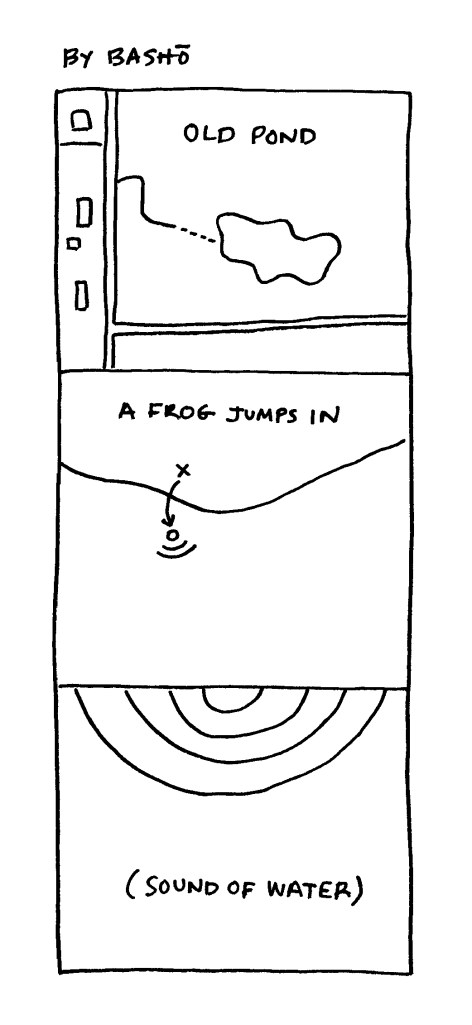
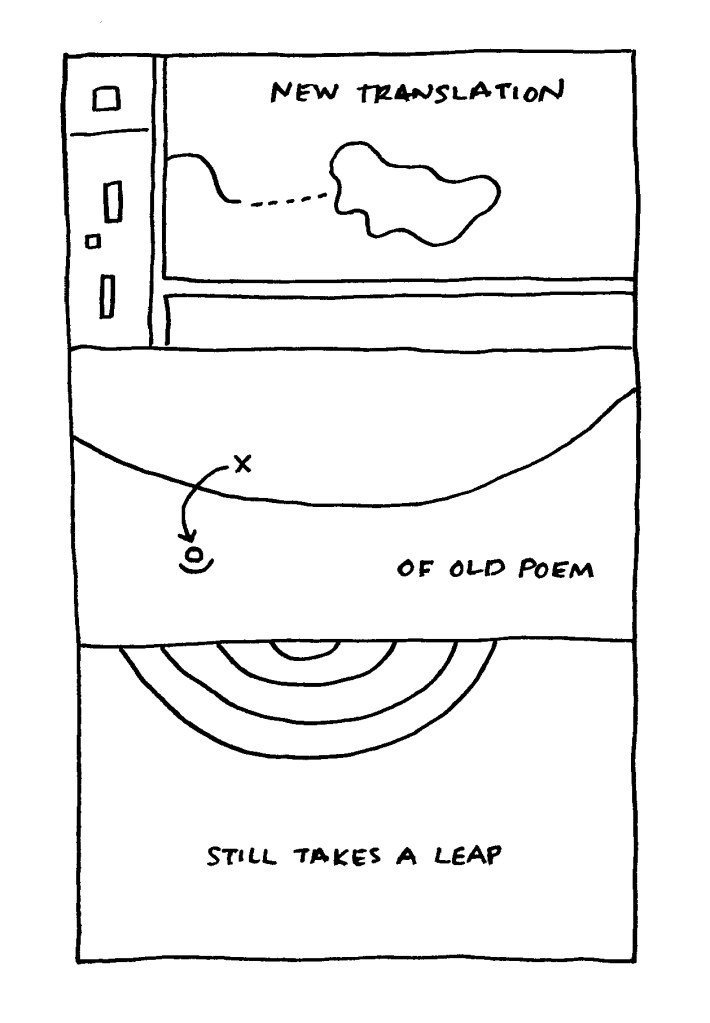
To get things rolling, here are two versions I made — the first one about 10 years ago as a class assignment and the second one last year as part of a series “Reading Basho.”

Here are your interpretations:


Submitted by David Lasky, Seattle (2020)

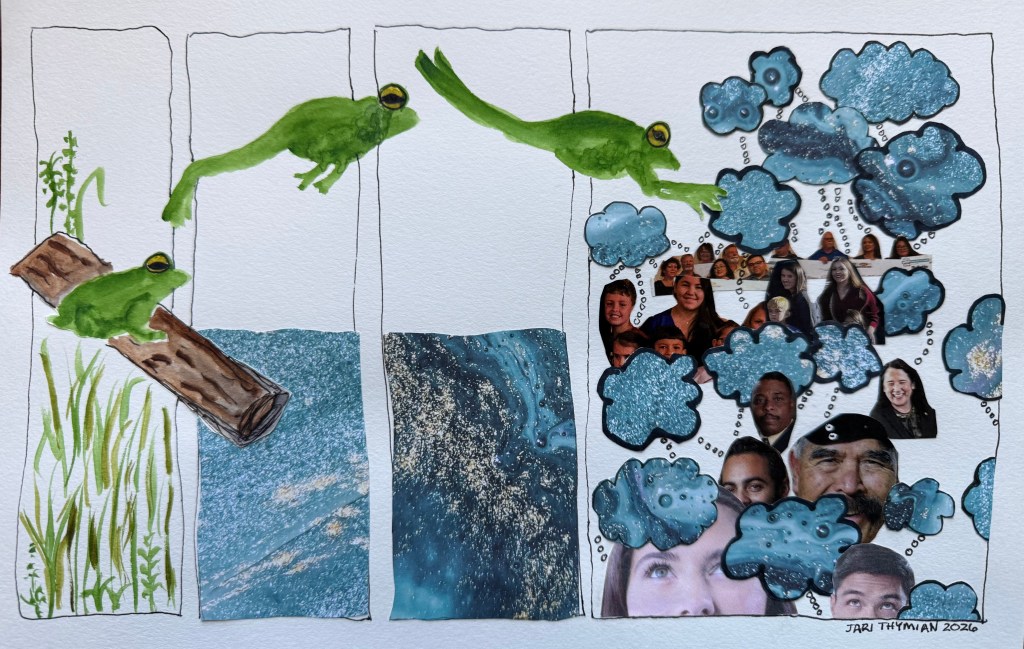
Submitted by Jari Thymian with this note: “The idea to do a comic for Basho’s frog haiku made me think about all the people who have read or heard the haiku and how it lands in their minds and stays there. It is the frog heard round the world. ”

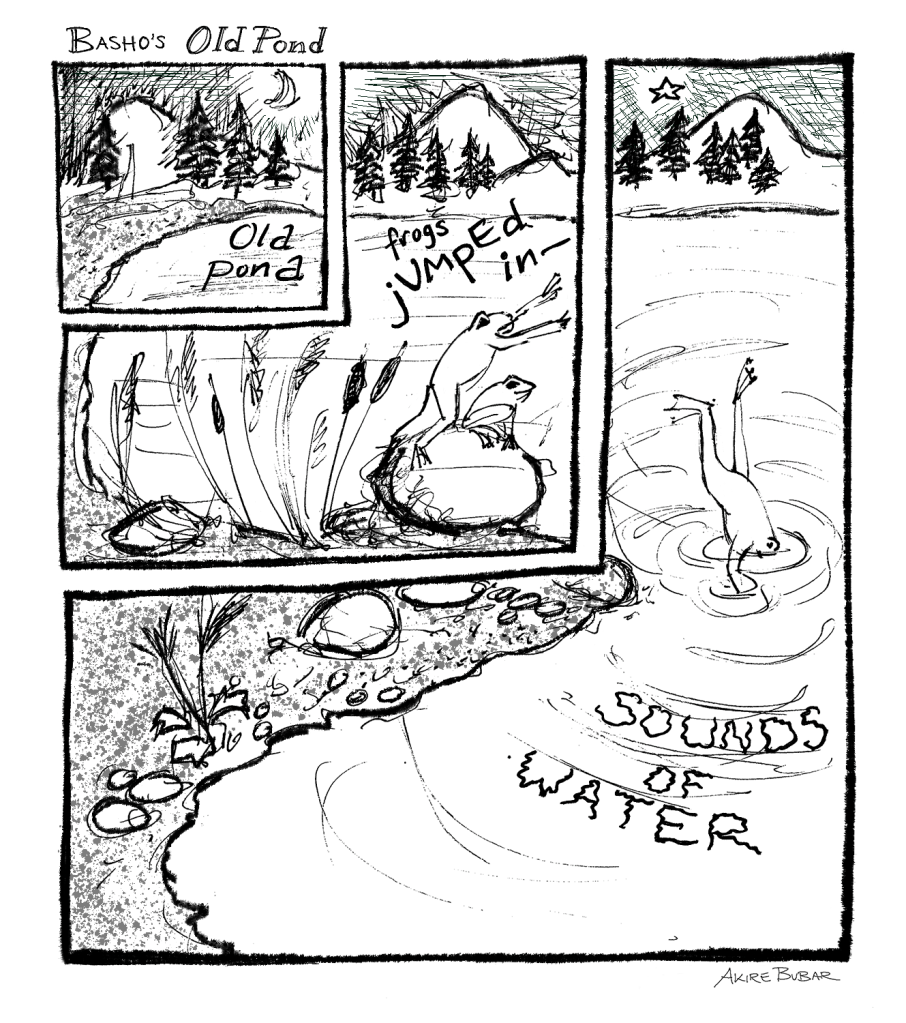
Submitted by Akire Bubar. See more of their work at akire.art, patreon.com/akirebubar, instagram.com/akirebubar

Timeline: Now

Warning: This incomplete history maps my journey as a poet learning about comics and doesn’t follow a strict chronological order.
A History of Poetry Comics

Naming Poetry Comics

“Rose is a rose is a rose is a rose.” -Gertrude Stein

Although labeled differently by poets, artists, and historians, work that investigates the relationship between pictures and words (i.e. drawing and poetry) strives for the same result: create meaning that’s not possible with words or pictures alone.

Here are terms “A History of Poetry Comics” has uncovered that each point in their own way to the practice of incorporating words and pictures into art.

TermRepresented byTimeline
haiga (Japanese haiku drawings)Bashō, Buson1500s on
illuminated poemsWilliam Blake1780s
sequential narrativesRodolphe Topffer1830s
comic books, comic strips, comics Various*1890s-1930s
pictorial prose poems (without words)Lynd Ward1930s
picture poemsKenneth Patchen1940s-70s
concrete poems –> vispo (visual poetry)Augusto deCampos,
Nico Vassilakis
1950s-70s on
graphic novelscoined by Richard Kyle1960s
hand-drawn poemsbpNichol1970s
poetry comics (drawings w/ other’s poems)Coined by Dave Morice1980s
comics mainly without picturesKenneth Koch1990s
haiku comicsSeth1995
poetry comics** (drawings w/ own poems)Bianca Stone2010s
poem/drawingsAlice Notley2020s
graphic poetryNaoko Fujimoto2021

*A good starting point to get perspective on when these terms were first use is Wikipedia’s History of Comics. For U.S.-centric perspective, American Comics: A History by Jeremy Dauber (W.W. Norton & Co., 2022) comes recommended.

**See A History of Poetry Comics #05 for suggested ways to identify poetry comics.

Timeline: Pre-history to Current

Warning: This incomplete history maps my journey as a poet learning about comics and doesn’t follow a strict chronological order.